Feeds:
Posts
Comments

Archive for the ‘book review’ Category

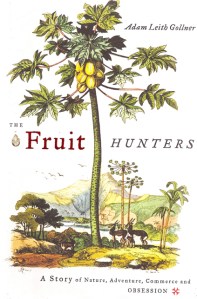
Most of us do not know a fruit hunter, much less a durianarian and their passion for durians. And what about fruitarians and their all-fruit diet? You might think you have very little in common with passionate individuals such as these, but you would be wrong. The common thread that ties us together is the global fruit industry and all its forms, from the produce section of markets to fruit drinks in the beverage aisle to agricultural checkpoints at airports and along highways. TheFruitHunters

Adam Leith Gollner traveled the world to interview fruit hunters, growers, enthusiasts, researchers, and vendors to explore the fruit industry. He explains how fruit makes it to our grocery store and why the selection of fruit at our local market is so uninspiring. He explains how the kiwi made it big and lets us in on fruit varieties that may become available in the near future. Gollner describes his encounters with fruit hunters so vividly, you will feel as if you experienced the “fruit underworld” yourself. To make the experience even more complete, Gollner has posted photos of his adventures online. View these photos after you have started to read The Fruit Hunters to help visualize the people and places described in the book.

Gollner is a writer who has written for The New York Times, Gourmet, Bon Appetit, and Good magazine. The Fruit Hunters is his first book.


Cover, paperback edition, 2013

Read Full Post »

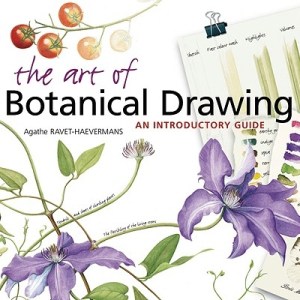
artofbotanicaldrawing
What is well-conceived is clearly expressed.

— Agathe Ravet-Haevermans

In The Art of Botanical Drawing: An Introductory Guide, Agathe Ravet-Haevermans provides a brief history of botanical art and interesting insight into how she and fellow scientific illustrators document plants at the Museum of Natural History in Paris. Beginners will find Ravet-Haevermans’ instructions easy to understand and they will appreciate her drawing and painting demonstrations which feature three different stages of development so beginners can observe how a technique is accomplished. All examples are executed gracefully and are sure to inspire new artists. This is a well-rounded portable gem of a book that fits easily into a backpack or small canvas bag.

Ravet-Haevermans addresses the following topics:

  • How to draw plants and how to capture their volumes and shadows on paper
  • How to mix colors and create gradations
  • How to reserve a light area and a highlight area
  • How to apply color
  • How to paint petals
  • Drawing and painting bark and storage organs
  • Drawing and painting stems and branches
  • Drawing and painting buds and leaves
  • Drawing and painting flower buds and flowers
  • Drawing and painting fruits and vegetables
  • Painting fruit and seeds

Ravet-Havermans also provides “how-to” examples for the following:

  • Garden Plants (poppy, Nasturtium, periwinkle, Agapanthus, Fuschia, Arisaema)
  • The Kitchen Garden (aubergine, Haricot/’Tongue of Fire’ beans, butternut squash, carrots)
  • Meadow Plants (grasses)
  • Forest Plants (mistletoe, holly, ferns, mushrooms)
  • The Botanical Garden (dried stalks, Arbutus, kiwi)
  • The Aquatic Garden (Equisetum, water hibiscus, lotus)
  • Succulents (melon cactus, Lithops, Gasteria)
  • Greenhouse Plants (Dendrobium, Venus flytrap, Cobra plant, Papyrus)
  • Field sketches and painting outdoors
  • Creating details such as skeletonized leaves, artichoke bracts, bamboo stalks, and the circles observed in the cross-section of onion slices
  • Water drops, insects, and eaten leaves

Get this book at your local independent bookstore.

Read Full Post »

WCFruitVeg_Jacket2.indd

Watercolour Fruit & Vegetable Portraits is a comprehensive resource for all artists. Billy Showell provides how-to instruction addressing the colors, shapes, textures, and patterns observed in fruits and vegetables. This book is for anyone who has ever wanted to paint the fruit and vegetables in their home garden.

Right from the start, Billy teaches readers how to observe patterns and how to think about the placement of various botanical elements. In her discussion of the drawing process, she does away with drawing’s “mythical status” and ensures readers that everyone is capable of learning how to draw. Billy takes the anxiety out of composition and patiently offers detailed instruction on how to mix browns, greens and dark washes. In a 4-page section that all painters will appreciate, Billy shares color combinations that will enable readers to mix the unique colors of 28 fruits and vegetables.

Demonstrations of ten essential watercolor techniques are presented. Techniques include wet-into-wet, color blending, color lifting, and dry brush. There are also demonstrations of how to glaze over shadows, how to use lifting preparation, how to scratch out highlights, how to use masking fluid to create the illusion of a shiny surface, and how to apply layers of paint to achieve color strengthening. Readers are also shown how to create highlights and shadows.

Several technique tips and small projects are presented in this book. Tips and projects include:

  • How to paint white vegetables
  • How to paint flowers and the veins on petals
  • How to paint patterns and highlights on sweet corn
  • How to paint patterns found on zucchini
  • How to capture the texture of artichoke bracts
  • How to create and apply the appropriate colors when painting black bean pods
  • How to paint corn husks
  • How to paint the changing colors of an asparagus stalk
  • How to paint roots
  • How to paint small fruit

The last four projects in the book are detailed step-by-step tutorials about how to paint kohlrabi, pumpkins, lemons, and assorted berries. Tutorials range in length from 42 to 59 steps.

Watercolour Fruit & Vegetable Portraits by Billy Showell contains many practical tips, step-by-step tutorials, and examples of finished studies. Throughout Billy discusses mistakes often made by artists and provides solutions along the way. Billy’s thorough approach ensures that even the most timid watercolorist will feel at ease applying what they learn from this comprehensive resource.

This book will be released in the U.S. in mid-April 2009 and will be available at ArtPlantae Books. You can pre-order this book here.


Related articles:
The Beauty Is In The Details

Read Full Post »

Review of New Orchid Book

ArtPlantae has been invited to review Orchids of Western Australia, a book to be published by the University of Western Australia Press. Written by three prominent Australian orchidologists, this new book provides a comprehensive review of all known orchid species in Western Australia. It also features 200 full-page color illustrations by botanical artist, Pat Dundas.

We look forward to sharing this new title with you!

Read Full Post »

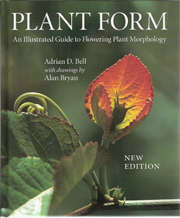
Adrian Bell describes the processes behind plant morphology in the new edition of Plant Form: An Illustrated Guide to Flowering Plant Morphology. Written for amateur botanists and plant enthusiasts, this book is an excellent reference containing bite-sized morsels of information. Author/botanist Adrian Bell and illustrator, Alan Bryan, combine interesting and informative text with detailed pen-&-ink illustrations to provide insight about the following topics:

  • General plant morphology
  • Leaf Morphology: Bell describes thirty-seven morphological aspects of leaves including development, shape change along a shoot, venation patterns, leaf folding, spines, prickles, and hairs.
  • Root Morphology: Bell describes nine morphological aspects of roots including development, root systems, tree root architecture, root modifications, and tubers.
  • Stem Morphology: Thirteen morphological aspects are described including development, bark, prickles, shape, scars, rhizomes, and corms.
  • Reproductive Morphology: Ten morphological focal points including the branching patterns of inflorescences, floral morphology, pollination mechanisms, fruit morphology, and seed morphology are described.
  • Seedling Morphology: Terminology, germination, stem development, and growth are discussed.
  • Vegetative Multiplication: Rhizomes, corms, tuber, stolons, runners, bulbs, and root buds are described.
  • Grass Morphology: Eight morphological aspects are described, including vegetative growth, inflorescence structure, spikelet and floret structure, bamboo shoots and rhizomes
  • Sedge Morphology
  • Orchid Morphology
  • Cactus Look-alikes
  • Constructional Organization of Plants: Forty-two topics including the arrangement of leaves on a stem, the Fibonacci sequence, rhythmic and continuous growth, galls, plant branch construction, tree architecture, and herb architecture are described.

This new edition contains over 1,000 illustrations and promises to be an invaluable asset to both illustrators and gardeners. This book will have you saying, “So that’s what that is!”

Now available at independent bookstores.

Read Full Post »

Written by Margaret Stevens, in association with the Society of Botanical Artists (SBA), this book complements The Art of Botanical Painting (2004) also published by Stevens and the SBA. In their first book, the SBA provided instruction on drawing techniques, colored pencil techniques, watercolor techniques, and gouache painting techniques. Stevens and SBA contributors gave instruction on the painting of fruit, vegetables, and foliage. In their follow-up work, they focus on colors specific to the botanical palette. They give special attention to the following colors: white, yellow, green, blue, purple, red, brown, and black.

Each chapter is dedicated to one color and contains instruction on how to create this color and how to apply this color in a painting. Instruction is supported by example as Stevens leads artists through step-by-step demonstrations in each chapter. No detail is left out and the methodical processes narrated by Stevens are easy to understand. Each chapter includes a line drawing artists can transfer to paper to immediately apply what they’ve learned. In response to the growing interest in colored pencil, five demonstrations address the creation of colored pencil paintings.

The five colored pencil demonstrations included in this book are:

  • Day Lily (yellow; demonstrator Ann Swan)
  • Madagascar Jasmine (green; Ann Swan)
  • Iris (blue; Susan Christopher-Coulson)
  • Red Rhododendron (red; Susan Martin)
  • Tulip (black; Susan Christopher-Martin)

Watercolor demonstrations featured in this book include:

  • Lily (white; demonstrator Margaret Stevens; how to create form)
  • Rhododendron (yellow; Kay Rees-Davies; how to work with a plant whose flowers fade quickly)
  • Sunflower (yellow; Paul Fennell; how to create highlights and the spiral pattern of disc flowers)
  • Plantain Lily (green; Janet Wood; how to paint variegated leaves)
  • Himalayan Poppy (blue; Brigitte E. M. Daniel; painting multiple stamen, leaf hairs)
  • Delphinium (blue; Vicky Mappin; how to build an inflorescence)
  • Columbine (purple; Valerie Baines; how to use grey and violet)
  • Clematis (purple; Brenda Watts; how to create glowing purple)
  • Cyclamen (red; Jennifer Jenkins; how to create leaf patterns and distinguish between old flowers & new flowers)
  • Poppy (red, orange; Sandra Wall Armitage; how to make orange from red; painting flat hairs)
  • Peony (red, burgundy; Susan Hillier; how to make burgundy using four shades of red)
  • Bearded Iris (brown; Barbara McGirr; how to make brown)

The eight watercolor projects included in this book are:

  • Lily (how to work with white)
  • Sunflower (how to work with yellow)
  • Hosta (how to work with green)
  • Delphinium (how to work with blue)
  • Clematis (how to work with purple)
  • Poppy (creating orange with reds)
  • Peony (creating burgundy with reds)
  • Bearded Iris (how to work with brown)

Stevens’ chapter about color charts is an invaluable tool that will help artists resist the urge to buy every tube of color they see on every materials list they receive in every class they take. Artists can save money by consulting these charts comparing and contrasting yellows, greens, reds, blues, purples, and browns produced by the following manufacturers: Daler-Rowney, Schmincke, Sennelier, and Winsor & Newton.

Stevens closes this book with a gallery of artwork created by members of the Society of Botanical Artists.
__________________

The Botanical Palette: Color for the Botanical Painter
Margaret Stevens, in association with the Society of Botanical Artists
9780061626678
September 16, 2008
$29.95, Hardcover

http://www.soc-botanical-artists.org/

Now Available at ArtPlantae Books

Read Full Post »

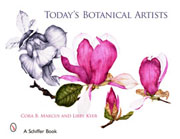
Cover, Today's Botanical ArtistsWhile several books have been published about contemporary botanical art, both how-to books and books about international collections, there has never been a book highlighting the work of North American artists until the publication of Today’s Botanical Artists earlier this year. Written by Cora B. Marcus and Libby Kyer, this book features 220 pieces of artwork by 65 contributing artists.

This book is about more than the traditional presentation of plant portraits. Contributing artists have demonstrated that plant portraits do not have to be comprised of plants suspended in the middle of the page on a white background. They have demonstrated that it is possible to uphold tradition and provide viewers with information about a plant through the use of digital imagery, colored backgrounds, creative borders, macro-photo flower portraits, and photorealism techniques. This is a refreshing and welcome approach to botanical art.

The drawings and paintings featured in this book reflect the diverse interests and creative energy of each artist. Carolyn Crawford is drawn to plant life cycles, while Lara Call Gastinger is drawn to detritus. Dr. Dick Rauh is attracted to the structure of “the wisps and traces flowers leave behind”, while Jessica Tcherepnine is attracted to the strong defining structures of a plant that enable its survival. Robin Jess, Kaye Hurtt, Derek Norman, Linda Petchnick, George Olson, Margaret Saul, Geraldine King Tam, Carol Woodin, Bruce Lyndon Cunningham, and Lee McCaffree choose to document and describe plants from specific geographic regions that are of special interest or have been protected by state and federal agencies. Mindy Lighthipe’s and Peg (Margaret) Steunenberg’s inclusion of both flora and fauna in their artwork is reminiscent of natural history paintings by Maria Sibylla Merian (1647-1717).

The media and grounds employed by contributing artists are as varied as their interests. In this book, botanical art enthusiasts will discover plant portraits created in the following media: watercolor, watercolor pencil, colored pencil, watercolor & colored pencil, pastel, pastel pencil, pen-&-ink, ink wash, ink & watercolor, hand-colored etching, scratchboard, digital collage, digital painting, graphite, graphite & watercolor, graphite & gouache, gouache, acrylic, acrylic & colored pencil, egg tempera, oil, and mixed media. Paper was not the exclusive ground used for the drawings and paintings in this collection. Jean Emmons, Kate Nessler, and Carol Woodin provide beautiful examples of watercolor paintings on calfskin vellum, while Martha Kemp demonstrates the awe-inspiring way that fine pencil work can be created on this traditional surface.

There are so many styles and techniques to admire in this book that it is impossible to share them with you here. If you have an interest in botanical art and illustration, then set aside some time to experience how this award-winning group of North American artists have captured their respect for plants and nature in their artwork.

Order Today’s Botanical Artists (2007)


Related

Today’s Botanical Artists Answer Your Questions

Read Full Post »
« Newer Posts