Feeds:
Posts
Comments

Archive for the ‘ArtPlantae Books’ Category

I am pleased to introduce you to Gilly Shaeffer. I met Gilly soon after enrolling in my first botanical drawing class in January 2001. At the time, Gilly was serving as President of a small group of artists who called themselves the Botanical Artists Guild of Southern California. Gilly served as President until 2006 and is largely responsible for transforming this small group of 30 artists into the organization it is today.

Since 2001, I have watched Gilly work diligently as a student in a certificate program, share her knowledge in her first watercolor class (in which I was enrolled), stick her neck out entering juried exhibits, receive an invitation to exhibit two paintings in the 11th International Exhibition of Botanical Art & Illustration at the Hunt Institute for Botanical Documentation, hold her first solo exhibit, and become a contributing artist to the first book dedicated exclusively to North American botanical artists.


Thank you, Gilly, for taking time for this interview. I wanted to interview you because I admire your focus, your dedication, and your ability to create artwork while all of your other lives swirl around you. Your career as a botanical artist has progressed quickly and I think readers would be interested in learning how one goes from student to published artist. You have spent countless hours with your nose hovering directly above your watercolor paper getting in all of those fine details. Your dedication is obvious.


What was the first botanical art class you completed?

The first art class was called The Art of Drawing Florals in Pencil and Pen and Ink taught by Olga Eysymontt at Otis College of Art and Design.


Were you hooked from the beginning or did you think that botanical art was “so-so”?

When I started I had almost no time to devote to drawing, but I made a special effort to get to the class. I always liked going to the classes but becoming “hooked” took place over a two year period of sporadically attending classes and starting to make the time to draw on my own when not signed up for a class.


How long after completing your first botanical art class did you take the leap into Anne Marie Evans’ Botanical Art Certificate Program?

About four years after taking the first floral drawing class through Otis College, I attended Anne-Marie Evans’ studio program at her home in England. At that time, I heard that she was planning a comprehensive watercolor painting certificate program at the New York Botanical Garden. This program evolved from Anne-Marie’s certificate course given at London’s Chelsea Physic Garden. I was impressed by the work of her Chelsea Physic Garden certificate students who I met at her home studio. It was shortly after my trip to her studio that I signed up for her certificate program to be held at the New York Botanical Garden.


Describe this program for those who may not be familiar with it.

The first part of the program was comprised of one- and two-week segments of full day classes at the New York Botanical Gardens. The certificate students went through a series of exercises to deepen understanding for rendering three dimensional forms, learning techniques to deal with problems encountered in rendering botanical subjects, dealing with composition and learning how to deal with detail in a painting. After each one or two week course segment, there were homework assignments given to complete before the next segment of classes began and there were periodic critiques. A final project was given after all the preliminary exercises were completed. Students were to choose a topic to be the theme of six paintings which had to be completed to be eligible to receive the Anne-Marie Evans Watercolor Program Certificate from the NYBG.


What was your first juried exhibit?

My first juried exhibit was at Longwood Gardens in Pennsylvania called “Flora 2000”.


Briefly describe what it is like to be a rookie at a juried show.

It was really great fun and a wonderful introduction to contemporary botanical art in the U.S. and internationally. I went to the opening and met a few of the artist participants and saw a lot of high quality and inspiring work on display.


What kind of advice do you have for rookies hoping to get into their first juried event in 2008 – 2009?

Realize that being accepted into a juried exhibit is part of the process of developing as a botanical artist. Sometimes your entry will be accepted into the show and sometimes it may not be. All that we can do as artists is make a commitment to keep on learning and improving and not allow ourselves to get discouraged if we don’t get accepted into a show the first time that we get up the courage to enter one or at any other point in our botanical art career. The first time that I entered work in a juried exhibit, I guess that I felt an inner readiness to take this step. Another point to consider when getting ready to enter a show is to look at your own work with as much objectivity, as possible.


Every learner, regardless of discipline, begins work in their field thinking that there is a right way and a wrong way to think of things. Eventually (i.e., hopefully), a learner’s experience enables them to see that there is more than one way to get things done. As a beginning botanical art student, one clings tightly to the tried and true techniques taught to them by trusted instructors. There comes a time, however, when an artist deviates from the reliable “formula” and begins to experiment. When did you first begin to experiment? How has this changed your approach to your work?

I have always had an “experimental streak”. As I have matured, I have come to see the importance and value in following a “ formula”. This “formula” has given me a solid foundation or confidence in knowing how to achieve a certain result. I reach a point in every painting when I will draw on every trick I can think of to make it work better. This is when lots of experimentation occurs. So, both “formula” and “experimentation” are essential in my painting process. The more I paint the less I need to rely on following the step by step method outwardly, though it continues to provide me with an invisible or internal structure for going about the job of creating a painting.


It is very exciting to see your paintings in Today’s Botanical Artists. What has it been like to be a contributor to this exciting project?

I feel very honored to be invited to be in this group of very talented artists. It is a wonderful experience to have my work appreciated in this way.


What’s next?

Doing more paintings. Finding more ways to make each painting a window for someone to more deeply appreciate the beauty that is so abundant in nature.


Thank you, Gilly. Very much.


Gilly’s website can be viewed at http://www.gillyshaeffer.com.
Read Full Post »

OUR NEXT STOP:

40th Annual Fern and Exotic Plant Show and Sale
Los Angeles International Fern Society, Inc.
Los Angeles County Arboretum & Botanic Garden
June 14 – 15, 2008
9:00 a.m. to 4:30 p.m.

Several copies of Today’s Botanical Artists will be available. Stop by to relax and read for a while!

Have a question about botanical art? Take advantage of the opportunity to submit your question(s) to the “Ask the Artist” panel during the fern show. Can’t make it to the fern show? Then send your question(s) to AskTheArtist@artplantae.com.

ArtPlantae Books will be located outside of Ayres Hall.

Hope to see you this weekend! Here is a map for your convenience.

Read Full Post »

Libby, thank you very much for participating in this interview and for allowing us to contact each contributing artist. This book event promises to be a very exciting and very educational opportunity.

I would like to take a moment to introduce readers and new subscribers to Today’s Botanical Artists. If you haven’t had a chance to read the review of this book, allow me to get you up-to-speed. Today’s Botanical Artists was published by Schiffer Books earlier this year. It is the first book to focus exclusively on botanical artists and botanical illustrators in North America. This collection contains 220 drawings and paintings completed by 65 exceptional artists. A list of contributing artists and links to their websites (or to websites featuring their work) can be viewed here.


Let’s start with a question I had not planned on asking. I caught my own differentiation in the introduction above. This question is often asked by people who are new to botanical art. What is the difference between botanical art and botanical illustration?

Well, that is the big question in this genre, isn’t it! In my mind, illustration is created to “illustrate” – text, an exhibit, posters, etc. It illuminates text and other verbiage in a way that makes words more fully realized. It gives a perfect visual for the perfect word. Illustration is an art form, as powerful as fine art, in particular since it is generally a significant collaboration with another creator. Illustration might be limited in expressive form by the job it has to do. Illustration must be accurate as to the science of the specimen to be considered botanical illustration.

I tend to think of art as that which is created from the artist’s own inner driver, not working within someone else’s confines – not needing to illuminate words. It can be more refined, innovative and personal than illustration, but that’s not always true. Fine art, in the botanical world, also needs to meet the demands of science as to anatomy, scale, and completeness of information of a given subject/species, but presentation and choices about media, focus, vignetting, composition etc. are the artist’s alone.

And, I want to make it very clear, “art” is not a higher calling than “illustration”. Both have respected, valuable niches.


Whose idea was it to create a collection of work by North American artists?

Cora Marcus, co –author, loves botanical art! She had worked on another project with Schiffer as her publisher (a wonderful book about fruit label art of the Great Northwest in conjunction with a Portland, OR, museum), and having become a member of the ASBA, she knew what she liked! She asked Schiffer if they’d be interested in a book about botanical art. She showed them some samples of the genre, and they said yes please!

It took her about 5 years to find someone who knew the artists of the genre, and could put together a work that made a definitive statement about the artworks and genre. She asked me if I’d like to co-author with her about 3 years ago. It took a bit for me to say yes, but then I decided that if there was a publisher that wanted to publish a book on botanical art, then it should be done. As editor of the ASBA newsletter, a botanical artist and a person who has looked around the world at great botanical art for the last 10 years, I felt I could bring a lot to the project. Originally we were going to go “around the world.” However, I felt that a book about North American artists would bring a new twist to the project. I feel our artists have a “look” – a willingness to push the envelope – that is not always found in botanical art from more traditional settings. So, I found the artists, Cora wrote the words, and I laid out and designed the book. It’s been an amazing honor and challenge to get this together.


With so many wonderful artists from which to choose, how did you narrow down the list?

Well, it helped that we focused on North America! I then spent about 300 hours finding works of botanical art from living botanical artists – not just living, but actively producing art in the last 5 years. I found about 200 artists that I felt fit the bill. I then winnowed using a series of criteria: Did the art meet general botanical art/illustration guidelines – science first, aesthetics only when science was satisfied. Each artist had to have a provenance of significant art exhibits, art awards, publications and commissions. That narrowed the field to about 85 artists. Because there really are no books on this subject featuring modern artists, except for catalogs, it was a bit of a slog to find these wonderful people. And of course, since publishing the book, I run into really great artists daily that I wish I had found sooner.


What was required of artists who participated in this book?

Each artist was invited to submit up to 10 slides of their best artwork. They completed a brief artist’s statement, a listing of exhibits/publications/commissions/awards. They submitted a handling fee of $40, so that I could send their materials (proofs, slides, publicity pieces, etc) back to them once the book was in stores.

Cora and I, a botanical/scientific artist, and an aficionado of the genre reviewed the slides and selected those images we felt were best for the book. The only changes made in that final image list were due to layout needs when I designed each artist’s two-page spread. Artists were notified which images had been chosen, and were required to sign a copyright release for this book and publicity for the book, send me their best materials for effective reproduction, and proof prints if they had them.


When someone goes to a botanical art exhibit, they see very traditional botanical art. They see white backgrounds, watercolor paintings of plants placed in the center of the page, a few colored pencil paintings and even fewer graphite illustrations. It’s pretty predictable. What I truly love about the collection of artwork in Today’s Botanical Artists is the inclusion of not only various media, but the inclusion of habitat scenes, plant life cycles with a lot of imagery, plants and their insects, paintings featuring plants & maps, backgrounds that are any color but white, colored borders, and digital paintings. Are these types of pieces included in this collection because you requested them or is their inclusion an artifact of the artwork submitted by contributing artists?

Yes! Both are true. I asked them for their very best work. I told them we were pushing the envelope. And they sent us amazing bugs, backgrounds, compositions and techniques. It’s exactly this variety and verve and vision that marks North American botanical art.


What about the media featured in this book? Was a conscious decision made to bring attention to botanical artwork completed in, what I will call, “non-traditional” media such as digital collage, acrylic, and pastel?

I don’t have a mindset that says one medium is more worthy or traditional than another, even though I know the genre generally favors watercolor. Coming from a graphic design/illustration background as I do, I find any medium that gets the job done is a good medium. So, no, I didn’t make a conscious decision to include the variety that is featured, but I’m sure my unconscious bent is to pretty much ignore the medium if the result meets the goals of botanical art/illustration – illumination of the species, recruitment of the viewer to understand and love plants, and scientific accuracy.

Creating in computer or digital collage can be extremely effective, but is, I have to admit, as far as I pushed the concept! Since all of the digital compositions were featured in major American museums, I felt we truly needed to honor that contribution. I feel the same way about “photorealism” or “super realism,” as it can entirely meet the goals of botanical art/illustration even if it employs some interesting compositional effects (lens blur, depth of field loss of focus, etc.).


What message are you trying to relay to readers of Today’s Botanical Artists? Since both artists and non-artists will view this collection, let me break it down a bit more. Is your message to botanical artists and illustrators different than your message to a member of the general public? If so, how is it different?

Well, the art sends the message that plants are really, really, really important. That is a critical message in this day and age. Every bio we got from an artist said, in short, “Gosh, I love plants and I love painting them and it’s SO important for people to be more ecologically aware.” Cora found a way to say that often and in many different ways when she wrote the majority of the artist’s statements included. It’s difficult to say that over and over again and not be boring or repetitive, and she found a way. So the primary message to the public is “Save them now – plants are in trouble. Look at how beautiful and inspiring they are to artists. We hope their inspiration moves you to bigger and better involvement in the ecological needs of the planet.”

I think our message to the artists is, very simply, what you do matters – to art and to the world. Hang in there, keep on creating. This genre is a legitimate and important art movement that serves us all. Thank you, and please, keep painting.


Will there be a sequel? How about several sequels such as books dedicated to specific North American ecosystems?

Yow! Yes, I hope we have sequels. The next book, in a few years, will include artists world-wide. As to ecosystems – what a great idea! I think we need you on “staff”, Tania. I am so delighted at the reception this book is getting. I do need a breather, to paint and meet some personal artistic goals. Then, more than likely, it’s back to the book beat. The rewards far outweigh the challenges, and again, it’s such a privilege to be involved in this project and hopefully more like it. Working with artists is amazing. So much creativity and generosity in this group. What a treasure.


Thank you, Libby, for your time and for visiting with us today.

Read Full Post »

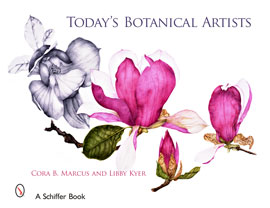
Cover, Today's Botanical ArtistsWhile several books have been published about contemporary botanical art, both how-to books and books about international collections, there has never been a book highlighting the work of North American artists until the publication of Today’s Botanical Artists earlier this year. Written by Cora B. Marcus and Libby Kyer, this book features 220 pieces of artwork by 65 contributing artists.

This book is about more than the traditional presentation of plant portraits. Contributing artists have demonstrated that plant portraits do not have to be comprised of plants suspended in the middle of the page on a white background. They have demonstrated that it is possible to uphold tradition and provide viewers with information about a plant through the use of digital imagery, colored backgrounds, creative borders, macro-photo flower portraits, and photorealism techniques. This is a refreshing and welcome approach to botanical art.

The drawings and paintings featured in this book reflect the diverse interests and creative energy of each artist. Carolyn Crawford is drawn to plant life cycles, while Lara Call Gastinger is drawn to detritus. Dr. Dick Rauh is attracted to the structure of “the wisps and traces flowers leave behind”, while Jessica Tcherepnine is attracted to the strong defining structures of a plant that enable its survival. Robin Jess, Kaye Hurtt, Derek Norman, Linda Petchnick, George Olson, Margaret Saul, Geraldine King Tam, Carol Woodin, Bruce Lyndon Cunningham, and Lee McCaffree choose to document and describe plants from specific geographic regions that are of special interest or have been protected by state and federal agencies. Mindy Lighthipe’s and Peg (Margaret) Steunenberg’s inclusion of both flora and fauna in their artwork is reminiscent of natural history paintings by Maria Sibylla Merian (1647-1717).

The media and grounds employed by contributing artists are as varied as their interests. In this book, botanical art enthusiasts will discover plant portraits created in the following media: watercolor, watercolor pencil, colored pencil, watercolor & colored pencil, pastel, pastel pencil, pen-&-ink, ink wash, ink & watercolor, hand-colored etching, scratchboard, digital collage, digital painting, graphite, graphite & watercolor, graphite & gouache, gouache, acrylic, acrylic & colored pencil, egg tempera, oil, and mixed media. Paper was not the exclusive ground used for the drawings and paintings in this collection. Jean Emmons, Kate Nessler, and Carol Woodin provide beautiful examples of watercolor paintings on calfskin vellum, while Martha Kemp demonstrates the awe-inspiring way that fine pencil work can be created on this traditional surface.

There are so many styles and techniques to admire in this book that it is impossible to share them with you here. If you have an interest in botanical art and illustration, then set aside some time to experience how this award-winning group of North American artists have captured their respect for plants and nature in their artwork.

Order Today’s Botanical Artists (2007)


Related

Today’s Botanical Artists Answer Your Questions

Read Full Post »

The following artists are featured in Today’s Botanical Artists:

Francesca Anderson
Bobbi Angell
Bonnie Anthony
Margaret Best
Vivian Boswell
Olivia Marie Braida Chiusano
Bobbie Brown
Carolyn J. Cappello, ASBA Gallery
Carolyn Crawford
Bruce Lyndon Cunningham
Monica de Vries Gohlke
Beverly Duncan, ASBA Gallery
Jean Emmons, ASBA Gallery
Margaret Farr, ASBA Gallery
Linda Heppes Funk
Lara Call Gastinger
Gretchen Kai Halpert, ASBA Gallery
Carol E. Hamilton, ASBA Gallery
Wendy Hollender
Kaye Hurtt
Kathy J. Imel, ASBA Gallery
Sally Jacobs
Kristin Jakob
Robin Jess
Karen A. Johnson
Martha Kemp
Libby Kyer, ASBA Gallery
Alana Lea
Katie Lee
Mindy Lighthipe
Michael Maskarinec, ASBA Gallery
Lee McCaffree
Dianne McElwaine, ASBA Gallery
Kathleen McKeehen, ASBA Gallery
Julie Sims Messenger
Angela Mirro
Sherry Mitchell
Rhonda Nass
Kate Nessler
Derek Norman
Suzanne Olive
George Olson
Hillary Parker
Rose Pellicano, ASBA Gallery
Linda Petchnick
Rayma Kempinsky Peterson, ASBA Gallery
Lynne K. Railsback, ASBA Gallery
Dick Rauh, ASBA Gallery
Scott Rawlins
Janet Rieck, ASBA Gallery
Susan Rubins
Dolores R. Santoliquido
Margaret Saul
Patricia Savage
Constance Sayas
Gilly Shaeffer
Sheila Siegerman, ASBA Gallery
Louise Smith
Wendy Smith
Rafael McKenzie Soares
Margaret J. Steunenberg, ASBA Gallery
Geraldine King Tam, ASBA Gallery
Jessica Tcherepnine
Louisa Rawle Tiné
Carol Woodin, ASBA Gallery

Return to book review

Read Full Post »

Updated 5/27/08

We are pleased to announce that twenty-five contributors to Today’s Botanical Artists will participate in the Ask the Artist Q&A on June 24, 2008. The artists who will be answering your questions are:

Bobbi Angell
Margaret Best
Olivia Marie Braida Chiusano
Bruce Lyndon Cunningham
Beverly Duncan
Jean Emmons
Carol E. Hamilton

Wendy Hollender
Kathy J. Imel
Sally Jacobs
Robin Jess
Mindy Lighthipe
Michael Maskarinec
Julie Sims Messenger
Sherry Mitchell
Rose Pellicano
Linda Petchnick
Rayma Kempinsky Peterson
Dick Rauh
Scott Rawlins
Janet Rieck
Susan Rubin
Dolores R. Santoliquido
Louise Smith
Wendy Smith

Do you have questions about artwork you’ve viewed in Today’s Botanical Artists?

Do you have any questions about botanical art and illustration?

Now is the time to ask!

Submit your questions now thru June 13, 2008 to AskTheArtist@artplantae.com

Questions will be distributed among artists on the panel.

Read Full Post »

ArtPlantae Books is excited to announce that the book event for May/June will feature the new book, Today’s Botanical Artists. Beginning next week, you can drop in to learn more about this new book, its authors Cora B. Marcus and Libby Kyer, and the 65 North American artists who contributed to this publication. Please make note of the following dates on your calendar:

  • Tuesday, May 20th – Book event for May/June is announced
  • Tuesday, May 27th – Book Review posted on ArtPlantae Today
  • Tuesday, June 3rd – An Interview with co-author, Libby Kyer
  • Tuesday, June 10th – An Interview with contributor, Gilly Shaeffer
  • Friday, June 13th – Last day for readers to submit “Ask the Artist” questions
  • Tuesday, June 17th – “Ask the Artist” reminder
  • Tuesday, June 24th – “Ask the Artist” Q&A is posted on ArtPlantae Today

Several of the contributors to this beautiful collection of contemporary botanical art will be participating in the “Ask the Artist” session. Check back next week to learn more!

Today’s Botanical Artist is available at ArtPlantae Books for $39.95, plus S&H.

Read Full Post »

« Newer Posts - Older Posts »