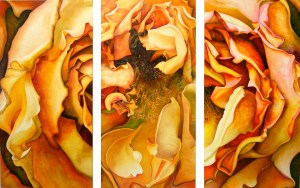
Centering © 2012 by Neena Birch. All Rights Reserved. Oil on canvas, Triptych, 48 x 24 inches, each panel.
In the ancient world, Roman artists used roses to represent Venus, the goddess of love; Egyptian art connected the lily to Isis, the goddess of fertility; and Asian art included lotus flowers to convey beauty. Plant symbolism reached a high point in Medieval Christian art when religious craftsmen and artists used plants to explain the meaning of church parables and doctrine to a largely illiterate population.
In keeping with this tradition, the seventeen artists of Studio 155 created drawings and paintings that bring attention to symbolic themes represented by flowers, trees, fruit, vegetables, herbs and vines. For example, museum visitors will see the whimsical watercolor painting by Wendy Cortesi of a pumpkin that recalls Dia de los Muertos, the Hispanic tradition “Day of the Dead”. They will also see Neena Birch’s rose painting symbolizing ancient spiritual contemplation and centering, as well as Michael Rawson’s painting of a white oak representing strength and endurance.
The artists of Studio 155 have also published a fold-out book called Small Works. This handmade book created by Elizabeth W. Carter features 4″ x 4″ plant idioms painted by each artist. Idioms include “Shrinking Violet” and “Apple of His Eye.” When viewing Beyond Words, museum visitors will be encouraged to match the idioms on the gallery’s list to a corresponding painting in the exhibition.
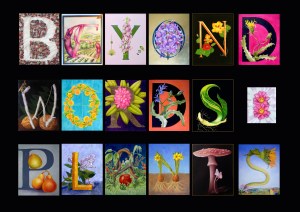
Studio 155 created the fun exhibition postcard at right by painting 10″ x 8″ letters in oil, watercolor or colored pencil and then mounting the letters on a panel. Learn more about the artists behind these letters on the Beyond Words website. The Small Works book is also available for viewing on this site, so be sure to visit and try your hand at matching idioms to their paintings!
Beyond Words: The Symbolic Language of Plants
Delaware Art Museum
Wilmington, DE
February 4 – April 8, 2012
Related


 ArtPlantae Today