• Home
  • About

ArtPlantae Today

Connecting artists, naturalists, and educators

Feeds:
Posts
Comments
« Humboldt Field Research Institute Offers Courses in Insect Illustration, Botanical Art
Using Social Media to Gather Feedback About Student Interest in Natural Resource Management »

The Language of Flowers at The Hunt Institute for Botanical Documentation

February 9, 2011 by Tania Marien

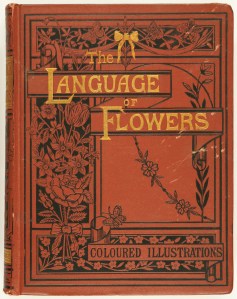
Cover of Robert Tyas’ The Language of Flowers, or Floral Emblems or Thoughts, Feelings and Sentiments (London, George Routledge and Sons, 1869), HI Library call no. DG21 T977L.

Courtesy of The Hunt Institute

FLORA’S LEXICON
25 March–30 June 2011

Flora’s Lexicon explores the 19th-century European and American phenomenon of The Language of Flowers, the common understanding that plants and blooms were charged with sentiment and meaning and held the potential to express emotion or to communicate privileged messages within the strict confines of social etiquette. Flower associations made their way into Victorian language from various sources, including Japanese, Middle Eastern, Turkish, Greek and Roman cultures, religions and mythology, as well as the literature of Shakespeare and the still-life painting of 17th-century Dutch artists. The result was a fashionable system of floral connotations that blossomed during a time of burgeoning public interest in botany and its scientific importance.

So pervasive and popular was The Language of Flowers trend that it launched the introduction of the floral dictionary or Language of Flowers book, a small, beautifully bound and illustrated volume devoted to the decoding of each flower’s secret meaning. This sentimental craze and the books associated with it originated in France, the most notable being Le Langage des Fleures of 1819 by Charlotte de Latour. This volume was reprinted in multiple editions, translated into English and imitated by other French, British and American authors until the trend waned in the mid-1880s, shortly after English author and illustrator Kate Greenaway (1846–1901) published her charmingly illustrated floral dictionary, The Language of Flowers (1884).

The Language of Flowers book phenomenon also attracted the skills of numerous
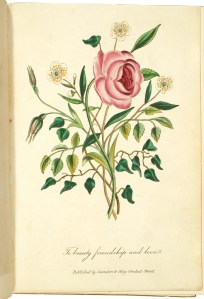
To beauty, friendship and love (rose, ivy and myrtle), hand-colored engraving published by Saunders and Otley, Conduit Street, from Anna Christian Burke’s The Illustrated Language of Flowers (London, G. Routledge and Co., 1856), HI Library call no. DG21 B959I.

respected botanical artists of the era, including Pierre-Joseph Redouté (1759–1840), Pancrace Bessa (1772–1846), Pierre-Jean-François Turpin (1775–1840) and Pierre-Antoine Poiteau (1766–1854). Although their illustrations for this genre differed slightly in scale and scientific detail from their major works, they were prized for their beauty and added to the appeal of these intricately bound and decorated volumes while serving to familiarize a large segment of the population with the artists’ talent.

Flora’s Lexicon presents books from the Hunt Institute’s Library and botanical portraits from the Art Department in an examination of the scope of The Language of Flowers phenomenon, from the influences on its beginning to its continued presence in 21st-century publishing. Differing approaches to the floral dictionary are displayed, while intricate systems of meaning are explored through artworks of many key 18th- and 19th-century botanical artists and illustrators.


Location & Hours

The exhibition will be on display on the 5th floor of the Hunt Library building at Carnegie Mellon University and will be open to the public free of charge. Hours: Monday–Friday, 9 a.m.–noon and 1–5 p.m.; Sunday, 1–4 p.m. (except 22–24 April; 15 and 29–30 May). Hours subject to change, please call or email before your visit to confirm viewing hours. For further information, contact the Hunt Institute at 412-268-2434.


Hunt Institute for Botanical Documentation

5th Floor, Hunt Library
Carnegie Mellon University
4909 Frew Street
Pittsburgh, PA 15213-3890
Telephone: 412-268-2434
Email: huntinst@andrew.cmu.edu
Website: http://huntbot.andrew.cmu.edu
Directions: View map

Share this:

  • Click to share on Facebook (Opens in new window) Facebook
  • Click to share on X (Opens in new window) X
  • Click to share on WhatsApp (Opens in new window) WhatsApp
  • Click to print (Opens in new window) Print
  • Click to email a link to a friend (Opens in new window) Email
Like Loading...

Related

Posted in botanical art, botanical art books, Education, Reference, Special Announcements, Special Events | 3 Comments

3 Responses

  1. on February 9, 2011 at 6:22 PM Randy C. Brown

    The illustrations in this book are exquisite. Sort of reminds me of the Audubon illustration plates. Very nice!


  2. on February 9, 2011 at 8:31 PM Kat

    It’s nice to note that we still have documentations on this kept at museums and libraries. I appreciate it because for me, botanical portraits always work as decorative prints; the ones that could be displayed in your room or office whether they’re framed or stretched into canvas.


  3. on May 30, 2012 at 5:35 PM anthony waghorn

    i have a copy of the language of flowers by robert tyas 1869 but it has a different cover it has a blue and gold round emblem with the title in gold it also has gold edging on pages


Comments are closed.

  • I’m curious about…

  • What Readers Are Reading Now

    • Earn a Professional Certificate in Natural Science Illustration at the University of Washington
    • Today's Botanical Artists On Using Photographs
    • May Release Date for "Watercolor Fruit & Vegetable Portraits"
    • Wendy Hollender Answers Your Questions About Botanical Drawing
    • Martin J. Allen Discusses the Power of Seeing
  • Plants & You

  • Featured Guests

    Wendy Hollender (interview)

    Wendy Hollender

    Gilly Shaeffer

    Today’s Botanical Artists

    Society of Botanical Artists

    Billy Showell (interview)

    Billy Showell

    Sarah Simblet (webinar)

    Robin Brickman

    Mark Granlund

    Wendy Hollender (webinar)

    Diane Cardaci

    Katie Lee (webinar)

    Bruce L. Cunningham (webinar)

    Jane LaFazio (interview)

    Jane LaFazio

    Mally Francis (interview)

    Kandis Elliot

    Anne-Marie Evans

    Margaret Best

    Elaine Searle

    Mindy Lighthipe

    Niki Simpson

    Anna (Knights) Mason

    Helen Allen

    Birmingham Society of
    Botanical Artists

    Hazel West-Sherring

    John Muir Laws

    Martin J. Allen

    Institute for Analytical Plant Illustration

    Mairi Gillies

    Georgius Everhardus Rumphius

    Liz Leech

    Valerie Littlewood

    Heeyoung Kim

    Anna Laurent

    Linda Ann Vorobik

    Shawn Sheehy

    Gary Hoyle

    Katie Zimmerman

    Mariella Baldwin

    Anita Walsmit Sachs

    Ruth Ava Lyons

    Katie Zimmerman

    Kellie Cox-Brady

    Jennifer Landin

    Laurence Hill

    Gretchen Kai Halpert

    Susan Leopold

    Tina Scopa

  • Global Impact

    Botanists and illustrators strive to document conifers around the world.

  • Nature Near You

    Global Directory of Botanical Gardens
    Botanic Gardens Conservation International
    Search for a Garden

    National Park Service
    Search for national parks at the National Park Service website.www.nps.gov

    National Environmental Education Foundation's Nature Center Guide.
    Find Your Nature Center

    Rails-to-Trails
    Find a trail for hiking, walking, cycling or inline skating. The Rails-to-Trails Conservancy and its volunteers work to convert unused railroads into trails for healthful outdoor activities.
    Search their national TrailLink database to locate a trail near you.

    Sierra Club Trails
    Locate trails for hiking, cycling, climbing, and many other outdoor activities.
    Search Sierra Club Trails

  • © 2007-2025 by Tania Marien. All rights reserved.
    Contact Tania

    Unauthorized use and/or duplication of this material without express and written permission from this blog’s author and/or owner is strictly prohibited. Excerpts and links may be used, provided that full and clear credit is given with appropriate and specific direction to the original content. Artists retain the copyright to their work.

    The ArtPlantae® logo is a registered trademark.

Create a website or blog at WordPress.com

WPThemes.


  • Subscribe Subscribed
    • ArtPlantae Today
    • Join 1,775 other subscribers
    • Already have a WordPress.com account? Log in now.
    • ArtPlantae Today
    • Subscribe Subscribed
    • Sign up
    • Log in
    • Copy shortlink
    • Report this content
    • View post in Reader
    • Manage subscriptions
    • Collapse this bar
 

Loading Comments...
 

    %d