Feeds:
Posts
Comments

Archive for the ‘Teaching & Learning’ Category

Welcome to the new Teaching & Learning column at ArtPlantae. This column celebrates the link between drawing and knowing. Articles related to the teaching and learning of plants, art, and nature will be published every Friday. Subscribe to this site by clicking on the “Follow” tab in your browser’s window to be notified when new articles are published or join the email list to receive weekly updates.


SEEING WITH GRAPHITE EYES

When student Samuel Scudder, an aspiring entomologist, told Harvard University professor Louis Agassiz that he wanted to study entomology, Agassiz handed him a fish to observe. After looking at this boring pickled fish for a period of time, Scudder began to draw it. When Agassiz re-entered the room he said to his student, “That is right, a pencil is one of the best eyes.”

No one reading this post needs to be convinced that you learn more about a subject when you draw it. We’ve all experienced it ourselves. Today we take a look at what sixth graders at three Vermont schools experienced as they engaged in a year-long curriculum designed to enhance their observation skills and their appreciation for trees.

Three teachers began this year-long project by spending a day with an environmental educator/illustrator to learn how to use nature journals as tools for observation. Environmental educators then visited each school to work with groups of students and to help them select the trees they would observe during the school year.

Throughout the year, students recorded observations in their sketchbooks. As the year progressed, they recorded more than simple morphological features and simple updates. They began to record and describe the growth patterns they were observing and began to formulate hypotheses based on their observations.
Students’ record keeping started as simple pictures, became pictures with labels, and evolved into written observations. Students were given the freedom to label their illustrations using their own words, thereby making each illustration a unique record of their understanding. Teachers then taught students the technical botanical terms of the morphological features recorded in their journals.

Changes in student observation skills were assessed using a rubric — a set of defined criteria used to evaluate performance. In this study, the criteria assessed included the amount of written and visual details present in a student’s journal, as well as a student’s demonstrated improvement of fine motor control as observed in student drawings. A thorough evaluation of student journals uncovered that students began the project drawing simple tree symbols. At the close of the project, student observation skills had improved, as did their enthusiasm for their respective trees.

Upon the conclusion of this year-long activity, the three teachers involved with the project felt their students learned from the drawing experience and each proclaimed they would continue their use of journals in the classroom.


How to obtain a copy of A Pencil is One of the Best Eyes
:


Related Info

Read Full Post »

A Reference for Botanical Illustrators

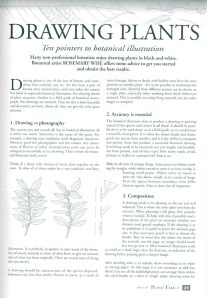
In the April 1999 issue of Plant Talk, Rosemary Wise (botanical artist at the University of Oxford) wrote an article about how to draw plants for documentation. In her article, Wise emphasizes how accuracy is important in a botanical drawing and explains how a botanical illustration can offer more information than a photograph. She also provides instruction on how to compose a botanical plate and discusses pen-and-ink drawing techniques in the process.

Wise also explains how to draw for publication, how to draw from herbarium specimens, how to draw dissections, how to hydrate dried material, and how to use tracing paper to draw dissections of symmetrical flowers.

The back issues of Plant Talk are no longer available. However a copy of this article is available for your use. This copy of Rosemary Wise’s article comes to you courtesy of the Eden Project and Plant-Talk.org.

Download – Drawing Plants: Ten Pointers to Botanical Illustration


Literature Cited

Wise, Rosemary. 1999. Drawing plants: Ten pointers to botanical illustration. Plant Talk. No. 17:29-32.

Read Full Post »

Questions to think about as you read about the research study below:

  • What are the most common drawing errors made by new botanical illustrators?
  • How do new botanical illustrators approach their drawing of plants? What is their strategy?


Studying the Cognitive Factors Involved in the Drawing Process

Susan B. Roth, a drawing instructor at Ohio State University, created an experiment to research the potential cause(s) behind the most common drawing errors she was observing in her classroom. Drawing (no pun intended) on her classroom observations and her previous research, she formulated the following hypothesis: Inaccurate perceptual analysis is the cause of drawing errors.

In her classroom, she observed the following errors repeatedly:

  1. Cubes drawn with the top face too large and in the shape of a square.
  2. Cylinders with the top face too large.
  3. Cubes drawn too wide.

To test her hypothesis that “the inability to translate a perceived three-dimensional image of an object into a two-dimensional drawn image” accounts for common drawing errors, she created an experiment enabling her to examine the relationship between drawing performance and the following factors: visual perception, drawing strategies, type of stimulus, “previous experience with visual studies”, and gender.

Students from different academic departments at Ohio State University were selected at random (n=27). Roth (1992) tested her hypothesis by administering standardized tests and taping each subject’s approach to drawing. Each subject created 10 drawings in response to different stimuli. Two drawings were created upon receiving a verbal command to draw a cube and a cylinder from memory. Eight drawings were created in response to observations made of “a three-dimensional cube, a distorted three-dimensional cube, a line drawing of a cube, a line drawing of a cube with shading added, a three-dimensional cylinder, a three-dimensional distorted cylinder, a line drawing of a cylinder, and a line drawing of a cylinder with shading added.” Drawing errors were recorded. Error type was also recorded. Errors were categorized on evaluation sheets specific to this study. Errors were arranged in a checklist containing phrases such as the image is too wide, the image is too deep, etc.

Roth (1992) found that the order in which lines were placed during the drawing process was not related to drawing performance. Roth observed that cube drawings (regardless of stimulus) contained more errors than cylinder drawings. The most common error was the “top face too large” error (Roth, 1992), followed by errors in drawing the appropriate width of an object, errors in drawing diverging lines, errors in drawing an object’s accurate height, and errors in drawing an object’s accurate depth. In her analysis of drawing performance and gender, Roth observed that male subjects had more experience with visual studies (e.g., shop classes, drafting classes, model building), than female subjects and suggests this might be the reason why the drawing performance of maie subjects was significantly different than that of female subjects.

Roth’s findings support her hypothesis. If the inability to translate the perceived three-dimensional image of an object into a two-dimensional drawn image accounts for common drawing errors, Roth suggests the implementation of the following instructional techniques in drawing:

  • Students must be taught how to view objects “as a collection of relationships between end points and other elements” instead of as a whole object.
  • Drawing instructors must enable the critical analysis of form, perhaps by using computerized instruction to help students see form and spatial relationships.


Today’s Questions
:

  • What are the most common drawing errors made by new botanical illustrators?
  • How do new botanical illustrators approach their drawing of plants? What is their strategy?


Literature Cited

Roth, S.K. 1992. An investigation into cognitive factors involved in the drawing process. Journal of Visual Literacy. 11(2):57-76.
Article available online in Vol. 11 (2). See Journal Archives.

Read Full Post »

After observing that drawing instructors spent 50% of class time making students aware of their mistakes because students were unable to identify their own errors, Japanese engineers created a way for drawing students to observe errors during the drawing process. Researchers observed 19 students enrolled in a lifelong learning school in Japan. They observed these students for five weeks and recorded conversations between tutors and students.

To enhance “error awareness”, the team of engineers created a tutoring system that creates a 3D model of a student’s drawing. Researchers hoped this tutoring system would enable students to identify their own mistakes upon seeing their drawing as a three-dimensional form.

Turning a student drawing into a 3D form did not happen with the simple click of a camera. Students had to enter twelve values pertaining to the size of the drawing subjects (in this case a plate and a mug), enter the distance between the them and the subject, and enter a handful of other measurements as well. Only after these twelve values were entered, could a student photograph his/her sketch and upload the image into the tutoring system.

Seven problem areas were analyzed in this study, each pertaining to the mistakes students made when placing shadows in their drawings. The seven problem areas of interest to engineers were:

  • The dark shadow on the inside rim of the plate.
  • The light shadow on the inside rim of the plate.
  • The shadow cast by the plate.
  • The light shadow on the beer mug.
  • The shadow on the outer rim of the plate.
  • The shadow along the rim of the plate.
  • The reflected light underneath the plate.
  • The light shadow on the handle of the beer mug.

To create a 3D form of a student’s sketch, the tutoring system evaluated three levels of shadow density in each of the seven problem areas. The features were extracted by the tutoring system and compared to the density levels of the actual drawing subjects. The 3D forms were created directly from these comparisons.

Engineers tested the effectiveness of the tutoring system by creating an experiment in which drawing students were asked to identify errors in a sketchbook drawing and then asked to identify errors in a drawing generated by the tutoring system. Students correctly identified more errors in the 3D drawing created by the tutoring system than in the sketchbook drawing. These findings suggest the tutoring system is effective in making students more aware of their mistakes.


How do you critique your placement of shadows
during the drawing process?

(please share below)


Literature Cited
:
Matsuda, Noriyuki, Saeko Takagi, Masato Soga, Tsukasa Hirashima, Tomoya Horiguchi, Hirokazu Taki, Takashi Shima, and Fujiichi Yoshimoto. 2003. Tutoring system for pencil drawing discipline. Proc. of International Conference on Computer in Education (ICCE2003). pp. 1163-1170.

Read Full Post »

Topinka, Lorie and Diane T. Sands. 2005. Sketching as a science tool. Connect. 19(1): 4-7.

Illustrators Lorie Topinka and Diane T. Sands answer this question in their article, Sketching as a Science Tool (2005). They discuss how biologists use sketches and diagrams in their field journals and explain how some initial observations are more easily captured as sketches instead of as words. They then explain how they develop observational skills in their students through sketching exercises and explain the procedure they use to grade student sketches.

Topinka and Sands’ checklist provides structure to any sketching activity and assigns points according to met criteria instead of the quality of art a student produces.

This article is accessible online through Synergy Learning.

Purchase a back issue of Connect, Vol. 19(1), September/October 2005 ($6, incl. postage).

Read Full Post »

« Newer Posts