Feeds:
Posts
Comments

Archive for the ‘Teaching & Learning’ Category

At the age of 60, biologist Maura Flannery decided to learn more about plants. She writes about her decision in Daring Botany, an article written for her Biology Today column in The American Biology Teacher. In this article, she discusses how botanical illustration and online databases about plants have helped to resolve her self-described “plant blindness” (Flannery, 2007).

Flannery is no stranger to the use of imagery in biology. One of her research specialties is the relationship between biology and art. So it was no surprise to learn she studied botanical illustration at the New York Botanical Garden (NYBG). She has written about botanical illustration in previous articles (Flannery, 1995). What was different about this article was who she mentioned as the botanical artist whom she describes as her “role model” (Flannery, 2007).

Dr. Dick Rauh is a much-loved and respected botanist and botanical illustrator and is currently serving as President of the American Society of Botanical Artists. He teaches Plant Morphology at NYBG and at botanical gardens across the U.S. In her article, Flannery (2007) writes how Dr. Rauh taught her to see “how plants are put together”, how they work and how their morphological features vary between plant families. She writes how Dr. Rauh’s passion for plants made each of his students want to learn more about them.

Flannery describes her time at NYBG as a “humbling experience”, one marked with challenges in learning how to draw, learning how to draw plants, and “even learning (how) to hold a pencil correctly” (Flannery, 2007). Her experiences in botanical illustration made her appreciate the challenges of learning a subject with many layers of information and caused her to reflect on the challenges her own students face when learning new concepts in her classroom. Her studies at NYBG also trained her to “look more carefully at the green world” and instilled in her such a strong enthusiasm towards plants, Flannery (2007) made plants the focus of a class she taught later that year. Anyone who has learned from Dr. Rauh knows such a transformation is not an exaggeration. This story is great example of the power of effective storytelling and how botanical illustration can connect people to the seemingly invisible world of plants.

Throughout the rest of her article, Flannery (2007) talks about how she learned a great deal about plants and modern botany at the Botany and Plant Biology Joint Congress. Flannery describes the plant databases and research projects that made an impression on her. It is a selection of these databases that I will focus on next, as they are resources botanical artists may want to bookmark for future studies and travels.


    PLANTS Database

    http://www.plants.usda.gov
    View tens of thousands of plant images, use interactive keys to identify the gymnosperms, legumes, grasses and wetland monocots in your state. Are you interested in creating a body of work about local plants? The information on this website will get you started.


    National Biological Information Infrastructure (NBII)

    http://www.nbii.gov
    A resource-rich website providing information about our nation’s biological resources.


    Botanicus Digital Library

    www.botanicus.org
    A free Web-based catalog of botanical literature, with a special focus on illustrated books.


    Jepson Herbarium, UC Berkeley

    http://ucjeps.berkeley.edu/consortium/about.html
    A searchable database of 1.2 million specimens stored in herbaria throughout California. This is a resource worth exploring if your current project involves drawing a plant indigenous to California.


    The C.V. Starr Virtual Herbarium

    http://sciweb.nybg.org/science2/VirtualHerbarium.asp
    The online herbarium of the New York Botanical Garden comprised of 1.3 million herbarium specimens and 225,000 images. Specimen catalogs feature bryophytes, fungi, lichens, algae, and vascular plants. This is only one of many digitizing projects being conducted by herbaria across the U.S.


    Tropical Plant Guide from The Field Museum in Chicago

    http://fm2.fieldmuseum.org/plantguides
    Explore the tropics! The Field Museum has created downloadable field guides to plants and animals for anyone to use. This is a fantastic resource. If you need a guide to explore the ferns of Bolivia, the fruits of Mata Atlantica, or the seedlings of Costa Rica, you’ll find color guides you can download and then laminate. Also available are photos of neotropical plants, herbarium specimens, and micro-herbaria available on DVDs.

Both of Flannery’s articles can be purchased online for $14 each. Alternatively, you can search for these articles at a library near you.


Literature Cited

Flannery, Maura C. 1995. The visual in botany. The American Biology Teacher. 57(2):117-120. [accessed 16 June 2011] <http://www.jstor.org/pss/4449936>

Flannery, Maura C. 2007. Daring botany. The American Biology Teacher. 69(8):488-491. [accessed 16 June 2011] < http://www.jstor.org/pss/4452210>
Read Full Post »

Linnaeus described plants expertly. But could he draw?

Independent scholar, museum consultant and exhibition curator, Karen Reeds, takes a look at how Linnaeus described plants in When the Botanist Can’t Draw: The Case of Linnaeus.

Linnaeus studied botany during a time when botany instruction, as Reeds (2004) puts it, was very “show and tell.” A time when students had to compare a plant specimen to several illustrations to identify it because the written descriptions of plants were so unorganized (Reeds, 2010).

Linnaeus put an end to the cumbersome search for descriptive text when he created his classification system. He spent years writing descriptions of plants, documenting what he saw and then organizing this information in a systematic way. He valued descriptive text over illustrations (Reeds, 2004) and interestingly enough, this preference has put him in the hot seat, at least where his drawing abilities are concerned.

Linnaeus’ own sketches have received mixed reviews over the years. Some reviews have been more critical than others. According to Reeds (2004), Wilfrid Blunt (The Art of Botanical Illustration) has been very critical of Linnaeus’ drawings stating:

Matisse once said that his ambition was to draw like his little girl of five; Linnaeus achieved this effortlessly.

Other Linnaean scholars have been less critical.

Reeds (2004) suggests Linnaeus’ preference for words over illustrations was a combination of being on the receiving end of “show and tell” botany instruction as a student (after all, she says, he was a “pre-Linnaean” student of botany), his natural “strengths as a scientist”, and his personal struggles with drawing. Struggles that Reeds (2004) says are easy to see in his work.

Reeds (2004) says you can see “how well a drawing succeeds as description of an unfamiliar object” by copying it. When Reeds tried to copy some of Linnaeus’ drawings without referring to his written words, she found she often questioned the purpose of Linnaeus’ lines and couldn’t tell if a line was intended to show “volume, perspective, shading or texture” (Reeds, 2004).

Linneaus’ preference for descriptive text over illustrations is clear in Hortus Cliffortianus (1737), a book about the plant collection of George Clifford, a Dutch banker and director of the Dutch East India company. Clifford hired Linnaeus and artists to document his plants. Linnaeus’ descriptive text is the heart and soul of this book, while the plant portraits created by none other than botanical artist Georg Ehret and engraver Jan Vandelaar, were placed at the end of the book without an effective index linking the text to the engravings (Reeds, 2004). While Linnaeus admired the illustrations of his counterparts, he held firm in his opinion that pictures could never offer the level of information achievable with the written word stating, “I do not recommend drawings ….. for determining genera – in fact, I absolutely reject them” (Reeds, 2004). Linnaeus felt words were much more effective at describing plants and their unique qualities than illustrations.

What do you think?

For a more thorough analysis of Linnaeus’ notebooks and his thoughts about illustrations, see Reed (2004).


Literature Cited

Blunt, Wilfrid. 1993. The Art of Botanical Illustration. Antique Collectors Club. Revised and enlarged edition. (9781851491773)

Reeds, Karen. 2004. When the botanist can’t draw: the case of Linnaeus. Interdisciplinary Science Reviews. 29(3): 248-258. Web. [accessed 8 June 2011] <http://www.ingentaconnect.com/content/maney/isr/2004/00000029/00000003/art00005>

Read Full Post »

Architect, lecturer and researcher, Ylva Dahlman, began to notice a trend in the graphic arts and design class she created for natural science and social science students. She noticed her students at the Swedish University of Agricultural Sciences in Uppsala, Sweden were taking more than art and design concepts with them when each term ended. What Dahlman observed were hints that the art activities students completed in class were having an effect on the students’ overall learning.

Dahlman created an investigative strategy to find out what that “something” (Dahlman, 2007) was that students were taking with them after completing her course.

Knowledgeable about research efforts studying links between artistic experiences and academic achievement, Dahlman decided to investigate her students’ learning.


Questions & Reflection

Dahlman’s investigation into her students’ learning process occurred from 1994-2001. The data she discusses in Dahlman (2007) comes from the responses and reflections of 220 students completing her class during this time period. Students filled out two questionnaires — one before the course began and the other when the course ended. Two key pre- and post-questions Dahlman asked were, Do you think your vocational studies can be influenced by art studies? How? and Do you believe that a natural scientist thinks differently than an artist?

Dahlman also asked students to spend the last 15 minutes of each lecture reflecting on their learning.

Ninety-three percent of Dahlman’s students completed the pre-course survey, 84% completed the post-course survey, and 75% submitted reflective summaries. From students’ written responses, Dahlman (2007) concluded that their artistic experiences in class:

  • Helped students develop problem-solving skills.
  • Taught students how to see their environment in new ways.
  • Instilled self-confidence in students.

Dahlman (2007) found each of these factors contributed to students’ overall ability to concentrate, resulted in students having a “changed attitude towards their studies”, and had an effect on their overall learning (Dahlman, 2007).

What type of art activity did Dahlman focus on to study the link between art and learning?


Dahlman’s Focus

Dahlman’s area of focus was drawing, specifically what happens during the drawing process. Dahlman (2007) refers to the act of drawing as “the pictoral process.” Dahlman (2007) claims the process of drawing turns “unarticulated forms of experience into non-verbal artifacts that invite reflection.”

According to Dahlman (2007), people make sense of confusing situations by grouping events into familiar categories. She says people acquire new knowledge only when they can overcome the urge to fall back on familiar categories. She says drawing is a great tool to use to overcome the desire for familiarity because drawing “often connects seemingly incompatible categories of experience” (Dahlman, 2007). Dahlman continues to say that through the act of drawing, “the world is being articulated in new shapes” and this takes us to a new level of understanding.

Eighty-eight percent of Dahlman’s students thought the art activities they completed in the graphic arts class had a positive effect on their studies. Regarding student responses to the question, Do you think your vocational studies can be influenced by art studies? How?, Dahlman shares two lengthy replies in her paper. Excerpts from these lengthy replies are included here.

One student replied:

Yes. It gives a knowledge of other ways of looking at the same thing. It yields a personal confidence. When it comes to problem solving, I feel that [if I] can make a painting of an abstract concept, I should feel more confident in other problem solving situations as well.

Another student said:

Yes. When I read a scientific article about, say, growth factors, I may understand all the words and accept their face value, but it is not until I make a sketch of the content of the article that I understand it thoroughly…..Creating pictures means taking responsibility for the kind of reality that you perceive.

In summary, Dahlman (2007) states it is important to view the world through the drawing process. As she puts it, “knowing is action” and drawing is action. Dahlman (2007) says it is through drawing that we “connect incompatible categories of experiences”. She also points out the act of drawing produces an object upon which we can reflect and it is through categorizing experiences in new ways and through reflection of the resulting object that we arrive at new knowledge.

In addition to describing her research project and results, Dahlman (2007) compares and contrasts the drawing process as a way of knowing to other ways of knowing (e.g., pragmatism, tacit knowing, metaphors). To read Dahlman’s complete analysis, search for this article at your local college library or order this article through the Wiley Online Library for $35 for 24-hour online access.


Literature Cited

Dahlman, Ylva. 2007. Towards a theory that links experience in the arts with the acquisition of knowledge. The International Journal of Art & Design Education. 26(3): 274-284. Web. [accessed 2 June 2011] <http://onlinelibrary.wiley.com/doi/10.1111/j.1476-8070.2007.00538.x/abstract>

Read Full Post »

An interest in botanical illustration and the future of this art form prompted
Niki Simpson to explore the digital arena to determine if botanical illustration had a place in this new medium. Aware of the argument that traditional illustrations are thought to be more informative than photographs, she investigated ways to increase the amount of information presented in digital illustrations. Her investigation resulted in the composite digital botanical illustrations seen in her online gallery.

Simpson’s digital illustrations give users clear information about leaves, flowers, reproductive parts, venation, leaf arrangement, inflorescence types, fruit, buds, and the underground features of a plant. Her botanical plates also include a color chart and botanical symbols identifying the sex of a plant’s reproductive organs, whether its species is monoecious or dioecious, plus many other characteristics. The symbols used by Simpson are unique to her work because she created many of them from scratch. The process by which Simpson created her symbols is the focus of Botanical Symbols: A New Symbol Set for New Images.

Botanical symbols have been used for centuries because they offer a way to abbreviate repeat words and conserve space on a page (Simpson, 2010). To make her botanical plates as informative as possible, Simpson knew she needed to use symbols in her illustrations. So she researched botanical symbols and how they had been used in the past.

During her research, Simpson (2010) discovered symbols with multiple meanings, symbols no longer in use and symbols not easy to think about, much less easy to write by hand. Her search made her realize that a universal set of botanical symbols about plants did not exist, so she decided to create her own set for her own use.

This lead to additional discoveries, namely that traditional typefaces and fonts lacked symbols suitable for the scientific documentation of botanical specimens (Simpson, 2010). Simpson realized whatever her symbols were to look like, they needed to be easy to write, needed to blend with modern fonts, needed to have a contemporary look, as well as a scientific feel. With these issues in mind, Simpson created the design criteria for her new symbols.

Simpson’s design criteria includes specific information such as, “symbols must be botanically appropriate”, “symbols must be easily readable; clear on reduction and enlargement”, and “symbols must be visually understandable by an international audience” (Simpson, 2010). Simpson’s detailed design criteria can be viewed in Appendix I of her paper.

In 2007, Simpson showed the new botanical symbol set in use in 40 digital composite illustrations in her solo exhibition, Digital Diversity: A New Approach to Botanical Illustration, held in the Botanisches Museum in Berlin-Dahlem, Germany.

Since then, she has fine-tuned her symbols and created a new botanical symbols font based on her symbol set. The Simpson Botanical Symbols OpenType font was completed in January 2009.

Simpson’s fonts are available for free and she invites readers to download the font from her website to use in floras, plant surveys and on plant labels. She also invites readers to use her symbols as shorthand while taking notes in class.

To obtain a copy of Simpson’s article, search the stacks at your local college library. This article can also be purchased online for $35.


Literature Cited

Simpson, Niki. 2010. Botanical symbols: a new symbol set for new images. Botanical Journal of the Linnean Society, 162: 117-129.


Other Items of Interest

Read Full Post »

Practical drawings are mental tools.

— Henning Nelms

When Henning Nelms wrote Thinking with a Pencil in 1957, he wrote it for two groups of people:

  • People who wanted to use drawing “as a tool for thought and communication” but who did not know how to draw.
  • People who knew how to draw, but who wanted to apply their skills in more than one discipline.

To emphasize the fact that drawing has a place in all disciplines, Nelms includes 692 illustrations that are more about how to use drawings instead of how to make them.

Nelms advocates practical drawing across all disciplines and encourages readers to use drawing as a learning tool in all areas of their lives. Throughout his 347-page guide to drawing and thinking, he shares tips and techniques that make accuracy easy to achieve.

After establishing foundation principles inherent in all drawings, he begins an insightful overview of drawing tips and techniques, never once straying from his primary objective — how to use drawing in everyday life.

The topics discussed by Nelms include:

  • Drawing for practical use
  • Drawings requiring no skills – Charts, diagrams, webs and grids
  • Making easy drawings out of hard ones – How to lower the accuracy requirements of a drawing.
  • Tracing Techniques – How to use tracing paper and tracing techniques as a learning tool to aid in the translation of an image.
  • Creative Tracing – How to rearrange old material to create something new.
  • Proportions – How to think about proportions, take measurements, and sight with a pencil.
  • Fixed-line Construction – How to use parallel and perpendicular lines to create dimensions of space upon which freehand drawings are based. Of particular interest to botanical illustrators is Nelms’ discussion about ellipses and logarithmic spirals.
  • Constructions for Free-line Drawings – How to create constructions for even the most irregular natural forms.
  • Data Management – How to visualize numerical data.
  • More Data Management – How to turn numerical data into graphic forms.
  • Mechanical Aids – Tools to help you construct the parallel and perpendicular lines present in nearly every drawing.
  • Seeing in 3-D – How to see the third dimension and how to “draw as you go.”
  • Distortion – How to control distortion, create oblique drawings and manage ellipses.
  • 3-D Form – How to project form in three-dimensions.
  • Drawing People & Animals – How to draw figures, joints, muscles, hands, etc.
  • Rendering – How to render an object (shading, scumbling, stipple, folds).
  • Presentation – How to improve the appearance of a drawing through your choices in lettering and layout.

Included in this book is a glossary of equipment and material. When you read this section, remember that this book was written in 1957 and that some of the materials in this section may no longer be available.

The same needs to be said about the books Nelms includes in his bibliography. Nelms states he spent eleven years reviewing every book that had anything to do with drawing. In his bibliography, he only includes books he deemed of value when it comes to the practical aspects of drawing.

Thinking with a Pencil is a gem. It was reprinted in 1964 and again in 1981. Fortunately, this book is still available as a used book. Search for this book and other drawing books at independent bookstores on Biblio.com.


Literature Cited
Nelms, Henning. 1981. Thinking with a Pencil (With 692 illustrations of easy ways to make and use drawings in your work and in your hobbies). Ten Speed Press.
ISBN-10: 0-89815-052-3
ISBN-13: 978-0-89815-052-0

Read Full Post »

Observe, observe, observe. It is not what the drawing looks like that matters. It is what has been seen and learnt that is important.

– Australian National Botanic Garden

The end of another school year is on the horizon. Summer nature camps are advertised everywhere you look. The summer season means road trips, warm evening walks and outdoor exploration.

Flowering plants get a lot of attention this time of year and now is a great time to look at them more closely. A fun way to bring attention to plants is through art. Creative activities involving leaves, paint, ink, etc. are pretty easy to find. What is more difficult to find are exercises about botanical illustration that are a nice mix of technique and history. If you are searching for lesson plans in botanical illustration to use at a summer camp or in some other informal learning situation, then consider the guides produced by the Australian National Botanic Garden (ANBG).

In Top Draw: Drawing Aussie Flora, educators will find comprehensive, concise and easy-to-teach exercises in botanical illustration. With this guide, both teachers and students will learn:

  • How to observe differences in leaves
  • How to dissect a flower
  • How to observe, record and label flower parts
  • How to shade a three-dimensional form in pen & ink through stippling
  • How to draw on-location

In Top Draw: Drawing Aussie Flora – Further Design Activities, educators will find information about printmaking and illustration techniques. The majority of this second guide, however, is dedicated to botanical painting. The easy-to-follow exercises in this guide will have students young and old mixing colors and painting leaves in no time at all.

The Top Draw teacher guide and instructional packets are available online through the Education page on the ANBG website. See the literature cited section for direct links to these resources.


Literature Cited


Also See…

  • Buy a Magnifier, Receive a Free Dissecting Kit at ArtPlantae Books
  • Members of the Society of Botanical Artists offer advice to budding botanical artists
  • Today’s Botanical Artists discuss drawing branches and veins
  • .

Read Full Post »

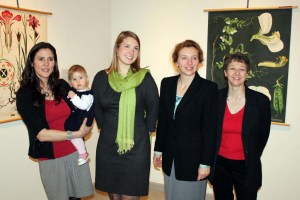
Lydia Kirchner at opening reception. (Courtesy: Randolph College. Photo by Brenda Edson)

Last year when Lydia Kirchner was taking courses in botany and museum studies, members of the Biology Department at Randolph College in Lynchburg, VA discovered botanical wall charts in the attic of the life science building. The wall charts were in very good condition, so the Biology Department contacted Randolph’s Maier Museum of Art to inform them of their discovery. One thing led to another and Kirchner was chosen to research the history of the wall charts and to curate an exhibition about the charts at the Maier Museum.

The exhibition Nature Perfected: The Art of Botanical Illustration, opened on January 23, 2011. Twelve of the wall charts are on view, along with pressed plant specimens, a 1920s microscope and microscope slides from the late 1800s emphasizing the significance of the wall charts and how they enhance our understanding of plants at a microscopic level.

Many of the charts discovered in the attic were created by Jung, Koch, Quentell in the 1950’s. Their trademark black background and colorful illustrations are still vibrant in spite of lying in an attic for many years.

Botanical wall charts have a history dating back to the 1800s. They were created during a time of educational reform in Germany. The first wall charts were created in the 1820’s, mostly for use in primary schools. In the 1840s, the student population increased 108% while the number of teachers increased only 40%. Wall charts made it possible for teachers to show supporting visuals in large classrooms filled with students.

From 1850 to 1890, botanical wall charts became very popular with the advent of color lithography. Contributing to the popularity of wall charts by Jung, Koch, Quentell specifically, is their absence of text. Because they do not contain text, the charts do not have to be translated. This makes the charts by Jung, Koch, Quentell very versatile.

Included in the exhibition are an original print by John James Audubon from the Maier Museum’s permanent collection, a 14th-century illuminated manuscript and four books from the College’s Lipscomb Library rare books collection. The books on display include:

    Beautiful Ferns
    Daniel Cady Eaton, Charles Edward Faxon, and J. H. Emerton
    S.F. Cassino, Boston (1882)
    Lipscomb Library, Randolph College

    This book features original watercolor drawings after nature accompanied with descriptive text. Although not intended for the classroom, the illustrations have captured scientific detail with artistic quality.


    The Birds of America, Vol. 1

    John James Audubon
    Roe Lockwood and Son (1859)
    Lipscomb Library, Randolph College

    The Birds of America is a collection of drawings by Audubon of birds from nature, accompanied by descriptive text. Published in seven volumes in 1840, the scientific illustrations capture idealized forms of nature with outstanding artistic expression. Audubon was recognized as both an artist and scientist for his drawings, and is still greatly celebrated and influential today.


    Conversations on Vegetable Physiology: Comprehending the Elements of Botany, with their Application to Agriculture

    Mrs. Janet Marcet, adapted for use of school by Rev. John L. Blake, 7th Edition
    E.L. Carey and A. Hart, Philadelphia (1837)
    Lipscomb Library, Randolph College

    Originally written by a woman, this classroom text was commonly called Blake’s Botany. The book features colored engravings that resemble the wall charts but include labels identifying specific structures.


    Manuscript Leaf of a Vulgate Bible

    ca. mid- to late- 14th century
    Lipscomb Library, Randolph College

    Illuminated manuscripts have a long tradition of botanical illustration used as a decorative border. The long and difficult process of hand painting each illustration limited the number of manuscripts available until early printing technology was developed in the 15th century using woodcut blocks and engravings.


    The Georgics of Virgil

    Translated by John Dryden
    Jacob Tonson, London (1697); reprint Cheshire House, New York (1931)

    A reproduction of Virgil’s poetic Georgics written in 29 B.C.E. accompanied with detailed engravings serving as a farmer’s manual teaching man about nature and the hardships of agriculture and field labor.


Nature Perfected: The Art of Botanical Illustration
will be at the Maier Museum of Art through July 31, 2011. Summer viewing hours from May through August are 1-4 PM, Wednesday through Sunday.


Exhibition Preview

Thank you to Lydia Kirchner and the Maier Museum of Art for sharing their wonderful exhibition with us. The gallery images below are provided courtesy of Lydia Kirchner.

L to R: Interim Museum Director Martha Johnson, curator Lydia Kirchner, advisor Dr. Andrea Campbell, and supervisor Deborah Spanich.


Related Topics

Read Full Post »

« Newer Posts - Older Posts »