Feeds:
Posts
Comments

Archive for the ‘Teaching & Learning’ Category

Next week at Dijon University in France, an exciting new program will begin.

Scholars from all over the world will contribute to a seminar series about illustrations used in the service of science, specifically the relationship between scientific texts and their illustrations and the role illustrations play in the scientific process.

The seminar series will occur over three academic years (2012-2015). Topic areas include illustrations used in medicine, physics, biology and other disciplines, as well as chronological reviews of history (e.g., illustrations during the Renaissance, the Enlightenment, etc.). Leading discussions during 2011-2012 are scholars from Belgium, France, Greece, the United Kingdom and the United States.

Marie-Odile Bernez is the project coordinator of this seminar series. I had the opportunity to ask her a few question about the three-year program.


    ArtPlantae
    : What made you decide to create this seminar series?

    Marie-Odile Bernez: My training is originally as an English teacher, specializing in the 18th century and the history of ideas. My research lab/centre focuses on the relationship between text and images, and has so far restricted its studies to the arts, the cinema and literature. I thought it would be a good idea to develop interdisciplinary seminars focusing on scientific illustration, in a historical perspective, mainly to strengthen the links between hard sciences and the humanities. Because we are in Burgundy, I was also involved in the organization of a 2007 conference commemorating the tercentenary of Georges Louis Leclerc, Comté Buffon’s (1707-1788) birth and it struck me at the time how important the illustrations for the Histoire naturelle were. Burgundy was the home of Marey also, and I thought we were totally legitimate in our approach, and could build on those two “ancestors”.


    AP
    : How long did it take to launch this series and get presenters scheduled?

    MB: It didn’t take very long. In fact, I posted the first call for papers last January and was astonished at the amount of positive responses I received. I was invited to join a seminar in Spain (Minorca) last May, where I met several historians of science including Klaus Hentschel from Stuttgart, Daniela Bleichmar from California and Nick Hopwood from Cambridge, and many of their students. This gave me more contacts and, from then on, I tried to organize a schedule. The schedule for 2012/13 is almost ready too.


    AP
    : What do you hope to accomplish through this seminar series?

    MB: This is a tricky one. My first aim was to reinforce our links with the hard sciences and show how much the history of ideas depends on the developments occurring in different scientific domains. Then, I would also like to advance our understanding of the relations (between) text/image, and especially see how images illustrating scientific texts differ from other images, because their acknowledged end is to contribute to our understanding of an accompanying text, but I think also that all images, even scientific ones, are connected to a wider context, and add to the text, by expressing other things than what they are supposed to illustrate. Is this different however in the case of scientific images?


    AP
    : You mentioned there is a publication planned that will focus on the presentations presented during this series. Will the publication be in book format? In journal format (i.e., a collection of articles)? Will the publication be available to the public?

    MB: My colleagues have suggested we should publish the collection of articles, preferably in English and in a book format, so that something remains of the seminars. My intention is to collect the papers over the next two years, which should give us quite a range of subjects, but also enough material to present a coherent project to a publisher. As far as I know, the series of seminars should go on after that, if funding remains available, and so perhaps two publications might be available eventually, to cover two two-year periods.

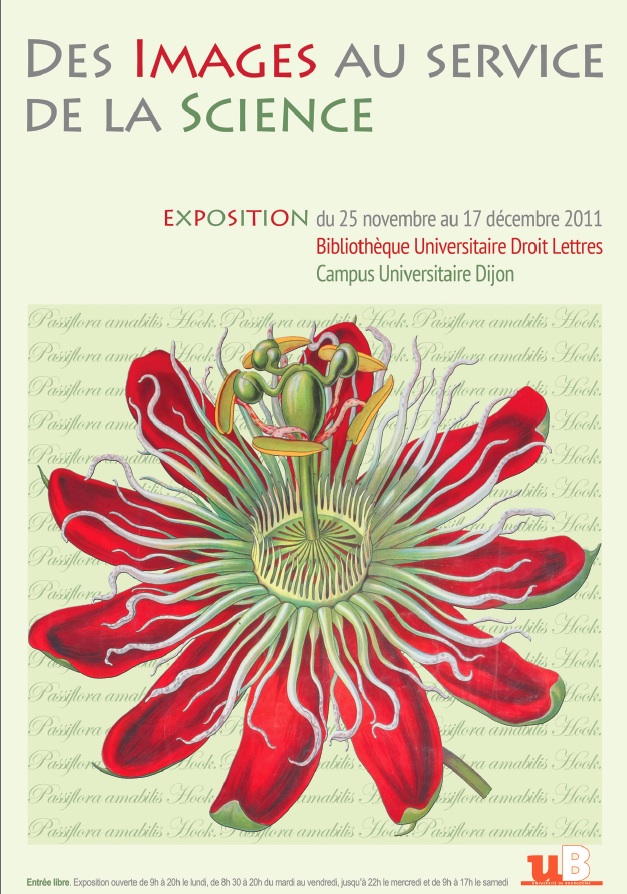
The Department of Communication & Documentation and the fund dealing with the Scientific Collections at the University of Burgundy are pleased to announce an exhibition entitled Images in the Service of Science, in conjunction with the launch of this special seminar series about scientific illustration organized by the Interlanguages Centre. The exhibition highlights various modes of scientific illustration, from wall panels to rare books about natural history.

Images have always been essential to the sharing of scientific knowledge. At a time when 3-D imaging and virtual images dominate, it should be remembered that up until the 20th century, the only way to show to the wider public what was observed, was through illustrations.

Images in the Service of Science will be on view November 25 – December 11, 2011 in the main University Library for Arts and Humanities on the campus of Dijon University.

The scholars presenting during the inaugural year of this unique program are:

    Valerie Chansigaud (France)
    Research Focus: Issues surrounding the discovery of biodiversity and early attempts to protect it. Dr. Chansigaud is also interested in how people can transmit their knowledge about wildlife using technology.
    Presentation: Five Centuries of Naturalistic Illustrations, Between Tradition and Evolution
    November 25, 2011


    Richard Somerset (University of Nancy 2, France)

    Research Focus: Relationships between science and literature, also the history of ideas in the 19th century.
    Presentation: Telling the Story of Evolution in Images: The Popularising Work of Arabella Buckley
    January 27, 2012


    Marie-Odile Bernez (University of Burgundy, France)

    Research Focus: 18th-century Britain and the history of ideas relating to the sciences and political events. Bernez translated the works of the French Revolution by Mary Wollstonecraft and has published articles about 18th-century aspects of the development of modernity.
    Presentation: Richard Bradley and Some Pre-Evolutionist Illustrations
    January 27, 2012


    Stephen Boyd Davis (Middlesex University, UK)

    Research Focus: The visualization of historical time, chronographics, electronic visualization and the arts
    Presentation: The Eye of History: Pioneering Depictions of Historical Time
    March 9, 2012


    Eric Kindel (University of Reading, UK)

    Research Focus: The history of stenciling. Kindel also served as the principal investigator for the research project, Isotype Revisited.
    Presentation: Recording Knowledge: Christiaan Huygens and the Invention of Stencil Duplicating
    March 9, 2012


    Maria Rentetzi (National Technical University of Athens, Greece)

    Research Focus: Sociology of science
    Presentation: Visualizing Postwar High Energy Physics: A Gendered Task
    May 11, 2012


    Sigrid Leyssen (Basel University, Belgium)

    Research Focus: History and the philosophy of psychology, scientific images, theories of image perception, psychological instruments and early cinema studies.
    Presentation: Perceiving Pictures and Picturing Perception
    May 11, 2012


    Alix Cooper (State University of New York at Stony Brook, US)

    Research Focus: European history, the history of science and medicine, women’s and gender history and environmental history.
    Presentation: Picturing Nature: Gender and the Politics of Description in Eighteenth-Century Natural History
    June 15, 2012


    Valerie Morrison (University of Burgundy, France)

    Research Focus: Irish cultural history, the links between art in the field of politics and the evolution of cultural nationalism in Ireland during the 20th and 21st centuries, visual representations of the Irish by the British in the 19th and 20th centuries.
    Presentation: Photographic Portraits in Anthropological and Ethnological British Journals, 1860-1900
    June 15, 2012


Related

Read Full Post »

We have seen how hands-on activities and drawing activities can enhance student awareness and understanding about plants. Today we look at the effectiveness of an outdoor education program in Plants Have a Chance: Outdoor Educational Programmes Alter Students’ Knowledge and Attitudes Towards Plants.

Biologist Jana Fancovicova and ecologist, Pavol Prokop, wanted to know if plant-centered activities conducted in a nonformal environment would influence Slovakian students’ attitudes toward plants, as well as their knowledge of plants. The program they evaluated is a program that might be found at any nature preserve or nature center. Program participants were taken to a meadow where they learned about the meadow’s ecosystem and its plants. Program participants recorded their observations in a journal and discussed their observations with their instructors at the end of each session.

The participants in this study were 5th grade students, ages 10-11. The students were divided into two groups, each with 17 children. One group served as the control group and the other as the experimental group. When taken to the meadow, members of the control group did not receive any instruction and were allowed to play sports (Fancovicova & Prokop, 2011). Members of the experimental group, however, learned about the meadow’s ecology, its plants and its animals through activities lead by forest experts and a graduate student (Fancovicova & Prokop, 2011).

Students’ attitudes and knowledge towards plants was measured using the authors’ questionnaire composed of Likert-type questions. Students also completed open-ended questions, multiple-choice questions and even a drawing task requiring students to draw the meadow’s ecosystem. Students were asked to include plants, animals, soil and the sun in their drawing and Fancovicova and Prokop (2011) graded each child’s drawing by assigning 1 point for each component included in the meadow scene.

The research questions Fancovicova and Prokop (2011) wanted to investigate were:

  • Can an outdoor education program positively influence participants’ attitudes towards plants?
  • Can an outdoor education program positively influence participants’ knowledge about plants?
  • Does having a garden lead to having more positive attitudes about plants?
  • Will female participants acquire more knowledge of plants than male participants?
  • Will female participants have more positive attitudes towards plants than male participants?

A brief summary of Fancovicova and Prokop’s findings follows:

  • Outdoor education programs can positively influence participants’ attitudes towards plants. This appears to be the case even if the outdoor program is located on campus. Fancovicova and Prokop (2011) determined that expensive long-distance field trips are not necessary. They also found that their outdoor program not only changed students’ attitudes towards plants, but changed students’ appreciation for the subject of biology.
  • Outdoor education programs focused specifically on plants can positively influence participants’ knowledge of plants.
  • Having a garden is not necessarily linked to having more positive attitudes about plants. Fancovicova and Prokop (2011) suggest that a study of “active gardening” be conducted to evaluate possible links between garden ownership and one’s attitudes towards plants.
  • Female participants acquired more knowledge of plants than male participants, as was determined by their test scores.
  • Female participants’ attitudes towards plants were no different than the attitudes towards male participants.

Fancovicova and Prokop (2011) feel that to improve attitudes towards plants and to teach the value of plants, it is important to engage students in the active caring for plants, naming of plants and identification of plants. They encourage teachers to consider creating outdoor experiences on campus, as they found that travel to distant sites is not necessary. Fancovicova and Prokop (2011) recommend bringing live plants into the classroom and recommend teaching about plants using non-lecture techniques.

Fancovicova and Prokop’s detailed statistical analysis can be viewed in their article.


Literature Cited

Fancovicova, Jana & Pavol Prokop. 2011. Plants have a chance: outdoor educational programs alter students’ knowledge and attitudes towards plants. Environmental Education Research. 17(4): 537-551.

This article can be purchased online for $34 or obtained at your local library.

Read Full Post »

Which plants can you identify upon first glance? Are they plants from the nursery? From the florist? Are they native plants?

How did you come to know these plants?

Plants featured in an advertisement, a children’s book, or a lavish garden are more recognizable to the public than common wildflowers (Bebbington, 2005). To determine the extent to which this is the case, Anne Bebbington of the Field Studies Council created a survey to test the environmental knowledge of students taking field classes at a field center. Students’ environmental knowledge was assessed through an evaluation of their plant identification skills. Bebbington discusses her findings in The Ability of A-level Students to Name Plants.

From October 2003 through December 2004, Bebbington (2005) collected data from 925 participants. Her sample was composed of A-level biology students (i.e., college-bound high school students; n=812), graduates working on their certificate in education (n=92), and biology teachers (n=21). All participants were asked to identify ten common wildflower plants at the beginning of field courses they enrolled in at the Juniper Hall Field Centre located 25 miles outside of London. Each participant was handed a sheet featuring color illustrations of ten common plants. Participants wrote the names of plants next to the appropriate illustration. General terms like “daisy” and “violet” were accepted in lieu of exact common names or scientific names.

An evaluation of participants’ responses revealed that most A-level biology students could not identify more than three plants, that teacher education students did only slightly better than the A-level students, and that biology teachers were the most successful at identifying plants (Bebbington, 2005). Of the plants used in the exercise, the daisy plant was the most easily identified, followed by the foxglove and the primrose — a result Bebbington (2005) attributes more to participants’ personal experiences with these plants instead of anything they might have learned in school.

Bebbington’s conversations with students revealed that students did not think plant identification was a skill worth learning. Students said that naming organisms is “a job for specialists” (Bebbington, 2005). This type of thinking raises concern because students’ lack of interest in knowing the names of plants impacts their working knowledge of environmental issues.

Why does this indifference exist?

Bebbington (2005) points to the absence of botany education at all grade levels, along with less exposure to organismic biology (whole organism biology) as contributing factors. She shares the results of an interesting study revealing that eight year-old children could recognize more than half of the unnatural Pokemon types presented to them, but were less able to identify common wildlife types (Balmford et al., 2002 as cited in Bebbington (2005)). Societal issues such as safety concerns about being alone in natural areas is also cited by Bebbington (2005) as a possible contributing factor because concerns about safety may reduce one’s interest in natural history. Cultural differences, family income, family background and parents’ own outdoor experiences can also be factors (Bebbington, 2005).

Since recognizing local plants and animals is necessary to establish an environmentally literate citizenry, Bebbington (2005) proposes that primary teachers be encouraged to incorporate plant-related activities into their curriculum, that teachers be encouraged to provide more field experiences for their students, and that schools encourage students to take part in the informal science education programs provided by local organizations. The latter recommendation is inline with an observation made by Kramer and Havens (2010) in the Botanical Capacity Project about private sector programs filling-in gaps in botany education left open by academe.

To read Bebbington’s detailed assessment of her findings and to view a copy of the wildflower quiz she used, purchase The Ability of A-level Students to Name Plants online for $34 or conduct a search for this article at your local library.


Literature Cited

    Balmford, A., L. Clegg, T. Coulsen. and J. Taylor. 2002. Why conservationists should heed Pokemon. Science. 295(5564): 2367.

    Bebbington, Anne. 2005. The ability of A-level students to name plants. Journal of Biological Education. 39(2): 63-67.

    Kramer, Andrea and Kayri Havens. 2010. Assessing Botanical Capacity to Address Grand Challenges in the United States. A report by the Botanical Capacity Assessment Project. Website http://www.bgci.org/usa/bcap [accessed 4 November 2011].

Read Full Post »

This past summer, we learned about the discovery of botanical wall charts at Randolph College in Virginia. Uncovered in the attic of the science building, the charts became the focus of a six-month exhibition at the Maier Museum of Art.

Today we learn more about not just botanical wall charts, but educational wall charts in general. The history of educational wall charts is revealed in the beautiful new book, The Art of Instruction: Vintage Educational Charts from the 19th and 20th Centuries by Katrien Van Der Schueren, a lifelong collector of educational charts.

As we learned from curator, Lydia Kirchner, wall charts became popular teaching devices when the growth of the student population in Germany exceeded the number of available teachers. The large visual aids helped teachers communicate with their large classes. The charts were created without text intentionally so teachers could present information as needed. Since the charts were void of descriptive text, the charts had to tell their own stories and this is exactly what they did. Charts did more than present images of morphological structures. They told stories about life cycles, species-specific behaviors, and relationships between species (Van Der Schueren, 2011).

The popularity of wall charts declined as class size declined and with the publication of illustrated textbooks and the creation of presentation tools like the slide projector (Van Der Schueren, 2011). Charts were taken off classroom walls, placed in storage and sat in the dark for years, just like the charts at Randolph College.

Van Der Schueren tells the fascinating story about how the wall charts of the late 1800s were created by painter Gottlieb von Koch (Ernst Haeckel’s assistant), college director Dr. Friedrich Quentell and teacher Heinrich Jung. The charts of Koch, Quentell, and Jung are still in print today. Most of the charts have been updated and are available from Hagemann Educational Media who purchased the rights to Jung-Koch-Quentell wall charts in the 1950s when the original distributor went out of business. Most of Hagemann’s revised wall charts are featured in The Art of Instruction. Also featured are images of Danish and French educational charts in their original condition (what a treat!).

Each page in The Art of Instruction showcases either a botanical or zoological wall chart. More than pretty paintings of flowering plants, the 71 botanical wall charts touch on several topics in botany. They also tell stories about algae, fungi and gametophyte and sporophyte generations. Jung, Koch, and Quentell not only highlight the gross morphological features of plants in their charts but address plants at the cellular level too. This same approach was taken with the zoological charts they created. More than paintings of animals and skeletons, the zoological charts explain biomechanics, organ systems, embryology, comparative zoology, avian morphology, insect life cycles and even how trichina worms embed themselves in muscle fiber.

While viewing this book, it is great fun to identify as many concepts as possible when studying each chart. You can “test” yourself by comparing your observations with the keys written for each Jung-Koch-Quentell chart. Keys accompanying 78 of the botanical and zoological wall charts in the book are included in the appendix.

There is much to learn from the vintage charts in The Art of Instruction. History aside, they show how biological concepts can be described in a limited space and without the use of words. They serve as beautiful examples of how to teach less, better.


The Art of Instruction: Vintage Educational Charts from the 19th and 20 Centuries

Available at ArtPlantae Books.


Also See

Read Full Post »

When teacher and textile artist, Rebecca Burgess was 19, she was asked to teach a textile arts class to children. Having received some training in art and education before entering the UC Davis Research Arts Center, she confidently lead group activities in the textile arts — activities that happened to require a lot of synthetic dyes. At this time, Rebecca knew nothing about natural dyes. She did, though, think it was unfortunate that an Art History major with a minor in Art Studio had not been told where paint or color came from. She took it upon herself to investigate where color came from and posed the occasional question to Jeeves of Ask Jeeves. She collected color recipes and learned how to make color using turmeric, berries, beets and cabbage. When she brought her new knowledge into the classroom, her students devoured all she taught them. They loved learning about natural dyes! She continued to explore color on her own and continued to fuel her students’ passion for nature’s palette.

Back then (as now), Rebecca felt that art is about “moving culture in a new direction” and felt that art missed the boat when it came to ecological awareness. She began vocalizing her concerns while she was an undergraduate student at UC Davis in the late 1990s. Unfortunately, the work she created within an ecological arts model was not well-received. She found herself pushing her professor’s buttons without intending to do so.

Today, Rebecca’s work and viewpoints about art and ecology are more appreciated. After graduating with a major in Art History, a major in Nature & Culture and minors in Art Studio and Design, she left the art world for a while and focused on earning her Masters in place-based education. During this time, she studied how human brains work and how they retain information. She also trained with an ethnobotanist and studied native plant restoration. When she realigned herself with the art world around 2005, she formed a bridge between the arts, education, and native plant restoration using her knowledge of these subjects. She began building restoration gardens at the school where she taught. Students learned the common names and Latin names of plants and witnessed the return of frogs, reptiles and birds to the restored habitat they created. All the while, students harvested art materials, natural dyes and natural inks. Rebecca’s curriculum took off.

The ecological literacy program Rebecca created provides many opportunities for children to experience plants in new and practical ways. Throughout the program, students document and reinforce what they have learned through drawing activities. Rebecca created her program by responding to what she thought was the “most instructive and holistic way” to introduce kids to plants. Rebecca explains:

With the curriculum, I aim for relevance, authenticity and honesty. Merging personal history and experience. Merging place-based history and experience. Merging the collective histories of students to create a single woven piece.

When asked what she feels people need to know about plants, Rebecca replies:

(People need to know) they are carbon. They can make food from sunlight and have a remarkable advantage over humans. They are constantly keeping the planet in balance. They manage the health of the planet through photosynthesis. They have a functional foundational place in our world and we need to appreciate their service.

When designing her curriculum, Rebecca created several activities and taught each of them over a three-year period. The eight lessons she includes in her free packet for educators, were chosen because they are the lessons that best embody the message Rebecca wants to deliver.

Second-grade teachers, textile artists and mothers have taught Rebecca’s lessons. While she knows of people as far away as Mississippi who have taught her curriculum, she receives the most feedback from teachers who have incorporated her lessons into their California classrooms.

Of the eight lessons Rebecca includes in her packet, seven can be adapted to any location. Only one lesson needs to be customized and tied-in directly with a school’s local ecology. To prepare for this lesson, Rebecca recommends teachers speak with professors at local colleges, botanists at a local herbarium, or ecologists familiar with an area’s ecological history. She also suggests teachers contact the native tribes in their region. Native tribes are often involved in restoring the traditional ecology of an area and are a rich source of information. The names of federally-recognized tribes in any region can be obtained online from the Bureau of Indian Affairs.

Today Rebecca no longer builds restoration gardens herself. She consults with schools and works closely with them on their projects. The Fibershed Project she launched with the publication of her book, Harvesting Color, demands a lot of her time. What began as a project to see if she could live off the natural resources within a 150-mile radius of her northern California home (this includes materials for clothing), has become a movement that will soon benefit the local economy of her area. The focus of the Fibershed Project has moved away from how to keep Rebecca clothed, to how to create a sustainable system that will give artisans and cottage industries access to local farmers for linen, cotton, hemp and more. The health of this system will be monitored by the Fibershed Marketplace, an online store that brings with it a no-nonsense analysis of what artisans, local industry and farmers can and cannot do using local resources. When it launches, the Fibershed Marketplace will launch with an assortment of raw materials. Items available for purchase will include yarn, raw fleece, knitting patterns created for Rebecca’s 1-year wardrobe, jewelry made from scraps of fabric created for Rebecca’s 1-year wardrobe, and small hand knit pieces. A percentage of each sale will go back into the Project’s fund to buy equipment for farmers and to improve the supply chain of goods for the online marketplace.

Finished garments will not be available at launch because fabric will not be ready. Currently the Fibershed Project, now a 501(c)(3), is working on issues related to the milling process that will utilize natural instead of synthetic dyes.

The Fibershed Marketplace will open on November 1, 2011.

To receive updates about the Fibershed Project and the grand opening of the Fibershed Marketplace, add your name to the Fibershed mailing list today.


Teaching Ecological Literacy

The curriculum Rebecca developed around native plants, habitat restoration, and plant dyes is available to educators for free. Download Teaching Ecological Literacy to Grades 1-5: Restoration Dye Gardens in the Restoration Education section on her website. If you use Rebecca’s curriculum, please let her know how you used it, how students responded, and tell her your thoughts about the experience. She would love to hear from you!


Read Full Post »

We know people are more attracted to animals than they are to plants and that the reasons why are many. People like animals because they move, can interact, are furry, etc. Do plants have any appealing qualities? Is love at first sight possible with plants? Can interest in plants be encouraged?

In Increasing the Interest of Students in Plants, Jelka Strgar of the University of Ljubljana in Slovenia brings attention to the differences in how people notice plants and animals. She points out that animals have instant appeal, while plants tend to be appreciated only after they have been explained or shared via the “enthusiasm of a third party” (Strgar, 2007). Interested in measuring the effects of classroom instruction on student interest in plants, she created the experiment that is the focus of this post.

Knowing that people are more attracted to plants if they are pretty, useful, have interesting features, or engage in some type of interesting behavior, Strgar (2007) established a collection of interesting plant specimens for students (n=184, ages 9-23) to observe. Her collection was composed of plants with immediate eye-catching qualities and plants with qualities that were less obvious. Plants were labeled “A” through “H” and students were asked to record their interest in each plant using a 5-point scale. Students rated each specimen twice. Once when they first saw the plants and again after they had received information about each plant and had the opportunity to touch the plants and reflect on what they learned. Included in the collection were a peanut plant with fruit (Arachis hypogea), a pine cone from a Himalayan blue pine (Pinus wallichiana), the fruit of an Osage orange (Maclura pomifera), a sensitive plant (Mimosa pudica), green algae, an Alice Sundew plant (Drosera aliciae), a plastic artificial squash, and a water lettuce plant (Pistia stratiotes).

Strgar (2007) observed that plants students considered to be too common generated little interest. While plants of an unusual size or shape, plants that did something (i.e., float, move), and plants with appealing colors generated immediate interest, as did plants students had never seen before. Students found the Osage orange, water lettuce and cone of the Himalayan blue pine the most interesting on first sight. Student interest in the green algae, Alice Sundew plant, sensitive plant and artificial squash was moderate. The plant generating the least amount of interest at first sight was the peanut plant.

After teachers talked about each plant and students had the opportunity to touch the plants, Strgar (2007) found there was a statistically significant increase in interest in the Alice Sundew plant, the sensitive plant and the peanut plant. Interest levels in the Osage orange, water lettuce, cone of the Himalayan blue pine and green algae remained the same. The only specimen for which there was a statistically significant decrease in interest was the plastic squash.

Upon review of data and student comments, Strgar (2007) determined that two factors contributed to the observed increase in student interest in plants:

  • Teachers showing students how to look at plants in a new way.
  • The element of surprise experienced by students with respect to some of the specimens.

Strgar (2007) concluded that it is possible to increase student interest in plants at all levels of education if teachers serve as enthusiastic guides and if living plants are used as examples.


Literature Cited

Strgar, Jelka. 2007. Increasing the interest of students in plants. Journal of Biological Education. 42(1): 19-23. Winter 2007

Search your local college library for a copy of this article

Read Full Post »

The past two weeks, we’ve looked at the critical role families play in reinforcing the value of the arts and at how the arts can be used to take advantage of how we learn and make meaning. This week, we take a look at tools and techniques demonstrated to improve observation skills and enhance learning.

Earlier this Spring we learned of the work by professor Joe Dirnberger and his colleagues when they wrote about reviving the use of naturalist journals in the classroom. In a follow-up paper, Dirnberger (2006) brings attention to the similar approach scientists and artists take when observing the world and suggests seven ways learners can be encouraged to keep a naturalist’s journal. Citing examples of how his students have benefited from documenting their experiences in the field and the lab, Dirnberger (2006) provides insight into how journals can be used effectively, how to encourage students to record and synthesize information, and how to grade student journals. Dirnberger’s recommendations can be viewed in Drawing on Nature.

In Journals of Discovery, Cathy Livingston cites the power of visual thinking. Livingston (2005) openly shares what she and her students have experienced about how students learn while recording observations and thoughts in a journal. Livingston’s students did more than just draw plants, animals and things. They drew what they read. Students visualized their vocabulary words to enhance their understanding of these new words. When reading Livingston (2005), you may also want to read about the six fundamentals of visual note taking to help you visualize the types of learning that could take place if pictures were used to describe words. Translating vocabulary words into pictures is extremely helpful, especially in disciplines drowning in terminology like botany. If you have a copy of Plant Identification Terminology by Harris & Harris (2001), just think about how much you rely on this extremely helpful book that pairs each botanical term with a descriptive illustration. It doesn’t get any better than this.

Are you bored with spiral-bound sketchbooks? Try scrolls!

Educator Jessica Levine will help you think beyond 9″ x 12″ pieces of paper in Scrolls as Science Journals. Levine (2004) explains how scrolls allow observers to record changes over time and how the format of the standard sketchbook can interfere with learning. She suggests topics lending themselves to documentation in a scrolling format and provides examples of a scroll created with photographic images and a scroll created with original drawings and written entries. Imagine if Maria Sibylla Merian recorded her observations about metamorphosis on scrolls. Would she have noticed patterns never before recorded?

Levine (2004) also provides examples of how she has used scrolls with students and includes instructions on how to make three types of scrolling journals. Her instructions can be adapted to use the papers, paints, pencils and other supplies favored by botanical illustrators and sketchbook artists.

How do you help learners see plants through drawing?
Do you have a favorite sketchbook?
A unique approach to journaling?

Share your experiences in the comment box below.


The articles by Dirnberger, Levine and Livingston are available at college libraries and available for purchase from the National Science Teachers Association (99¢).

Literature Cited

Read Full Post »

« Newer Posts - Older Posts »