Feeds:
Posts
Comments

Archive for the ‘Teaching & Learning’ Category

Looking at plants isn’t always as simple as simply looking at plants. It can be when you have a cut flower from the florist staring back at you. However, when there is a bigger story to tell, it is helpful to know the life history of your subject. In Plants Alive! Revealing Plant Lives Through Guided Nature Journaling, educator and author Charles E. Roth teaches plant observation skills to amateur plant observers.

In his book, Roth encourages amateurs to move beyond being familiar with only one or two species. He teaches plant observers how to understand seasonal changes experienced by plants and how to observe a plant and its neighbors in their natural environment. Roth explains how to gather information about a plant’s life history, how to observe growth patterns, how to study plant communities, and even how to observe the ferns, mosses, aquatic plants and lichens one might encounter in the field. Roth presents a list of investigative questions for each of the life history stages he presents. These questions serve as prompts to help bring attention to specific elements of a plant’s life cycle.

The field techniques in Roth (2005) will be familiar to anyone who has studied population biology or plant ecology. Roth provides instruction about how to observe the life history of plants along a familiar route, as well as how to set up more formal study areas using quadrats, line transects and belt transects. All techniques, while appearing large-in-scope initially, are doable for amateur botanists and can be modified to a smaller scale by classroom teachers who have limited amounts of time to teach plant observation skills.

In the journaling section of this book, plant observers will learn how to create a field journal, how to press plants, how to record information using photographic techniques, how to incorporate field sketches, how to draw maps in the field, and how to mark the plants they are studying. To give plant observers a good start on their projects, Roth dedicates a section of his book to templates that serve as guides to the type of information plant observers should record in their journals. In this section, plant observers will find helpful guides to:

  • Building Life Stage Observations
  • Keeping Bloom Calendars
  • Observing Insect Visitors & Plant Diseases
  • Observing Seeds
  • Observing Plants Growing Near Your Specimen
  • Observing Trees
  • Observing Lichens
  • Observing Ferns
  • Observing Bryophytes (mosses, liverworts)
  • Observing Plant Communities
  • Reflective Journaling About Your Experiences Observing Plants

Included throughout Roth (2005) are hand-drawn illustrations by Roth and Mary Sage Shakespeare. Each clarifies related text and serves as inspiring examples of what plant observers could include in their own journals.

In the interest of providing a complete review, I need to mention one thing and this is the number of typographical hiccups present in the text. They are the types of hiccups usually observed in the unedited proofs distributed to bookstores by publishers. I am not sure why they are present in the final version of this title. This said, these typographical hiccups, while noticeable, do not reduce the value of the many skills Roth teaches to plant observers. If you are seeking a way to understand the “big picture” of a native plant and its natural habitat, Plant’s Alive! will help you paint this picture.


Literature Cited

Roth, Charles E. 2005. Plants Alive! Revealing Plant Lives Through Guided Nature Journaling. Lincoln, NE: iUniverse, Inc.

Plants Alive! is available at ArtPlantae Books. ($18.95)


Related Resources

Read Full Post »

The tree which moves some to tears of joy is in the eyes of others only a green thing that stands in the way.

— William Blake

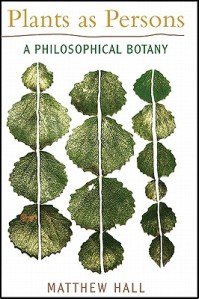
This observation by poet William Blake is one of the thought-provoking quotes included in Plants as Persons: A Philosophical Botany, an in-depth look at human-plant relationships in Western, Eastern, Pagan and Indigenous cultures by Dr. Matthew Hall, botanist and research scientist at the Center for Middle Eastern Plants at the Royal Botanic Garden Edinburgh.

Why write a book about seeing plants as persons?

This book was written to encourage humans to change their relationships with plants and to get them thinking about nature in a different way. Dr. Hall wants people to stop thinking of plants as “radical Others” inferior to humans (Hall, 2011) and to begin thinking of them as “other-than-human persons” worthy of respect and moral consideration (Hall, 2011). Plants are the foundation of all ecosystems and without them, the natural world would become a very unstable place.

Dr. Hall’s book is a survey of cultural and philosophical attitudes towards plants. In it he discusses the construction of hierarchies in nature by the Greeks, how plants and animals are viewed within Christianity, and how plants are devalued in the Western world’s hierarchical view of nature. In his discussion about Western attitudes, Hall (2011) addresses plant blindness and explains how this phenomenon falls short of explaining people’s ignorance about plants. He points out that by citing a physiological basis for plant blindness, Wandersee and Schussler (1999) imply that a “zoocentric attitude is in a sense natural and inevitable for all human beings” (Hall, 2011). He instead argues that zoocentrism is a “cultural-philosophical attitude” (Hall, 2011) and is not rooted in physiology. Hall supports his argument over and over as he introduces readers to the many ways people have relationships with plants; relationships that are very different than what is experienced in the Western world.

Hall (2011) explains human-plant relationships observed in Hinduism, Buddhism and Jainism. He discusses the relationship indigenous cultures have with plants, the relationship pagans had with plants before Christianity entered Europe, and the relationship contemporary pagans want to have with plants today. He introduces themes of personhood and kinship into the botanical literature and makes a very strong case for why humans need to be more mindful of plants and open to the idea of treating each plant as a fellow person — a person who is sensing and intelligent and worthy of moral consideration.

Intelligent? Sensing?

Yes.

Stories about plants communicating and having feelings are not only found in mythological tales and the folklore of ancient cultures. Stories about plants communicating, sensing their environment and regulating their own lives are also present in modern botanical research. Hall spends a chapter discussing research demonstrating how plants are capable of sensing changes to their surroundings and how they are capable of communicating with other plants to regulate their own growth. He discusses research studies about movement in plants, molecular signaling in plants, and theories about plant tissues capable of electrical signaling in a new field called “plant neurobiology” (Hall, 2011). He also introduces the controversial concept of plant intelligence to make the point that plants are active beings and not lumps of green waiting to be picked or eaten by humans.

Dr. Hall does a wonderful job of presenting many layers of research and insight in a very organized way. His introduction outlines the content of his book clearly and each chapter ends with a helpful summary and a smooth transition into the next topic of discussion.

There is a lot of information to think about in Plants as Persons.
All of it enlightening. Now here is a book that is hard to put down.


Plants as Persons: A Philosophical Botany
can be purchased at an independent bookstore near you.


Literature Cited

  • Hall, Matthew. 2011. Plants as Persons: A Philosophical Botany. New York: State University of New York Press.
  • Wandersee, James H. and Elisabeth E. Shussler. 1999. Preventing plant blindness. The American Biology Teacher. 61:84-86.

Related
Cover art for Plants as Persons by March Feature Artist, Mairi Gillies.

Read Full Post »

Why are botany labs organized the way they are?

When was the first botany class taught?

Is “plant blindness” a recent infliction or is there evidence of it happening long before our time?

When was field work incorporated into botany instruction? You mean field work had to be deliberately integrated into botany class and wasn’t always a logical, natural extension of the learning process?

The answers to these questions can be found in Botanical Education in the United States: Part 1, The Impact of Linneaus and the Foundations of Modern Pedagogy, the first installment of a series of articles about the history of botany education in the United States. This history lesson taught by Marshall D. Sundberg, Botany Professor at Emporia State University, is one you won’t want to miss.

Sundberg (2011) is a great storyteller and presents hundreds of years worth of information in a way that will keep you reading to find out what comes next. In his article, Sundberg (2011) introduces readers to key figures in US botanical history and sets up a timeline that is easy to follow. Here is a quick look at the fascinating people you get to learn about while reading Sundberg’s article:

  • Carl Linnaeus: Linnaeus and his Philosophia Botanica influenced botany instruction in the US.
  • Cadwallader Colden: Colden was an Irish immigrant who collected the plants of New York and corresponded with Linnaeus.
  • Jane Colden: Jane was Cadwallader’s daughter. She was well-versed in Linnaeus’ classification system (thanks to her dad). The first woman botanist in the United States, Jane’s detailed plant descriptions and botanical illustrations were highly regarded by her male peers.
  • Adam Kuhn: A student of Linnaeus, Kuhn became the first botany professor in the US.
  • Benjamin Waterhouse: The “first endowed professor of botany and entomology” (Sundberg, 2011), Waterhouse taught the first regularly-offered botany course in the US. In the natural history course he taught at Harvard, he stressed the importance of drawing in education.
  • Benjamin Smith Barton: Self-published the first botany textbook.
  • David Hosack: Hosack studied with William Curtis, brought duplicate specimens from Linnaeus’ herbarium back to the US, and built a botanical garden in New York to emphasize the value of gardens as teaching tools.
  • Amos Eaton: A New York lawyer interested in natural history and making botany practical for young students, Eaton demonstrated the positive impact laboratory work and field work has on student learning.

The impressive contributions these individuals made to botany education in the US, and how their lives intersected, are explained in Sundberg (2011). In his carefully researched article, Sundberg (2011) provides insight into the history of US botany, insight into the history of teaching and learning, and insight into the history of botanical illustration in the US. The series Marshall Sunderg has launched is difficult to summarize because of its breadth. It is so interesting, I don’t know how to describe it.

So allow me to say simply this…

Read this article!


Literature Cited

Sundberg, Marshall D. 2011. Botanical education in the United States: Part 1, The impact of Linnaeus and the foundations of modern pedagogy. Plant Science Bulletin. 57(4): 134-158. Winter 2011. Web.
<http://www.botany.org/plantsciencebulletin>. [accessed February 21, 2012]


Related History

Read Full Post »

A respected botanist and botanical artist, Sir Joseph Dalton Hooker (1817-1911) made contributions to the field of botany that continue to benefit us to this day. His life story, his contributions to botany and his illustrations are presented in Joseph Hooker: Botanical Trailblazer, a new book by science writer Pat Griggs.

Released in the US just this week, Griggs’ book is based on the exhibition about Joseph Hooker now on view at the Shirley Sherwood Gallery at the Royal Botanic Gardens, Kew.

Joseph Hooker lived to be 94 years old. During his lifetime he identified over 12,000 species of plants, had a 40-year friendship with Charles Darwin, collected plants in the western US with botanist Asa Gray, worked closely with botanical artist Walter Hood Fitch, received many awards for his work, and was a family man with 9 children.

When Joseph was born, his father Sir William Hooker, the first director of the Royal Botanic Gardens, Kew, was struggling to turn his passion for plants into a financially viable profession at a time when the study of plants was not taken seriously and the fields of astronomy, physics, chemistry, and geology were more highly regarded. According to Griggs, William Hooker used to collect fees from his students as they entered his classroom. Because teaching a “lowly” (Griggs, 2011) subject such as botany did not ensure financial stability, William supplemented his income with writing articles and books for gardeners. A young Joseph Hooker used to sit in on his father’s lectures and tag along on field trips. All he wanted to do with his life was to study plants. However, recognizing that professionals in the other sciences did not think much of botany, Joseph became a doctor and used this title (and his father’s contacts) to secure a place on an expedition to the Antarctic. Being only a rookie assistant surgeon at the time, Hooker asked to be appointed as the ship’s botanist. The expedition commander granted Hooker this “meaningless title” (Griggs, 2011) and this set in motion the first of many adventures for the young enthusiastic botanist.

Upon opening Griggs’ book, you are struck immediately with one undeniable fact, and this is the critical role drawing has played in our understanding of plants and nature. The value of visual note taking is reinforced on almost every page of this 64-page book. Griggs does a wonderful job presenting Hookers’ pencil sketches alongside his watercolor paintings and of presenting the paintings by Walter Hood Fitch. Fitch was a botanical artist and lithographer who was the illustrator for Curtis’s Botanical Magazine. The paintings and lithographs Fitch created for Hooker were based on Hooker’s field drawings. Excerpts from Joseph Hooker’s field journal and personal letters are also included in the book and they offer a brief glimpse at the extensive notes and abundant illustrations he must have created during his lifetime.

Hooker’s plant studies, with their pencil sketches and watercolor accents, are irresistible. The dissected plant parts he includes in his studies make them even more exciting and will cause you to linger over his drawings to think about how each plant is assembled. The off-color and aged grounds upon which the sketches are drawn will cause you to wonder about the stories Hooker could tell if he were alive today. Fortunately, we don’t have to wonder about this for too long because Griggs treats readers to a list of references that includes links to websites where readers can view digitized copies of Hooker’s books and field notes dating from 1849-1878.

In addition to the historical text and botanical images in Joseph Hooker: Botanical Trailblazer, Griggs provides an informative timeline of significant events in Joseph Hooker’s life, as well as information about Kew’s Economic Botany Collection that was founded by Sir William Hooker. This collection is composed of 85,000 items, many collected by Joseph during his plant collecting trips.

Joseph Hooker: Botanical Trailblazer is recommended for anyone with an interest in plants, plant exploration, or natural history art. It is written for a general audience and is a wonderful introduction to the history of botany.

Joseph Hooker: Botanical Trailblazer is available at ArtPlantae Books. ($17)


You May Also Like…

Read Full Post »

The research team of Melanie A. Link-Perez, Vanessa H. Dollo, Kirk M. Weber and Elisabeth E. Schussler continue their analysis of nationally-distributed textbooks in What’s in a Name: Differential Labelling of Plant and Animal Photographs in Two Nationally Syndicated Elementary Science Textbook Series. Last month we learned how their evaluation of the life science units in these textbooks revealed that more text was dedicated to non-human animals than to plants and that the number of animal examples used in textbooks exceeded the number of plant examples used in textbooks.

Today we look at their analysis of the photographs used in Macmillan McGraw-Hill’s Science (2005) series and Harcourt’s Science series (2006). Both textbook series were versions specific to the state of Ohio (Link-Perez, et al., 2010).

Once again, Link-Perez et al. (2010) studied only the life science section of the textbooks in each series. This time the research team wanted to know:

  • Are there different numbers of plant and animal photographs in the textbooks?
  • Are plant and animal photographs labelled differently?

To answer their first question, Link-Perez et al. (2010) considered photographs where plants and animals were shown at the organism level. They excluded from their analysis, photographs of plants and animals shown at the cellular level. They also excluded diagrams and drawings because these depicted concepts or processes and not only images of whole organisms. Photographs were grouped into the following categories: Plant Subject, Animal Subject, Landscape as Subject, and Dual Subject. In the dual subject photos, the featured plant and animal were represented equally (e.g., a photo showing a bee and a flower) (Link-Perez, et al., 2010).

To answer their second question, Link-Perez et al. (2010) looked to see if a label was associated with an image. Labels were categorized according to how it described the subject of the photograph. For example, a label’s “level of specificity” (Link-Perez et al. (2010) was considered to be broad if it contained general terms like plant or animal. Intermediate labels were those containing terms “corresponding to a phylum, class or order” such as gymnosperm or mammal (Link-Perez et al. (2010). Specific labels were those containing an organism’s common or species name. The research team considered photos to be labelled if they had a caption (not just referred to in the text). Two coders were trained to code the images. The coders worked independently of each other.

Link-Perez et al. (2010) found that of the 1,288 images they evaluated, 59.6% were of an animal subject, 25.6% were of a plant subject, 7.1% were of a landscape scene, and 7.6% were of a dual subject. They also discovered that animals shown in animal subject photos had more specific labels than plants shown in plant subject photos. The research team also discovered that plants were often identified by the name of a plant part or a plant life-form (i.e., “tree”, “flower”, etc.) instead of a more detailed description. In fact, intermediate-level labels were not used with plant photographs in textbooks for grades K-2; these labels only appeared in 3rd, 4th and 5th grade textbooks (Link-Perez et al., 2010). In contrast, intermediate-level labels were observed with animal photographs in textbooks for all grade levels (Link-Perez et al., 2010).

Of the 92 landscape images identified, most had labels that did not name the organisms in the image, but instead described a habitat or biome (Link-Perez et al., 2010). Ninety-eight dual subject images were identified and even though the featured plant and animal were weighted equally, 75% of the images had labels where the animal was identified more specifically than the plant (Link-Perez et al., 2010). Only 6% of the dual subject images featured captions in which the plant in the image received a more specific description than the animal in the image (Link-Perez et al., 2010).

Link-Perez et al. (2010) also observed that a more diverse selection of animal images were featured in both textbook series.

Because animal photographs outnumber plant photographs and because they have more specific labels than the plant photographs do, Link-Perez et al. (2010) recommend educators speak about plants using their specific names and by referring to them as whole organisms instead of as merely plant parts. They cite research studies demonstrating that student interest in plants can be encouraged if students are exposed to a diverse selection and if students are provided with the actual names of plants.

Link-Perez et al. (2010) include in their paper interesting discussion about how photographs improve student learning and information about the importance of naming plants properly. You can buy a copy of their article from Taylor & Francis Online ($36) or get a copy by visiting the reference section at your local college library.


Literature Cited

Link-Perez, Melanie A., Vanessa H. Dollo, Kirk M. Weber, and ElisabethE. Schussler. 2010. What’s in a name: differential labeling of plant and animal photographs in two nationally syndicated elementary science textbook series. International Journal of Science Education. 32(9): 1227-1242.

Read Full Post »

Interested in making scientific illustration a part of your classroom’s culture?

Then you will be interested in reading about the pilot program created by illustrators, Patricia Ferrer and Joseph E. Trumpey. Ferrer & Trumpey (1999) created a pilot project through which they taught observational drawing to third grade and fifth grade students. They discuss their program in Assessing the Effectiveness of Scientific Illustration as a Learning Tool in the Elementary School Classroom.

Through a learning sequence they developed, Ferrer and Trumpey (1999) taught students how to observe subjects, how to take visual notes, how to discuss their observations with their peers, how to apply new knowledge to new drawings, and how to continuously assess their understanding of a subject. Ferrer and Trumpey (1999) measured learning gains using an assessment tool that was administered three times during the sequence and once after the sequence was completed. The fourth assessment was administered to determine how much information students retained one week later.

The Ferrer & Trumpey Learning Sequence was integrated into a biology unit about grasshoppers and into a unit about the classifying characteristics of eight phyla of invertebrates. The grasshopper lesson prepared by Ferrer & Trumpey (1999) was administered to 24 third grade students. The grasshopper unit was designed to teach students:

  • Grasshoppers are insects.
  • Grasshoppers do not have a backbone.
  • The physical characteristics of grasshoppers.
  • How to make accurate observations and how to draw what is observed.

The lesson about invertebrate phyla was designed to teach both third grade students (n=46) and fifth grade students (n=54):

  • Invertebrates are classified according to a variety of characteristics.
  • All invertebrates lack a backbone.
  • How to make observations and to draw what has been observed.
  • How to engage in inquiry activities leading to higher-level thinking.

In both lessons, students followed the methodical and thoughtful steps of the Ferrer & Trumpey Learning Sequence. These steps included:

  • A pre-assessment quiz to establish students’ prior knowledge of a subject. The quiz included a variety of questions (fill-in-the-blank, multiple choice and questions calling for matching, observational drawing and written observation).
  • Unguided observation. Students were allowed to make their own observations without any instruction from the teacher. Students then shared observations with each other in groups.
  • A second assessment quiz. This second assessment was administered to determine what students “can learn on their own when given the opportunity” (Ferrer & Trumpey, 1999).
  • Guided observation. Classroom teacher provides formal instruction about a subject and corrects any student misconceptions about a subject. Students create new observational drawings applying their new knowledge.
  • A third assessment quiz. The key question here is, How do structured lessons aid the learning process?
  • A fourth assessment quiz. This assessment is conducted one week later to determine how much information students retain about a subject.

Ferrer & Trumpey (1999) assigned the objective questions of the assessment quiz a value of 2 points each. They created a rubric for the questions requiring students to make visual and written observations. Data collected indicate assessment scores improved between Assessment 1, Assessment 2 and Assessment 3. Students improved an average of 4.1 points between Assessment 1 and Assessment 2 and demonstrated an increase in knowledge between the unguided and guided assessments (Ferrer & Trumpey, 1999). While scores for Assessment 4 dropped an average of 0.9 points, data indicate an average overall point gain of 8.4 points between Assessments 1 and 4 (Ferrer & Trumpey, 1999).

Ferrer & Trumpey (1999) also observed that students spent more time doing science when drawing was involved, that student drawing ability increased over time and that students paid more attention to detail as the lessons progressed. Because of the results observed through their pilot program, Ferrer and Trumpey (1999) feel that scientific illustration-based activities are effective tools that can be used to teach science in the classroom.

The paper by Patricia Ferrer and Joseph E. Trumpey was published in the third volume of the Journal of Natural Science Illustration, an excellent publication published by the Guild of Natural Science Illustrators (GNSI). While back issues of Volume 3 are no longer available for purchase at the GNSI Store, other issues of the Journal are available, as well as GNSI Technique Sheets II, a publication highlighting the techniques used by scientific illustrators.


About Patricia Ferrier

Patricia received her M.F.A. in medical and biological illustration from the University of Michigan, Ann Arbor. She is the founder of ScientificIllustration.org and the owner of FerrerBeals Biomedical Illustration + Design. Follow Patricia on Twitter at @ScientificArt.


About Joseph E. Trumpey

Joseph is an associate professor at the School of Art & Design at the University of Michigan, Ann Arbor. He also serves as the Director of International Engagement at the school. Joseph received a M.F.A. in medical and biological illustration from the University of Michigan and prior to joining the faculty at the university, was the chief medical illustrator and director of graphic arts for the College of Veterinary Medicine at North Caroline State University. Joseph is the founder and director of Michigan Science Art, one of the largest groups of science illustrators working together in North America.


Literature Cited

Ferrer, Patricia and Joseph E. Trumpey. 1999. Assessing the effectiveness of scientific illustration as a learning tool in the elementary school classroom.
Journal of Natural Science Illustration. 3(1): 33-42.

Read Full Post »

Cultural anthropologist, Emanuela Appetiti, and historian of science, Alain Touwaide, believe that cultures would not have invested time and energy into medical formulas if they were not effective. To preserve traditional therapeutic remedies before they are lost forever, Emanuela and Alain founded the Institute for the Preservation of Medical Traditions. The Institute is a research and education organization with non-profit 501(c)(3) status hosted by the Smithsonian. Through the Institute, Emanuela and Alain pursue their research activities, including research for the PLANT program.

The acronym PLANT stands for PLantarum Aetatis Novae Tabulae (meaning in Latin Renaissance botanical illustrations). The PLANT website is a historical encyclopedia of botanical illustrations found in Renaissance herbals and is a collaborative effort between the Smithsonian Libraries Digital Collections department, the Biblioteca Nazionale Centrale di Roma (National Library of Rome) and the Library of the Botanic Gardens of Padua. While still under development, the website contains a lot of interesting information and images. Visitors are able to view images from ancient herbals. Visitors can enlarge an image so they can view each illustration up close, closer than if each herbal were in front of them. When you visit the PLANT website, be prepared to be there for a while.

Today we have the unique opportunity to learn from Emanuela and Alain. Please join me in welcoming them.


    ARTPLANTAE
    : The PLANT project currently features 149 herbals created between 1470-1745. Funding was awarded in 2002 and research for this project began in 2003 in Rome, Padua, and Washington, DC. This comprehensive project has already been a 10-year effort. How much work remains?

    EMANUELA APPETITI and ALAIN TOUWAIDE:
    During 2003-2006 we browsed, analyzed and photographed all these books with the help of about 250 Earthwatch volunteers who came with us to work in the National Library in Rome, and later on in the Library of the Botanic Gardens of Padua. As a result, we have collected more than 70,000 images and generated three dictionaries of plant names, one for ancient names (Greek and Latin), another for Medieval and Renaissance names (including 32,000 items in Arabic, Medieval Latin and vernacular languages), and a third with the names of plants in five modern languages (12,000+ items). We are now in the process of double-checking all this information. We are writing original bios and essays about the authors and their books, based on the direct contact we have had with these works. We have completed our collection of portraits in collaboration with the National Library of Medicine and the Hunt Institute for Botanical Documentation, both of which own extensive collections of historical portraits. A few biographies have already been uploaded, such as those of Prospero Alpini and John Gerard.

    Once all the databases and the images are uploaded and connected, it will be possible to retrieve all the illustrations of the same plant in chronological order, so as to visually follow the transformation of the botanical drawing and knowledge. Each image will come up with its names from all the dictionaries listed above. This means that users interested in a plant of which they know only the vernacular or the common name, for instance, will be able to retrieve it and get all its names, including the scientific, binomial name. For the user to contextualize the books, the Latin names of cities where these books where printed are translated into their current name. Also, a short bio-sketch of publishers is provided together with the list of the botanical books they have published in order to see their contribution to the production of herbals. The cities should already be clickable on the website. We are currently working on the bios of the publishers, research that requires hours of investigation into the field of Renaissance publishing.


    AP
    : Many of the illustrations in the herbals are highly stylized renderings containing elements that look as if they were meant to serve as symbols of something else (e.g., Arbor vel lignum vite paradisi, folio 20 verso in the anonymous Ortus sanitatis (1491) published by Jacobus Meydenbach). How do you determine the accuracy of an illustration?

    When you know what a plant looks like, you have a sense of the elements that may have been a bit exaggerated (e.g., Ananas, page 268 in Trattato della historia, natura, et virtu delle Droghe Medicinali, & altri Semplici rarissimi, che vengono portati dalle Indie Orientali in Europa (1585) by Cristobal Acosta). But when you are not familiar with a plant, how do you check on the accuracy of an illustration, and more importantly, the accuracy of the species name?

    AT: These are two different cases, both very interesting and hinting at fascinating aspects of our work.

    One, the arbor paradisi (which is also the tree of knowledge), opens to the anthropological dimension of the research. Part of the text related to this tree (tree or wood of paradise life) reads as follows:

    “They naturally have such a property that he who eats its fruit, is invigorated by a perpetual strength [….] and will not be affected by any illness, anxiety, sign of tiredness, or weakness […]”.

    As you can understand from this extract of the text, this is an imaginary plant that serves educational and moral purposes. Theoretically, it should not appear in a book of herbs, but its presence clearly indicates that the benefits to be obtained from a plant were both physical and spiritual. And the Ortus Sanitatis is indeed about body and soul. Incidentally, you will note that the initial letter of the word arbor (tree) is missing. However a space has been left for it to be added, probably by hand, as a painted initial.

    The second case you mention, the ananas (pineapple), makes clear the function of this kind of illustration: it emphasizes the most characteristic features of the plants for identification purposes. So, when you did not know the plant, you memorized this peculiar morphology so as to recognize it in the field, being able to connect the plant with such characteristics and its name.

    Concerning the botanical identification, we use all possible available information to propose the best possible identification. This includes the text related to the illustration, the botanical tradition (coming from the most remote antiquity and continuously handed down up to the Renaissance), and the modern (= post-Linnean) scholarly and scientific literature, along with dry specimens from herbaria. Of course, we do this work in collaboration with botanists; sometimes, one ancient plant name corresponds to more than one modern taxon, and therefore we cannot arrive at the species level.


    AP
    : There are times when I wish I could read every language on the planet on demand. Exploring the herbals on the PLANT website made me wish for this ability yet again so I could learn more about the illustrations. In the herbals you have studied, is there any mention about how the illustrations were created?

    AT: In the preface of the herbals, several authors discuss this point. For example, Otto Brumfels, Leonhard Fuchs and Matthioli. Publishers were pushing authors to include illustrations with their texts. A significant case is the publisher and printer, Christian Egenolph, in Frankfurt, Germany. He created a set of woodblocks that he used for several texts, which were not originally illustrated. In so doing, he expanded considerably the market for his production. Though initially reluctant, the authors followed his example and agreed to have their works illustrated. Matthioli perfectly understood this logic and, besides repeatedly publishing new editions of his work, moved from small to large illustrations, each time also adding new items.


    AP
    : Do you know of any studies focused specifically on the marks used to depict form (or light and shade) in the herbals? Some of the marks seem a bit excessive and confusing (e.g. Rhamnus secundus, page 73 in Pedacio Dioscorides Anazarbeo, Acerca de la materia medicinal, y de los venenos mortiferos, Traduzido de lengua Griega, en la vulgar Castellana, & illustrado con claras y substantiales Annotationes, y con las figuras de innumeras plantas exquisitas y raras, por el Doctor Andres de Laguna (1570).

    EA: There is quite a body of literature on the history of botanical illustration in early printed books. However, studies have mainly focused on botanical accuracy, sources of illustration, floristic extensiveness and, more recently, on printing techniques. Rarely, analysis has addressed such an aspect at the crossroads of the visual arts and botanical knowledge.


    AP
    : The hand-colored illustrations I saw in the Kreuterbuch herbal by Adamus Lonicerus (1582) were colored loosely. It looks like the coloring was done very quickly. Is this approach to hand-coloring commonly observed in herbals?

    EA: There are indeed several herbals in collections worldwide that are hand-colored. Each and every such book is an individual case. Some have been very roughly and rapidly made like the Kreuterbuch, whereas others were artistically painted with botanical exactness, as in Fuchs. It depended on the personal choice of the owner of the book. Some probably wanted to have a nice copy, while others needed it to study and work with in the field.


    AP
    : I have a question about Alain’s Life & Literature slideshow that you shared with me. On the slide that shows what I assume to be Arabic characters, certain words/phrases were circled in red. Why were these words/phrases highlighted? What was the story behind this particular slide? I’m curious, that’s all.

    AT: Good catch! You are totally right in asking, and you’ll be amazed to know this story (which is one of our most cutting-edge programs). This is indeed the reproduction of a page from a Chinese manuscript containing formulae for medicines. This page should be vertical to read Chinese in the proper way (in columns), but I turned it horizontally to read what are, in fact, Arabic terms (names of medicines)! This story is long, but let’s make it short. Greek pharmaceutical texts were translated into Arabic and, the Arabic versions were transmitted up to China through India. So, we can state that Greek science traveled up to China.

    The most marvelous thing is that the terms in Arabic are actually Greek words written with the Arabic alphabet (what is called transliteration). And, these Arabic terms have been reproduced as such in the Chinese manuscript. This means that we have in China the Greek names of medicines, even though they are written in Arabic.

As mentioned above, Emanuela and Alain’s research includes the preservation of information about plants and their use in medicine. Their current focus is on Greek medical heritage and contributions to medicine made by the Arabo-Islamic World. The website of the Institute for the Preservation of Medical Traditions (IPMT) features a growing collection of books, images, digital texts and databases related to plants and medicine. The Institute’s website is very interesting and contains many layers of information. You are sure to spend hours on this website too.

Emanuela and Alain have studied medical traditions for decades and have worked in Spain, France and England. Emanuela says that they work in at least four languages everyday!

What is the relationship between the PLANT project and the Institute for the Preservation of Medical Traditions?

After moving to the US in 1999, Emanuela and Alain worked for a few years as independent scholars affiliated with the Smithosonian. Alain received a grant from the National Institutes of Health (NIH) to conduct research on the therapeutic uses of plants in Classical Antiquity. Alain conducted his research at the Smithsonian. The PLANT program arose as an extension of this NIH project and received early support from the EarthWatch Institute.

The PLANT project is a consortium composed of Alain & Emanuela (project authors and co-principal investigators), both libraries in Italy and the Smithsonian Institution Libraries (SIL). The SIL and the Italian libraries helped to collect the primary information for this project, and each library owns the rights of the images coming from its herbals and then published on the website. SIL Digital Collections is the e-publisher of this work.

The Institute for the Preservation of Medical Traditions (IPMT) is a natural extension of Emanuela and Alain’s research that, over time, grew into a new field of its own. This area of research needed its own space, so Emanuela and Alain created IPMT. The Institute is a self-funded entity that is now affiliated with, and currently housed at, the Smithsonian.

Alain and Emanuela work with about ten students and volunteers who help develop the Institute’s programs. The Institute has established an extended network of institutions and scholars with whom Alain and Emanuela work. A short list of their partners can be viewed on the IPMT website. It is IPMT’s mission to disseminate the concepts and methods they have developed to recover, preserve and analyze ancient knowledge. Emanuela says they want to educate the next generation of educators who will “expand the scope of our activity and broaden the audience we reach.”

The Institute hosts seminars at the Master’s and Doctoral level and conducts classes worldwide to interested audiences. The Institute’s educational activities address all disciplines related to its research, from ancient books to scientific technology. Emanuela describes the Institute’s mission succinctly, “We trace and follow the development and transmission of knowledge in the field of the natural and life sciences based on the written record, with a special focus on the Mediterranean area.”

Botanical artists painting medicinal plants and interpreters researching a heritage site will find the Science Services offered by IPMT especially interesting. Emanuela explains how the Institute can assist artists and interpreters with their research:

Our work is not only about collecting, but also, if not mainly, interpreting. We have created tools for a correct understanding of ancient botanical history and illustration, and also heritage sites. For example, in approaching ancient illustration of plants in books, we read the illustrations together with the related text. In so doing, we inject botany into history, and we are in a better position to properly understand the ancient documentation. Similarly, to approach a site, for example, we connect it to its contemporary botanical knowledge and create bridges between such knowledge, on the one hand, and, on the other, architecture and landscape. Alain has studied the representation of a garden in a 1st-century Roman palace and demonstrated that it reproduces the organization of a garden in nature, which, in turn, was based on the classification of plants in ancient botanical knowledge. There thus is a strong link between artistic creation and scientific theory.

When asked how they would like scholars, physicians and the public to use the IPMT website and its resources, Emanuela replies:

As a research entity, the IPMT is both a laboratory and a library collection. Alain and I have been collecting books on all the topics covered by our research for years and years and currently own a specialized library of circa 15,000+ items. This is a research collection for consultation. It is currently housed at the Smithsonian and is open to the scholarly and scientific community. We regularly receive requests for information, and for permission to visit the collection and take advantage of its resources from students and colleagues. In the future, we hope to be able to offer grants for students to stay in-house for a certain period of time, to carry on their own research.

As for our research, our vision is to generate new data from tradition and to inspire further innovative investigation. Ancient information is indeed a source for new developments that will contribute to (the improvement of) people’s health and healthy lives. In this view, we wish to partner with entities that will capitalize on our work and translate it into new applications, in the fields of medicines, food, hygiene and cosmetics.

A not-for-profit organization, the Institute for the Preservation of Medical Traditions relies on donations to conduct its research. Interested individuals can contribute to the Institute by becoming an Associate Member ($20/yr.) or by making contributions through NetworkforGood.org, JustGive.org, or Razoo.com.

The PLANT website will be the focus of a roundtable discussion during a meeting of the Renaissance Society of America in Washington, DC (March 22-24, 2012). On March 24, Alain will co-present The Digital Herbal: Roundtable on Renaissance Botanical Illustration on the Internet.


A Special Viewing

Emanuela and Alain’s research started, and still focuses, on handwritten manuals of therapeutics, conserved in libraries or private collections all over the world. Unlike printed books produced on a larger scale, each handwritten manuscript is unique. As an example of their analysis and study of manuscripts, Emanuela and Alain have provided a link to view the Padua manuscript. This section is still a work in progress, with several parts still to be presented. This is the first time this manuscript has been uploaded and Emanuela and Alain hope you enjoy the sneak preview!


Related

Read Full Post »

« Newer Posts - Older Posts »