Feeds:
Posts
Comments

Archive for the ‘Teaching & Learning’ Category

I asked this month’s featured guest, Liz Leech, to identify the aspect of plant biology she finds to be most unfamiliar to the public. She replied…

The most unfamiliar aspect of plant biology, and the greatest barrier, seems to me to be the ability to distinguish plant characteristics and therefore to differentiate between plants within generally recognizable broad groupings such as trees, grass, ferns, moss, flowers, seaweed etc. Most people can put typical examples into these rather loose “groupings” of plants but are lost as soon as they have to be more specific and have to look more closely at less obvious examples. For instance, I have found that most high school students, when faced with assessing how many different species there are in a patch of lawn, only recognized the existence of lawn daisies if the flowers were still left on! After mowing they gave 100% grass! Smaller plants and different grasses were certainly not “seen”.

Join this conversation already in progress…

Read Full Post »

Georgius Everhardus Rumphius (1627-1702), soldier and naturalist, has many “firsts” to his name. His “firsts” are outlined in the introduction to The Ambonese Herbal. They include being the first to write about epiphytes, the first to describe how orchids reproduce from seed, and the first to write detailed descriptions of coral (Beekman, 2011). And, of course, he was the first to describe the plants of eastern Indonesia.

Rumphius’ Ambonese Herbal is a significant botanical work for more than the fact it contains the medicinal uses of 1,300 plants. His herbal is an important piece of botanical literature because it is a documented history of eastern Indonesia, its dialects, its culture, and its beliefs (Beekman, 2011). It is a snapshot of what life was like in a part of the world not easily accessible by the average person.

What also makes The Ambonese Herbal an impressive resource is the fact it was published in spite of several unfortunate events. Events such as Rumphius losing his eyesight. Up until he lost his eyesight to glaucoma in 1670, Rumphius was writing the herbal in Latin. After he lost his sight, he had to start over. He started over not because there was anything wrong with his work. He had to start over so he could continue his work. This meant dictating the herbal’s contents in the only language his assistants understood — Dutch. Switching to Dutch also meant his herbal could be read by a larger European audience (Beekman, 2011).

A draft of the herbal’s 12 books was completed by 1687 (Beekman, 2011). This draft included half of the herbal’s illustrations which Rumphius drew himself. An accomplishment to say the least!

Continued forward movement would not come easily for Rumphius, however. In 1674, his wife and daughter were killed in a major earthquake that struck the island of Ambon. A neighborhood fire in 1687 destroyed all of his original illustrations (his manuscript was saved). In 1692, the first six books of the herbal, including the redrawn illustrations, were lost at sea. Fortunately, the then governor-general of Batavia was a naturalist and one of Rumphius’ biggest supporters. Before the original manuscript was shipped to Amsterdam, he had Rumphius’ manuscript copied. Now that the governor-general’s copy was the only one in existence, he ordered that a second copy be made, as well as two sets of illustrations (Beekman, 2011).

Adding to Rumphius’ misfortunes was the theft of completed drawings stolen from his office in 1695 (Beekman, 2011).

In spite of these setbacks, the completed herbal and the appendix were safely in the hands of the Dutch East Indies Company by 1701. There was only one problem, though. The Dutch East Indies Company did not want to publish the herbal because they felt it contained proprietary information; they were especially concerned about Rumphius’ notes about cloves and nutmeg (Beekman, 2011). The Company eventually changed its mind about publishing the herbal, but with the condition that they be allowed to review passages that “could be judged detrimental to the Company” (Beekman, 2011). This change-of-heart came too late for Rumphius, however. He died three months earlier.

You would think the Dutch East Indies Company’s change-of-heart would clear the way for the herbal to be published for public consumption as Rumphius had planned. But this did not happen. It would be another 34 years before the Dutch East Indies Company would release the manuscript. The manuscript was eventually received by Johannes Burman, a Dutch botanist and expert in tropical biology. The year was 1736. A mere seventy-nine years after Rumphius began the field work for his herbal upon transferring to the civil service branch of the Dutch East Indies Company.

The herbal was printed twice before the current English translation. The first edition was printed in 1741 (view it here) and the second edition was printed in 1750.

For convenience sake, Rumphius’ original twelve books are grouped into six volumes in the English translation. These volumes are arranged as follows:

  • Volume 1 (Book 1): Trees Bearing Fruit That Are Husbanded by People
  • Volume 2 (Books 2-4): Aromatic Trees; Trees Producing Resin, Notable Flowers or Hurtful Milk; Trees That Provide Timber
  • Volume 3 (Books 4-7): Wild Trees in No Particular Order; Shrubs – Domesticated & Wild; Forest Ropes & Creeping Shrubs
  • Volume 4 (Books 8-9): Potherbs Used for Food, Medicine and Sport; Bindweeds, Twining Plants and Creeping Plants
  • Volume 5 (Books 10-12): Random Wild Plants; Remaining Wild Plants; Sea Trees and Stony Sea Growths Which Resemble Plants
  • Volume 6: Index of Common and Scientific Names

The Ambonese Herbal is an amazing reference. Get two sentences into any page and Rumphius’ life opens up before your eyes.

Beekman’s English translation of the herbal matches the original Dutch version as closely as possible. He does not use modern-day terminology to replace or change descriptions written in Rumphius’ 17th-century Dutch. On occasion he explains why he chose to use some of the English words that he uses. Sometimes his choice of words are based on the fact that the modern word we would use and recognize today did not exist during Rumphius’ time. A thorough explanation about the translation of The Ambonese Herbal is included in Beekman’s introduction.

In this new edition, Beekman speaks to readers through incredibly detailed annotations located in the margins of the text. Their placement in the margin (both on the sides and on the bottom of the page) are a huge help to readers. There are many footnotes in the English edition and flipping back and forth to the back of the book would have been troublesome.

Reading the herbal is truly an engaging experience and for this we need to thank E.M. Beekman. Unfortunately Dr. Beekman, like Rumphius, did not see his masterpiece as a finished product. Dr. Beekman passed away in 2008.

Dr. Beekman spent many years of his life bringing Rumphius and his achievements to a larger audience. He wanted to bring attention to the plant world, especially the plants in The Ambonese Herbal that have gone extinct or are about to go extinct (Beekman, 2011). In a world where the current focus on the molecular study of plants separates plants from their native habitat, Dr. Beekman felt it important to emphasize the value of the descriptive texts written by early naturalists. He says texts written by Rumphius and others make “readers see, sense, and taste the reality they were trying to communicate” (Beekman, 2011).

As he brings his introduction to The Ambonese Herbal to a close, Dr. Beekman leaves readers with the following quote by 19th-century physician, William Osler:

We miss more by not seeing, than by not knowing.

What do you think?


Literature Cited

    Rumphius, Georgius Everhardus. 1999. The Ambonese Curiosity Cabinet. Translated, annotated, and with an introduction by E.M. Beekman. New Haven, CT: Yale University Press.

    Rumphius, Georgius Everhardus. 2011. The Ambonese Herbal. Translated, annotated, and with an introduction by E.M. Beekman. New Haven, CT: Yale University Press.

These books and Rumphius’ Orchids, also translated by E.M. Beekman, are available at ArtPlantae Books by special order.


Related Topic

Botany Superstars Become Rare Specimens

Read Full Post »
When Rumphius arrived in Ambon in 1654, he walked into a world very different from his home in Hesse, Germany.

It is safe to say many things piqued his curiosity. Today we take a look at Rumphius, the naturalist.

Before we get too far ahead in this story, we need to remember that Rumphius did not travel to Indonesia to write about its natural history. He went to the East Indies in 1652 on a five-year contract to work as a soldier for the Dutch East Indies Company to protect their interests in the spice trade. He had his hands full and could not dedicate himself to documenting the many interesting things he observed.

It is estimated that Rumphius began to collect botanical and zoological specimens in 1657 (Beekman, 2011). No longer a soldier and now working in the civil service branch of the Dutch East Indies Company, Rumphius worked on personal projects in his spare time (Beekman, 2011). His focused work on the herbal is thought to have begun three years later in 1660 (Beekman, 2011).

The curious naturalist that he was, Rumphius observed and described insects, mammals, birds, marine life, and plants. At one time he was in possession of a large cabinet of curiosities containing specimens collected over many years. Unfortunately, he had to sell his collection to the Grand Duke of Tuscany in 1682 (Beekman, 2011). He did not sell his collection to make money, but to make his employer look good. The Dutch East Indies Company used Rumphius’ collection to cater to the Grand Duke whom the Company saw as a potential business opportunity.

Rumphius lived the latter years of his life as a “naturalist for the people.” In an open letter he writes to readers in the preface of The Ambonese Herbal, Rumphius refers to himself as a “lover of natural science” who offers his talents “to the common good” (Beekman, 2011). Rumphius was determined to introduce Europe to the plants and animals of the East Indies. He tells readers that if his work brings them pleasure, then it would be worth all the trouble and expense he endured to bring it to them.

Rumphius is considered to be one of the greatest naturalists of the 17th century. This is because of his observation skills, his first-hand accounts and his detailed written descriptions about what he saw while living in the “Water Indies” (Beekman, 2011). It is also because his significant works were created by one man.

During his lifetime, Rumphius wrote a small collection of scholarly articles. He also wrote a book about the history and politics of Ambon and his observations from the field (the Dutch East Indies Company did not make this book public). Rumphius’ most significant works were The Ambonese Curiosity Cabinet (D’Amboinsche Rariteitkamer) and The Ambonese Herbal (Het Amboinsche Kruidboek).

The Ambonese Curiosity Cabinet describes the marine life of the East​ Indies. It contains​ Rumphius’ descriptions of arthropods, shells and much more. A general description of its contents is included in the book’s very long original title. Here is the English translation taken from Beekman (1999):

The Ambonese Curiosity Cabinet, Containing a Description of all sorts of both soft as well as hard Shellfish, to wit rare Crabs, Crayfish, and suchlike Sea Creatures, as well as all sorts of Cockles and Shells, which one will find in the Ambonese Sea: Together with some Minerals, Stones, and kinds of Soil, that are found on the Ambonese and on some of the adjacent Islands. Divided into three Books, And supplied with the requisite Prints, drawn from life. Described by GEORGIUS EVERHARDUS RUMPHIUS, from Hanau, Merchant and Counselor on Amboina, also member of the Academiae Curiosorum Naturae, founded in the Holy Roman Empire, under the name PLINIUS INDICUS.”

This collection of three books was first published in 1705 (three years after Rumphius’ death) and includes the only known portrait of Rumphius drawn from life. It was drawn by his son sometime between October 1695 – July 1696 (Beekman, 1999). Translated, edited and annotated by Dutch scholar, E.M. Beekman (1939-2008), the English translation includes the original sixty plates paired with the modern scientific names of the species illustrated on each plate. Beekman (2003) describes this book as Rumphius’ most popular work because of the shell illustrations it contains. As for Rumphius’ greatest achievement? Beekman (2003) says it is The Ambonese Herbal.

Contained in the original twelve books of the herbal are descriptions of the trees, shrubs, herbs, wild plants and sea trees (coral) of eastern Indonesia.

We’ll take a closer look at the herbal next week.


Adopt a first-edition copy of The Ambonese Curiosity Cabinet

Vassar College has a first-edition copy of The Ambonese Curiosity Cabinet in their collection. This book is featured in Vassar’s Adopt-a-Book program. Through this program, the conservators in Vassar’s Archives and Special Collections Department seek donor support for the conservation of fragile and damaged items. To see images from this historic work and to learn more about the conservation effort surrounding Rumphius’ book, see the webpage for The Ambonese Curiosity Cabinet on the Adopt-a-Book website.

Wondering if there are botanical works in this program? Yes, there are. See here.

NOTE:
I contacted the Special Collections department and asked about the donation amount. I learned that they are seeking a donation that covers the entire conservation amount. So if you were thinking of making a smaller donation (like I was), this is not possible because they are not set up to receive small amounts that do not add up to the amount required for conservation.


Literature Cited

    Rumphius, Georgius Everhardus. 1999. The Ambonese Curiosity Cabinet. Translated, annotated, and with an introduction by E.M. Beekman. New Haven, CT: Yale University Press.

    Rumphius, Georgius Everhardus. 2003. Rumphius’ Orchids. Translated, annotated, and with an introduction by E.M. Beekman. New Haven, CT: Yale University Press.

    Rumphius, Georgius Everhardus. 2011. The Ambonese Herbal. Translated, annotated, and with an introduction by E.M. Beekman. New Haven, CT: Yale University Press.

All six volumes of The Ambonese Herbal are available at ArtPlantae Books.
Find out how you can view all six volumes this month.


Continue Rumphius’ story with…

Inside “The Ambonese Herbal”

Read Full Post »

Georgius Everhardus Rumphius was born in 1627 in Hesse, Germany during the Thirty Years’ War (1618-1648), a conflict between the Holy Roman Empire and the Protestants. He was born at a time when formally recognized countries did not exist. There were only regions, towns and villages and one’s loyalty was to a specific village or region. If an individual strayed too far outside of their area, they were considered to be a foreigner. Plague and war almost destroyed the region of Wolfersheim, where Rumphius was born. The plague hit this region in 1628 and again in 1635. As Rumphis scholar E.M. Beekman explains, the hardships experienced by this region “reduced a population of about 5,000 down to thirty-eight adults, ten girls and six schoolboys” by 1648 (Beekman, 2011).

In 1652 Rumphus left Germany for the second, and last, time in his life. The first time, a young Rumphius was tricked into going to Brazil to fight for the Dutch (he thought he was going to Venice). This second time, though, he left on a five-year contract to work as a soldier for the Dutch East Indies Company to protect their interests in the “Spice Islands”, specifically their control over the trade of cloves, nutmeg, mace and cinnamon, “the four most lucrative spices in the world” (Beekman, 2011). During the six-month journey to the East Indies, Rumphius spent ten days at the Cape of Good Hope while his ship was being restocked after having spent 3.5 months out at sea. Rumphius’ writings suggest he began to take notice of plants during this brief visit to the Cape. Once his ship was filled with fresh food and supplies, Rumphius returned to sea. Three months later, he arrived in Batavia (now Jakarta) on the island of Java. The city of Batavia served as the headquarters of the Dutch East Indies Company. Rumphius arrived in July 1653. By early 1654, he was living on the island of Ambon, an island on which he would spend the rest of his life.

While he may have left Germany to escape war and poverty, Rumphius’ new home was also a place where much fighting occurred. From 1654-1657, Rumphius fought as a soldier in the Great Ambonese War, a war between militants and local government impacting the clove trade (Beekman, 2011). Rumphius’ military contract with the Dutch East Indies Company ended in 1657. At this time, he transferred into the company’s civil service branch.


The Naturalist

Rumphius’ life as a naturalist began when he transitioned into the civil service branch of the Dutch East Indies Company. Records show he began writing about the flora and fauna of Ambon in 1657. It appears Rumphius’ interest was rooted in simply wanting to learn more about the world around him. There appears to have been no grand plan at this time. Rumphius was merely observing, writing and illustrating. Beekman (2011) states Rumphius wrote about the specimens collected by those who worked for him, as well as the specimens brought to him by the local people. It is speculated that Rumphius paid the locals for the specimens they collected. Rumphius, who became fluent in Malay, was respected by the local people and he got along with them very well.

The tropical setting in which Rumphius would spend the rest of his life was filled with wonderful curiosities.

Next week we will learn more about Rumphius, the naturalist.


George Everhardus Rumphius is the Feature Botanist for April. The accounts of Rumphius’ life featured in this column this month are from the books by E. M. Beekman. A scholar of Dutch colonial history, Beekman dedicated many years of his life bringing Rumphius’ story to a general audience. Beekman’s thorough documentation of Rumphius’ life and his contribution to botany are being reviewed in this column specifically because Rumphius, one of the greatest naturalists of the 17th century, continues to teach through his herbal to this day.


Literature Cited

Rumphius, Georgius Everhardus. 2011. The Ambonese Herbal. Translated, annotated, and with an introduction by E.M. Beekman. New Haven, CT: Yale University Press.

All six volumes of The Ambonese Herbal are available at ArtPlantae Books.
Find out how you can view all six volumes this month.


Continue Rumphius’ story with…

Rumphius: A Naturalist for the People

Read Full Post »

You don’t have to be a professional artist to enjoy drawing plants, any more than you have to be a professional writer to compose an e-mail or write a letter.

— Gail Selfridge

Scientific illustrator, Gail Selfridge, shares how she was inspired to start collecting and documenting Stapelia after reading a book about these interesting South African succulents. While she had prepared countless illustrations for books, journals, and museums as a professional illustrator, she had never prepared extensive illustrations for herself. Drawing her personal collection of Stapelia was a rewarding experience taking more than two years to complete.

In her article, Selfridge (2008) explains how she created her colored pencil illustrations and shares images of work-in-progress. Using little more than graphite pencils, colored pencils, a portable sketchbook, paper from a desktop printer, and discarded cardboard boxes from the grocery store, Selfridge (2008) built a collection of work about her favorite plant. With these mundane materials, she created a studio-worthy collection of portable drawing supplies, inexpensive sketching paper, and a homemade flat file. The “formal” art supplies in her studio included Prismacolor colored pencils, tracing paper, a kneaded eraser, drawing paper, illustration board, and a 10x linen tester with which to study a plant’s details (instead of an expensive dissecting microscope).

In Selfridge’s collection is an educational piece about Stapelieae designed specifically to introduce people to this group of plants and to “spark an interest in (viewers) to observe and learn more about their own plants through drawing” (Selfridge, 2008). This piece has traveled to museums and has been included in exhibitions such as Focus on Nature VII and a show at the Bruce Museum of Art and Science in Connecticut about flowers and their pollinators.

To learn more about Selfridge’s practical approach to creating a personal florilegium, contact the author to request a copy of her article.


Literature Cited

Selfridge, Gail. 2008. Drawing from your collection. Cactus and Succulent Journal. 80(1): 7-11.


QUESTION FOR READERS:

What everyday items do you like to use to document your observations about plants and nature? Tell us about your favorite simple art supply.


Updated June 20, 2016

Read Full Post »

The quest to understand the attitudes people have towards plants gets a statistical boost from biologists Jana Fancovicova and Pavol Prokop in Development and Initial Psychomatic Assessment of the Plant Attitudes Questionnaire. This study marks the first attempt to systematically evaluate the attitudes students have towards plants (Fancovicova and Prokop, 2010).

Fancovicova and Prokop (2010) used their new assessment tool in a study to determine the following:

  • Do students from families who maintaiin a garden exhibit a more positive attitude towards plants?
  • Do females have more positive attitudes towards plants than males?

Attitudes towards plants are the focus of their assessment tool and research because attitudes affect behavior and changes in behavior are necessary for humans to take responsibility for their role in the loss of plant biodiversity (Fancovicova and Prokop, 2010).

The Plant Attitude Scale (PAS) they created contains 45 Likert-style questions addressing student attitudes about the importance of plants, interest in plants, plant use in society and the costs and benefits of urban trees. The structure and reliability of the PAS was assessed using statistical analysis. The attitudes of 310 Slovakian students were analyzed. Students age 10-15 years were surveyed specifically because this age group has been found to be “important in the development of children’s cognitive abilities and their ecological awareness of the role of animals in their natural habitats” (Fancovicova and Prokop, 2010) and the authors assumed this was also true regarding this age group’s awareness of plants. Student participation was on a volunteer basis and dependent upon whether or not a teacher wanted to take the time to distribute the PAS to his/her students.

Fancovicova and Prokop (2010) found that student attitudes towards plants was neutral overall. Children who came from families who maintained a garden had a more positive attitude towards plants than their counterparts. While more positive, the difference in attitudes was statistically significant only with respect to Interest in plants. These results are consistent with the results found in other studies about student interest in plants. The authors also found there was no significant difference with respect to interest level between male and female students.

These findings, as well as additional observations, are discussed in detail in Fancovicova and Prokop (2010). Overall results suggest students do not value plants and that educational programs aimed at increasing student appreciation towards plants are important and necessary (Fancovicova and Prokop, 2010). Fancovicova and Prokop (2010) make several suggestions for future research using the sound assessment tool they created. Suggestions include assessing teacher attitudes towards urban trees, assessing the effectiveness of gardening activities in schools, and assessing the effectiveness of outdoor education programs.

The paper by Jana Fancovicova and Pavol Prokop can be purchased online from the Journal of Science Education and Technology for $34.95 or obtained at your local college library.


Literature Cited

Fancovicova, Jana and Pavol Prokop. 2010. Development and initial psychometric assessment of the Plant Attitude Questionnaire. Journal of Science Education and Technology. Volume 19: 415-421.


Related Information

Read Full Post »

By Carol Gracie

From the time I was a child, plants have always interested me, first for their beautiful flowers, but then because I would always notice something interesting happening on or near the flowers: insects visiting them (sometimes eating them!), other insects mating on them (rather risqué for a 10-year-old), colors or shapes changing; I always wanted to know why.

As an adult, I began teaching children and other adults about plants, both informally on nature walks and then on a professional basis at The New York Botanical Garden. Many people already appreciated the beauty of plants, but few gave them more than an admiring glance and failed to get to know the stories behind their pretty faces. It was my job to introduce them to the rich lives of plants and give them a sense of their role in the environment. Like animals, each plant interacts with its environment in some way. Since plants are stationary they have had to evolve creative strategies to accomplish tasks like reproduction, dissemination of their seeds, and protection from predators that are more easily carried out by mobile animals. Plants are particularly important because they are the very basis of life for most other organisms on earth; they can manufacture their own food, and without them, life as we know it would not exist.

Most of the adults that I taught were in class because they already cared about plants and wanted to learn more about them. However, capturing the interest of kids at the Garden on a school field trip was often more of a challenge. What to do? I found that a “hands-on” approach was best. Let them touch — sometimes even pull apart — what they were studying. Ask them questions about it. Get them to look and discover. When outdoors, I gave them magnifying lenses and let them observe what the insects were doing on/in the flower. The latter idea is easier said than done. The only insect that some city kids knew was the cockroach— in their eyes a creature put on this Earth to be stepped on – and many kids (and some adults) have such a fear of bees that they instinctively flail about when approached by one. Showing them that I wasn’t afraid of 6-legged creatures, and that the insects usually paid no attention to me if I remained still, would often give them the courage to become observers. And what keen observers young plant detectives can be! Once “into it,” they spot things that most adults miss — an insect camouflaged on a tree trunk, one hiding beneath a leaf, ants cooperating to carry something too heavy for one to bring back to the nest alone, etc. Being in the field with an interested child can open one’s eyes. However, I must admit that if a snake suddenly slithered across the trail, an immediate halt to all botanical education ceased. Things that move – fly, crawl, run, and slither — are just inherently more interesting to children. Since snakes have little direct connection to plants, I would share their excitement about the snake and once it had disappeared from view, get them to think about what snakes ate — often frogs or small mammals — and then to consider what those animals ate until we got back to plants, thus following the food chain back to the miraculous plants that didn’t need to “eat” anything else but could manufacture their own food. Of course, someone would always ask about “meat eating” plants, and we were off on another discussion. Several species of carnivorous plants are on display in the greenhouses of The New York Botanical Garden, so I could show them how each traps its prey and explain that the green plants still made their own food and only absorbed certain nutrients, which were lacking in the poor soils where they grew.

Although I no longer teach in a classroom setting, I still lead occasional wildflower walks and lecture about wildflowers. I find that the same techniques are effective with adults. I’ve led or co-led over 30 ecotours with a botanical focus, mostly to places in South America, but also to more local destinations. The location is not important. It’s getting people to take the time to really look at things. Once they learn to “stop and smell the roses,” they become interested observers and can enjoy the excitement of discovering something new, even if that something is long known, and only new to them.

We have had several artists, particularly natural history artists, travel with us over the years. Because they always seemed frustrated that they didn’t have time to do proper sketches before we moved on, we decided to offer some ecotours that included a separate component for artists. We offered one of these tours to Trinidad and two to the Amazon. On the Amazon tours we had one with the artists traveling together on the same boat with us and one with artists traveling on a separate boat that traveled along with the general natural history boat but was able to take longer stops at places where the artists could complete comprehensive sketches or photos. The artists’ boat would catch up with the other boat later in the day. What we found was that the artists didn’t want to miss anything that people in the general boat were seeing, and they preferred to stay with us, clipping specimens and keeping them fresh in water along the way. We would travel from one locale to another during the heat of the day, with most people on the “regular” boat taking a siesta or reading, while most of the artists were busily working away on the morning’s specimens or attending workshops led by our friend and artist-in-residence (or rather artist-on-board), Katie Lee. In the afternoon, we would be off in the canoes again, enjoying more of the Amazon’s wonders side-by-side with the artists. Over cocktail hour and dinner together we would view what they had created that day and marvel how each chose to focus on different aspects of nature, or used different styles, media, or techniques to depict the same species. As most of us settled in for the evening, we would notice lights on until late into the night on the artists’ boat as they diligently completed their work for the day. We all learned from each other and had a great deal of fun together on those trips. The Trinidad trip was a bit easier since we were based at a lodge with more spacious facilities for the artists to spread out. Nevertheless, they generally accompanied us on all excursions, and we often enjoyed sitting in on their workshops.

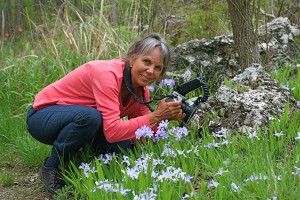
I hope to reach a larger audience with my latest book, Spring Wildflowers of the Northeast: A Natural History. In it I have included details about the lives of 35 plus wildflower species that have interested me over the years. As a photographer I’ve spent long hours in the field plant watching, and in the process learning about the plants’ lives. Knowing what pollinates them, how they reproduce, what eats them, etc. gives me a better understanding of how they fit into the environment and a deeper appreciation for their importance. It’s this information — from my own observations and that of many others — which I have written about in the book. Although I am not an artist I feel that depicting some of these interactions would make drawing or painting the wildflowers more interesting, both for the artist and for the viewer of his/her artwork.


About Carol
:
Carol Gracie is retired from The New York Botanical Garden, where over her three-decade career she served as Senior Administrator of Children’s Education, Foreign Tour Director, and a Research Assistant on tropical plant collecting expeditions. Aside from her current book, she is the co-author (with Steve Clemants) of Wildflowers in the Field and Forest: A Field Guide to the Northeastern United States (2006), co-author (with her husband, Scott Mori, and others) of A Guide to the Vascular Plants of Central French Guiana (Part 1, 1997; Part 2, 2004), principal photographer for Flowering Plants of the Neotropics (2004), and editor of Guide to the Natural Areas of the Lower Hudson Chapter of The Nature Conservancy, second edition (1981). Carol has five plant species named for her (and one named jointly for her and her husband) as a result of her work in the tropics. Carol and her husband live in South Salem, NY.

Read Full Post »

« Newer Posts - Older Posts »