Feeds:
Posts
Comments

Archive for the ‘Teaching & Learning’ Category

The disciplines of science and art are intertwined in more ways than you can imagine. The benefits of using art to communicate science is articulated beautifully in Communicating Science Concepts Through Art: 21st-Century Skills in Practice by Sandy Buczynski, Kathleen Ireland, Sherri Reed, and Evelyn Lacanienta.

In an article published two weeks ago, Buczynski et al. (2012) explain how it is necessary for the next generation of scientists to communicate using more than words. They explain that the scientists of the future will need to use artistic means of communication that include “illustrating, animating, videography, cartooning, and model building” (Buczynski et al., 2012).

To show how art can be used to reinforce learning in science, they cite the results of their work with students at a college prep academy. Students were taught how to use fundamental art techniques as tools to aid their comprehension of science content.

Buczynski et al. (2012) explain how they and the academy’s art teacher put into practice the five conceptual art strategies identified by Julia Marshall (2010). The academy’s art teacher taught students how to draw, how to observe angles, how to observe positive and negative spaces, and how to observe patterns and textures (Buczynski et al., 2012). Students were also taught how to shade, how to create form and how to apply highlights using colored pencils, graphite pencils, charcoal and ink pens (Buczynski et al., 2012).

The authors then incorporated Marshall’s art strategies into lessons about the human body, the scientific process, science communication through popular culture, and botanical exploration.

Briefly, here are the conceptual art strategies Buczynski et al. (2012) used and how they used them:

  • Depiction – Seventh-grade students were asked to apply their new knowledge about “scale, shadow and proportion” (Buczynski et al., 2012) to observe and draw the human body. This strategy was employed to move students away from the usual “stick figure”-type of thinking often observed in science lab notebooks.
  • Projection – Students were asked to predict the outcome of a scientific event using hand-drawn images instead of words.
  • Reformatting – Utilizing art forms from popular culture, students were asked to reformat scientific content into “a comic book, magazine, advertisement or film” (Buczynski et al., 2012).
  • Mimicry – Students were assigned the task of becoming botanists by mimicking how botanists collect information in the field.
  • Metaphor/Analogy – Students were asked to create a visual metaphor to describe how the digestive system works.

Buczynski et al. (2012) explain how they evaluated student work and what they learned from implementing each of these strategies. To learn more about their study, visit your local college library to get a copy of their new article or buy this article online for 99¢ from the National Science Teachers Association.


Real-life Science Communicators

This week I had the opportunity to attend the annual conference of the Guild of Natural Science Illustrators (GNSI). As expected, my appreciation for what scientific illustrators do has increased yet again. Scientific illustrators are a significant force in the field of science communication and their contribution to this field knows no bounds. From children’s books, to outdoor sculpture, to magazines, to cultural exchange (take the virtual tour), they make science and the natural world easier to understand through everything they do.

This year the conference theme was Scientific Illustration: Frontiers Past and Future. Featured were presentations about explorers and natural history artists from the past and presentations about how scientific illustration is used and created today in the 21st century.

Learn more about the Guild of Natural Science Illustrators at www.gnsi.org.

Looking for a scientific illustrator to work on a project? Visit Science-Art.com, a resource connecting artists and art buyers in the nature, science and medical community.

The host of the GNSI conference this year was the Savannah College of Art & Design (SCAD). The Illustration Department at SCAD offers a minor in scientific illustration and is doing their part to create the next generation of science communicators. Learn more about this wonderful school and their students at www.scad.edu.


Literature Cited

    Buczynski, Sandy and Kathleen Ireland, Sherri Reed and Evelyn Lacanienta. 2012. Communicating science concepts through art: 21st-century skills in practice. Science Scope. 35(9): 30-35.

    Marshall, Julia. 2010. Five ways to integrate: Using strategies from contemporary art. Art Education. 63(3): 13-19.
Read Full Post »

Nature Art
Science Art
Scientific Illustration
Natural Science Illustration

What do you call art that gets people thinking about nature and the environment?

Today I am going to use the label “natural history art” because it is nature that professor, Ashley Campbell, emphasizes in Avenues to Inspiration: Integrating the Life and Work of Nature Artists Into Middle School Science.

In her article, Campbell (2011) suggests several ways teachers can use art as a learning tool to connect with students whose reaction to the word “science” is less-than-positive.

Campbell (2011) suggests introducing students to the work of nature artists such as Maria Sibylla Merian (1647-1717) and John James Audubon (1785-1851). She provides suggestions about how teachers can use the work of nature artists to teach students about biological processes, local plants and animals, and occupations in the fields of life science, physical science and art.

She also offers suggestions about how teachers can create a “Science & Art” (Campbell, 2011) component in their classrooms and how they can keep this component fresh and engaging from September to June through the use of themes and interactive activities.

To learn more about Ashley Campbell’s ideas, visit your local college library to get a copy of her article.


Literature Cited

Campbell, Ashley. 2011. Avenues to inspiration. Science Scope. 35(2): 24-30


Teachers, Here’s Another Idea!

Participate in conversations with artists and educators right here on this website. Since 2007, ArtPlantae Today has been where artists, naturalists and educators have learned from people who use art to bring attention to plants and to important issues in botany education. We learn from a different featured guest each month. Would you like to join us?

Bring ArtPlantae into your classroom!

Share this unique learning opportunity with other teachers!

Before you go, however, meet this month’s featured guest Heeyoung Kim. Heeyoung is a botanical artist, teacher and advocate for America’s prairies. Today she tells us how she creates art with a message.

Read Full Post »

Let’s say your normal teaching assignment involves introducing adult audiences to plant morphology and botanical illustration. Then one day, you are invited to teach the same subjects to children under the age of five.

Easy enough, you think.

However, when you start sifting through your notes, you realize you talk too much and that it has been a while since you’ve had a conversation with a three-year-old. How do you transform an adult activity about botanical illustration and plant morphology into one suitable for children with a very short attention span?

Many books have been written about early childhood science education. Many children’s books have also been written about the botany of flowers, seeds, leaves, trees and plants.

But let’s say you need help NOW and are looking for one good resource to help you rework your usual lesson plan. Consider reading the paper The Early Years: First Explorations in Flower Anatomy by preschool science teacher and author, Peggy Ashbrook.

In her paper, Ashbrook (2008) provides detailed instruction about how to lead a flower morphology lesson that uses drawing as a learning tool.

Probably the biggest difference between interacting with children, compared with adults, is the extent to which you have to model behavior. Conducting a demonstration or a desk-side show-n-tell comes pretty easily to adults. But modeling is more deliberate and requires a bit of forethought. To do this successfully, Ashbrook (2008) recommends teachers talk about the specimens under observation when modeling how they want students to observe. She recommends teachers say things such as, “Look at the tiny petals on this flower. The stamen has a yellow dust on it called pollen. Do all flowers have pollen?” (Ashbrook, 2008). Modeling, of course, does not end here because teachers then need to act out each step of the activity. They need to draw the same flowers students draw, explain how sketches or “first tries” (Ashbrook, 2008) don’t ever look like the actual specimen, and so on.

Ashbrook’s plant morphology lesson relies heavily on drawing. She has students drawing up to 5 varieties of flowers, recording differences between flowers, and describing each flower’s color either visually or in a written statement. She also has students pulling flowers apart so they can view, draw and describe each flower’s innermost structures.

And just like in any botanical illustration class, students gather at the end to share their drawings with classmates. For this closing activity, Ashbrook (2008) groups drawings by flower type to make sure the class discussion focuses on flower diversity and not on the quality of her young artists’ drawings.

If you lead young children in botanical art-related activities, consider adding Peggy Ashbrook’s article to your reference library.


Literature Cited

Ashbrook, Peggy. 2008. The early years: first explorations in flower anatomy. Science and Children. 45(8): 18-20.

To obtain a copy of The Early Years: First Exploration in Flower Anatomy, search the stacks at your local college library or read this article online here. [accessed on Google Docs June 28, 2012]


Related

Read Full Post »

Valerie Littlewood has a lot of experience speaking with the public about pollinators. I asked her to describe the aspect of the plant-pollinator relationship with which the public is the least familiar.

She replied:

I think that many people are totally unaware of the number of insects that do pollinate flowers and crops but are also unaware of the needs of the insects. To thrive they need safe habitats, a variety of food, nesting sites, and a steady supply of both nectar and pollen plants throughout the year.

What else has Valerie observed?

Read Full Post »

To bring attention to the shapes of leaves, flowers, and the types of fruit a plant produces is a fairly straightforward process. The usual approach is to point, name and label.

But how do you teach people to see color?

This week we look at an activity that goes beyond asking, “What color is it?”

The key question today is, “Can you find this color?”

In Nature’s Palette, authors and educators, Brooke B. McBride and Carol A. Brewer describe how they turn students into explorers in search of color.

Using the color cards readily available in the paint aisle at home improvement stores, McBride and Brewer (2010) create field cards for students to use in outdoor investigations. With these cards in hand, students are assigned the task of looking for natural objects matching the colors on their respective cards.

What makes this activity more than one requiring students look for green, red and yellow, is that McBride and Brewer (2010) do not create cards with predictable color schemes. Instead, they collect a broad range of colors from the paint aisle. To make sure they collect a broad selection, they pull “every fifth or tenth paint chip” as they work their way down the aisle. When they pull a chip containing many shades of color, McBride and Brewer (2010) simply cut the cards to separate the shades.

To make the reference cards their students use in the field, McBride and Brewer (2010) cut the poster board down to a size that is easily transported. They then paste 5-10 colors on each sheet of poster board. One board is then given to each group of 2-4 students. To get students excited about their investigation, McBride & Brewer (2010) engage students in conversations about where they may find the range of colors before them and encourage students to match the colors as best they can. They also remind students to collect only natural items, not manmade items, and remind students that what they collect has to fit on their piece of poster board. The reason for this is that when their investigation ends, students must present their posters and their observations to their classmates.

McBride and Brewer (2010) have found that students need only 25 minutes to conduct successful color searches and to collect specimens matching the colors on their assigned color card. They go on to say the number of natural objects students find in 25 minutes has been “mind-boggling and far surpassed” their expectations.

During the poster presentations, McBride & Brewer (2010) ask the following types of questions to help guide student discussions:

  • Which color did you observe the most? Which color did you observe the least often? What was the most unusual color you found?
  • Which of your senses did you have to rely on during your search? How did you find the objects you collected?
  • What is the most interesting object your group found? What makes it so interesting? What do you think it is?

The authors have found these questions, and this activity, helps students “focus and observe with a purpose” (McBride & Brewer, 2010).

Readers, how do you help others see nature’s colors?
Share your stories in the Comment box below.


Literature Cited

McBride, Brooke B. and Carol A. Brewer. 2010. Nature’s palette. Science and Children. 48(2): 40-43.

Visit your local college library to get a copy of this article or purchase a copy online (99¢).

Read Full Post »

Join me in welcoming Valerie Littlewood, our featured guest for June!

Valerie has been a commercial illustrator, designer for industry, artist and art lecturer for many years. Most recently, she has been drawing plants and insects, becoming more and more interested in their relationships and their conservation. Currently she is drawing bees and other pollinators and has a traveling show, BUZZ: A Celebration of British Bees and Their Flowers, showcasing 24 of Britain’s bees. Valerie was awarded a bursary from The Society for All Artists in 2012 to help encourage creative people of all abilities to take inspiration from the natural world, from insects, bees and flowers and to understand more about their important relationship to us.

A hands-on artist, Valerie says she loves “everything about making art with brushes, pencils and paint.” Valerie made her living as a general illustrator creating illustrations for anything from packaging and advertising to book illustration. She also created illustrations as a giftware designer. Valerie does less commercial work these days because so much of the work she used to do is now done on the computer. Being a hands-on artist, Valerie says she is “very reluctant to sit at a computer all day.” So she has turned more of her attention to teaching.

Throughout her career, Valerie has always taught art — from degree students to “purely-for-pleasure art holidays.” She feels teaching is a wonderful way to open up possibilities for all kinds of people. Valerie has taught many subjects and has many interests herself. She is a printmaker, a painter, loves ceramics and bookmaking. She used to teach an interior design course teaching creative thinking and fine faux finishes. Her experiences as an artist and teacher have enabled her to be happy painting with a 6″ house brush or a 00 sable brush.

An admirer and advocate of craft skills, Valerie believes artists should hone their skills to be able to say what they want to say in their work.

Reflecting on an almost 40-year career as an artist, designer and educator, Valerie says the natural world has been a recurring theme in her work. While she may teach people how to draw and paint, she says her main preoccupation is to teach them to “see”.

(I teach students) to observe and to consider what is around them through the eyes of an artist. 
The observation and interpretation of the natural world can be the inspiration for so many of the artistic disciplines, from pattern and form to structure and colour informing sculpture, textiles, architecture and more.

Then there is the emotional connection we have with nature, things that we as humans relate to. A fascination with how things live, thrive, survive and reproduce and an affinity with their daily struggle. For example, how could you not admire the ingenuity of a little bee who makes her nest in a snail shell, who diligently collects twigs many times her own size to cover the shell and who chews little pieces of leaves to use as a green camouflage?


To practice art in any of its forms you first have to learn to look. Artists have to be observant. But it is so worth the effort because the added joy of that looking, seeing, and learning, especially in the field of natural sciences, is the understanding it brings. Then what hopefully follows is a greater connection with a world which can sometimes seem increasingly distant as we rely on machines more and more.

Certainly since painting the bees, I have become more aware of the astonishing variety and interdependence of living things, especially some of those small often overlooked creatures. I have become increasingly appreciative of how important they are in our lives.

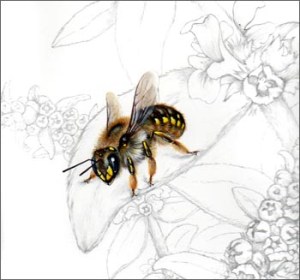
Bombus hortorum on honeysuckle. © Val Littlewood. All rights reserved

Save the Date!
Pollinator Week
(June 18-24, 2012)

Valerie will discuss her work with Britain’s bees and the plants they pollinate during Pollinator Week. You will have the opportunity to ask Valerie questions during this annual event that brings attention to declining pollinator populations.

One of the topics Valerie will discuss is her book, BUZZ, dedicated to British bees and the plants they visit and pollinate. BUZZ is a self-published title. You can preview Valerie’s book here. Above is an example of the type of pollinator illustrations Valerie creates. Featured is an illustration of Bombus hortorum (Garden Bumble Bee). This species of Bombus has a long tongue it uses to access nectar from the long tubular flowers of the honeysuckle plant. While drinking nectar, pollen is deposited on the bee’s body. When the bee travels to another flower, it brings the pollen with it and deposits the pollen on the stigma of the new flower, thereby completing the transfer of pollen (i.e, pollination).

Unlike their longer-tongued counterparts, short-tongued bees are unable to access the nectar of honeysuckle flowers in the same way. This does not stop them from getting what they want, however. To get their share of the nectar, they bite holes into the base of the tubular flowers and steal the nectar. While this may be a win-win for the nectar robbers, this form of nectar harvesting negatively impacts pollination success because pollen is not transferred in the process.

Even the simple act of pollen transfer is not as simple as one might think!


Ask the Artist with Valerie Littlewood

Watch for more information about our conversation with Valerie during Pollinator Week. Share this information with colleagues, friends, fellow gardeners and the pollination ecology students in your life. Look for events in your state, download planting guides and learn about resources for the home gardener and professional landscaper here.


Gardens for Pollinators with the BeeSmart Pollinator Gardening App

Created by the Pollinator Partnership and Catch.com, this app is a database of almost 1,000 native plants found across the United States. To find pollinator-friendly plants for your garden, simply enter your zip code to view a list of plants for your area. Then sort through your list by selecting specific pollinators, flower colors, soil types, plant types or the type of sunlight your garden receives. To learn more about the BeeSmart Pollinator Gardening app click on the image above.


UPDATE
: Pollinator Week Q&A with Valerie Littlewood

Read Full Post »

Know your veggies.
Eat your veggies.
Draw your veggies.

Making vegetables and plants irresistibly interesting to the next generation is the goal of Botany on Your Plate: Investigating the Plants We Eat, a ready-to-use curriculum written by Katharine D. Barrett, Jennifer M. White and Christine Manoux.

The eight interdisciplinary lessons in this book written for K-4 students are based on the Grocery Store Botany program taught at the UC Botanical Garden Berkeley. Each lesson includes a materials list and instruction on how to lead students to an understanding of plants through inquiry. Drawing is an essential part of each lesson and clearly enhances student observation skills and student understanding of plants and how they grow. Here is a summary of each lesson:

  • Lesson 1: Let’s Become Botanists! – During this lesson, teachers will determine students’ prior knowledge about plants and learn about the plants their students eat. Students create the botany journal they will use throughout the unit and learn about the “plant snack process”. A recurring feature, the “plant snack” activity encourages students to “taste and describe” the fruit and vegetables they are learning about.
  • Lesson 2: Roots – Students learn about roots and their function through observation, dissection and drawing. Suggestions about how to relate this lesson to math, nutrition, cooking, social science, language arts and plant propagation are provided.
  • Lesson 3: Stems – Students learn about stems and how water and nutrients travel through plants while dissecting and drawing stems. Students learn about the scientific process while conducting an experiment and learn about products made from stems. Suggestions about how to relate this lesson to math, nutrition, cooking, social science and language arts are provided.
  • Lesson 4: Leaves – Leaf structure and photosynthesis are the focus of this lesson. Dissection and drawing again play an integral role. Suggestions about how to relate this lesson to math, nutrition, social studies and language arts are provided.
  • Lesson 5: Flowers – Students study flowers and learn about pollinators while dissecting flowers and drawing floral structures in their botany journals. Suggestions about how to relate this lesson to math, nutrition, pollination ecology, cooking, social science and language arts are provided.
  • Lesson 6: Fruit – A study of two types of fruit leads to discussion about seeds and seed dispersal. Suggestions about how to relate this lesson to math, nutrition, ethnobotany, social science, cooking and language arts are provided.
  • Lesson 7: Seeds – In this lesson, students explore seeds in more detail. They learn about a seed’s function through dissection and drawing. Suggestions about how to relate this lesson to math, nutrition, cooking, gardening, social science, and language arts are provided.
  • Lesson 8: Plants – Top to Bottom – A recap of the many elements in this unit, students end the eight-lesson series drawing and writing about plants in their journals.

Background information about plant biology is provided for teachers, as are copies of the handouts required for each lesson. A helpful glossary is also included.

Botany on Your Plate: Investigating the Plants We Eat is an invaluable resource that should be in every classroom or at least in every school library.


Literature Cited

Barrett, Katharine D. and Jennifer M. White and Christine Manoux. 2008. Botany on Your Plate: Investigating the Plants We Eat. Burlington, VT: National Gardening Association.


Related Topics

Read Full Post »

« Newer Posts - Older Posts »