Feeds:
Posts
Comments

Archive for the ‘Teaching & Learning’ Category

How to Use a Pencil

Click to download

Click to download

Sometimes the most interesting resources are right in front of you and you don’t even know it.

I had one of those “Hey, I didn’t know this was here” moments this week. Lost in the shuffle of all that zips across the computer screen is a resource I haven’t spent much time digging into.

My discovery?

Books about drawing in pencil!

The best thing about them is that they are as much about history as they are art, they’re free, and they’re available as downloadable PDFs.

The notable discovery of the week is
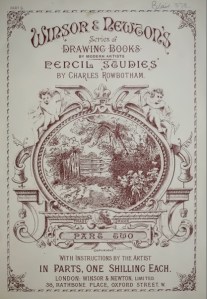
Pencil Studies by Charles Rowbotham. Published in the late 1800’s, Pencil Studies was one of the handbooks published by Winsor & Newton. This book, along with 32 others, was published as a series of drawing books written and illustrated by individual artists. Rowbotham’s handbook about pencil studies was Number 2 in the series. Other handbooks addressed topics such as landscape painting, marine painting, portrait painting, miniature painting, flower painting, figure drawing, murals, ornamental art, wood engraving, etching, perspective, illumination and even the art of botanical drawing (I haven’t found this one yet).

In his handbook, Rowbotham discusses how to create foliage using pencil strokes and explains to readers how he created the four pencil sketches in his handbook. His explanations are concise and delightfully eloquent in that 17th century way. Rowbotham explains how a broken stem can be created using a few “sharp touches” instead of through the deliberate placement of a line. He explains how dirt walking paths need only be hinted at, and how grass can come from
“a few decided and effective touches”.

He also demonstrates the power of negative space and dark values while creating tree canopies, dense foliage, foreground plants, background plants and other landscape elements for readers.

Equally interesting, and somewhat entertaining, is the Winsor & Newton ad for drawing pencils. During this time, Winsor & Newton sold six kinds of pencils, each serving a specific purpose. The penny drawing pencil was for office or school use. The twopenny drawing pencil was for “artists and professors of eminence”. The threepenny drawing pencil was for architects and draughtsmen. The fourpenny drawing pencil was “warranted perfectly free from Grit”. The fivepenny drawing pencil was of “high quality in color, smoothness, and ready erasure”, while the sixpenny drawing pencil was manufactured with the “finest Lead”, was grit-free, contained “a larger quantity of Lead than usual”, and produced a “good volume of color”.

(Note: Lead pencils don’t really have lead in them. They are graphite and clay.)

Of course my discovery of Rowbotham’s handbook changed the course of my afternoon. More searching uncovered other treasures, all free and available as PDFs. Before I leave you with a list of only a few of my discoveries, I would like to share a quote I found in the book, Pencil Sketching from Nature (1906):

The pencil is indeed a very precious instrument after you are master of the pen and the brush, for the pencil, cunningly used, is both,
and will draw a line with the precision of the one, and the gradation of the other. — Ruskin

My Discoveries:


Related


Disclosure: ArtPlantae is a partner of Kobo Books

Read Full Post »

Yesterday was Valentine’s Day, the event for which February is probably best known. Today I propose that there is a bigger and better event in February. This event is Digital Learning Day. A new national movement, the second annual Digital Learning Day was celebrated just last week. This national campaign celebrates “education champions who seek to engage students, celebrate and empower teachers, and create a healthy learning environment, personalized for every child.”

Allow me to stray just a bit from the usual drawing-specific topics covered in this column. I am not straying too far, really, as today’s featured activity can be implemented as a clever way of encouraging the collection of quality reference photographs — resources valued highly by all botanical artists and natural science illustrators.

Meet Wendy Walker-Livingston. Drawing upon her fond memories of scavenger hunts at summer camp, science teacher Wendy Walker-Livingston created a scavenger hunt about plants in which learning is reinforced through field work and technology. She describes her 21st-century scavenger hunt in the article, Botanical Scavenger Hunt.

Walker-Livingston’s field adventure is exactly what you’d expect a scavenger hunt to be — a mad dash with list in-hand and a sprint to the finish line.

What is different about Walker-Livingston’s scavenger hunt is that participants are not collecting objects. Instead, what they are collecting are images. In this case, images of 16 key plant characteristics used in plant identification (Walker-Livingston, 2009) that were collected using digital cameras and cell phones. Today, of course, you can add iPods and tablets to this list of image-capturing devices.

When conducting this activity, Walker-Livingston (2009) prepares students for their scavenger hunt by first introducing them to botanical terminology, plant morphology, plant classification and dichotomous keys. When distributing the list for the scavenger hunt, she tells students they have 50 minutes to collect photographs of the characteristics on their list and 10 minutes to download their images.

The day (or two) after the scavenger hunt, each student team is given 60 minutes to create a 3-minute multimedia presentation that includes a narrated description of the images they collected.

Walker-Livingston (2009) says her activity has been successful on many levels. Students love the activity, the multimedia project helps students verbalize their new knowledge and the project successfully addresses the various ways learners interact with the world, ways Howard Gardner describes in his theory of multiple intelligences.

Walker-Livingston’s Botanical Scavenger Hunt is easy to add to your teaching toolbox. This article can be purchased online for 99¢ from the NSTA store.


Literature Cited

Walker-Livingston, Wendy. 2009. Botanical scavenger hunt. Science Scope. 32(6): 31-34.


Related

Read Full Post »

With spring and Earth Day fast-approaching, here is a resource you’ll want to refer to the next time you need to talk about plants with preschool children. It will also help you introduce young audiences to the subjects of inheritance and traits.

In Plants, Alike and Different professor Kathy Cabe Trundle and doctoral students Mandy McCormick Smith and Katherine N. Mollohan explain how they use a learning cycle involving play, exploration, and discussion to teach students how plants and insects are alike and different. Below is a general overview of their process. For a thorough review that includes the prompts they use in class and how they bridge one activity with another, read their enlightening paper.

During the Play Phase of the learning cycle, Trundle et al. (2013) provide children with unstructured playtime in a play area that has been stocked with silk flowers and plants. The authors state they often observe children pretending to pick flowers and pretending to plant a garden. Trundle et al. (2013) explain that unstructured playtime with plants gives children time to think about plants and to ask questions about them. Instructor-guided learning begins later in this phase and begins with a conversation about how humans are similar and different. This then leads to a conversation about how plants are similar and different (Trundle, et al., 2013).

During the Exploration Phase, students compare two types of marigolds, two types of pansies and two types of coleus plants to make observations about flower size, flower number, leaf shape, leaf color, textures, stem length and stem shape (Trundle, et al., 2013). Children document observations by drawing them, by creating leaf rubbings and by tracing leaves. The visual data recorded by children are then shared, much like how works-in-progress are shared at the end of a botanical illustration workshop. The sharing of data enables students to more easily see patterns in color, shape, size etc.

This visual information created during the Exploration Phase is paired with detailed discussion during the Discussion Phase of the learning cycle. Student observations are grouped and then arranged in a graphic organizer (i.e., chart). This chart helps students compare traits for each plant they studied.

The process of observing similarities and differences described above helps establish a foundation for more detailed conversations about traits and inheritance, concepts that are the focus of Part II of this activity by Trundle, et al. (2013). A link to their activity about inheritance is included in their paper.

Also included in their paper is a link to the rubric the authors use to evaluate student drawings and assess student understanding. The rubric serves as a checklist of objectives and targeted behaviors and is based on a project about helping children draw and sketch from observation from Illinois Projects in Practice at the University of Illinois at Urbana-Champaign.

Published just this week, Trundle et al. (2013) can be purchased online for 99¢.


Literature Cited

Trundle, Kathy Cabe, and Katherine N. Mollohand and Mandy McCormick Smith. 2013. Plants, alike and different. Science and Children. 50(6): 52-57


Related Resources

  • Look Once, Look Again – Fruit and Seeds by David M. Schwqrtz and Dwight Kuhn
  • Look Once, Look Again – Plant Leaves by David M. Schwartz
  • Secrets of the Garden: Food Chains and the Food Web in Our Backyard by Kathleen Weidner Zoehfeld and Priscilla Lamont
  • Trait-based Learning with Trading Cards

Read Full Post »

Trading cards are small 2.5″ x 3.5″ pieces of paper about a specific subject that were created to be traded with others (think baseball cards and artist trading cards). The only difference between artist trading cards (ATCs) and baseball cards are that ATCs are decorated by each individual before they are traded.

Biology graduate student, Jay M. Fitzsimmons, put the trading card concept to good use recently during a presentation he made to a group of young naturalists. Invited to speak about his dissertation research, Fitzsimmons designed a creative learning activity to replace his standard PowerPoint presentation. He describes this activity in Local Species Trading Cards: An Activity to Encourage Scientific Creativity and Ecological Predictions from Species’ Traits.

    Fitzsimmons’ Challenge: Explain PhD research to children ages 8-18.

    Fitzsimmons’ Solution: Engage young naturalists in an activity that is enjoyable, sparks creativity and encourages critical thinking.

Fitzsimmons’ current research focus is about how Canadian butterflies respond to climate change. As Fitzsimmons (2012) explains in his paper, his primary research question is, Can a butterfly species’ response to climate change be predicted based on a species’ traits?

To explain this concept to members of a young naturalists club, Fitzsimmons (2012) created stacks of butterfly trading cards. On one side of a card was a photograph of a species of butterfly and the other side contained a summary of this species’ traits. He chose 12 species local to his location in Ottawa, Canada and created a stack of 12 trading cards for each member (Fitzsimmons, 2012).

After introducing members to his research, he distributed the stacks of cards he prepared. He then instructed members to sort the cards into two piles — one for butterfly species “likely to shift north rapidly” in response to climate change and the other for butterfly species “unlikely to shift north rapidly” in response to climate change (Fitzsimmons, 2012).

Each member paired up with another member and together they sorted through their decks of cards, discussed the traits of each species, and made predictions about how a given species might respond to climate change. Club members were given 20 minutes to sort through their cards and then shared their predictions and justified their thinking during a group discussion (Fitzsimmons, 2012).

In his review, Fitzsimmons (2012) states the activity was well-received by both the young naturalists and participating adults. He also mentions that during this activity, club members were able to justify their predictions the same way professional biologists would, but “with less jargon” (Fitzsimmons, 2012). In light of this positive outcome, he encourages educators to modify his activity when teaching other natural history subjects.

Fitzsimmons’ activity can be adapted easily to encourage an interest in plants, and even a bit of botanical art along the way, especially if art-specific papers that can handle different media are used.

How can we use ATCs to teach about plants? Let’s toss around some ideas.

How about trait-based studies of plant adaptations?
What about plant-pollinator relationships?
Life history patterns? Resource allocation? Plant communities?

What else comes to mind? Share your ideas below.


Literature Cited

Fitzsimmons, Jay M. 2012. Local species trading cards: An activity to encourage scientific creativity and ecological predictions from species’ traits. Journal of Natural History Education and Experience. 6:10-15.Web. http://naturalhistorynetwork.org/journal/articles/local-species-trading-cards-an-activity-to-encourage-scientific-creativity-and-ecological-predictions-from-species-traits [accessed 24 January 2013]


Also See

Read Full Post »

The Hunt Institute of Botanical Documentation will host its annual open house in June. This year the library will host lectures and tours related to the exhibition What We Collect: Recent Art Acquisitions, 2007-2012.

Here is the schedule of events:


Sunday, June 23, 2013

    1:00
    Registration (continues all afternoon)

    1:15–1:30
    Welcome and Introduction in Reading Room by Publication and Marketing Manager Scarlett Townsend

    1:30–2:15
    Exhibition Tour of What We Collect: Recent Art Acquisitions, 2007–2012 by Curatorial Assistant Carrie Roy

    2:15–3:00
    Walking tour of Reading Room furniture by Publication and Marketing Manager Scarlett Townsend

    3:15–4:00
    Botanical Wall Charts
    Lugene Bruno, Curator of Art
    Bruno will present an overview of the Hunt Institute’s collection of instructional wall charts that were produced in Europe and circulated around the world from the late 19th to the early 20th centuries. Using the less expensive printing process of lithography, these large-scale charts featured the characteristics of important plant families (often in magnified detail) and were used in introductory to advanced botany courses. As information became accessible in different formats, this important record of educational presentation fell into disuse. In recent decades these charts have often been retrieved from neglected storage areas and dumpsters and donated to institutions for preservation.

    4:00–4:30
    Enjoy exhibition and displays; talk with curators and staff


Monday, June 24, 2013

    1:00
    Registration (continues all afternoon)

    1:15–1:30
    Welcome and Introduction in Reading Room by Curator of Art Lugene Bruno

    1:30–2:15
    Exhibition Tour of What We Collect: Recent Art Acquisitions, 2007–2012 by Curatorial Assistant Carrie Roy

    2:15–3:00 W
    Walking tour of Reading Room furniture by Publication and Marketing Manager Scarlett Townsend

    3:15–3:45
    From Field to Folio: Stories Behind Botanical Publications
    Jeannette McDevitt, Assistant Librarian
    Long before our modern conveniences, such as overnight shipments and photocopies, passionate botanists and botanical artists were pouring blood, sweat and tears into their work. Ever at the mercy of the natural elements, each other and tight budgets, they traveled near and far to document the world’s flora. McDevitt will display some of Hunt Institute’s special items and speak about the dramas, disasters and absurdities that went on behind the scenes before these beautiful books could come to fruition.

    3:45–4:30
    Enjoy exhibition and displays; talk with curators and staff


Related

Read Full Post »

In a review of the environmental education literature, professors Donald J. Burgess and Jolie Mayer-Smith found that research about childhood experiences in wilderness settings was lacking, as were data describing what an active love of nature looks like in young children. In response to this, they created a study in which they documented the reactions and comments of urban students in a wilderness setting. They discuss their findings in Listening to Children: Perceptions of Nature and address how children perceive nature and identify the types of experiences that encourage a love of the natural world.

Burgess and Mayer-Smith (2011) used the framework of environmental values created by Stephen R. Kellert to evaluate children’s reactions to nature. Kellert is the first person to methodically assess and classify how people view nature (Burgess and Mayer-Smith, 2011).

The categories of environmental values created by Kellert are very interesting and they need to be explained in order to discuss Burgess and Mayer-Smith’s findings. Kellert describes values as “the convergence of emotion and cognition” (Burgess and Mayer-Smith, 2011). Through his categories of nature values, he explains the different ways individuals value and perceive nature. Here is a summary of Kellert’s value categories as described by Burgess and Mayer-Smith (2011):

    Scientific-Ecological Valuing – Interests focus on looking for knowledge or information

    Naturalistic Valuing – Interests focus on exploring and discovery

    Symbolic Valuing – When nature is viewed as a source for language or imagination

    Aesthetic Valuing – Formation of emotional connections to nature

    Humanistic Valuing – Similar to Aesthetic

    Utilitarian Valuing – Viewing nature as a source for materials or reward

    Moralistic Valuing – When ethical and spiritual connections are formed with nature

    Dominionistic Valuing – Viewing nature as something to master or control

To conduct their study of how children perceive nature, Burgess and Mayer-Smith (2011) observed two classes of 5th grade students (n=35, age 10-11) while they attended Mountain School, a three-day environmental education class held in the wilderness of North Cascades National Park in Washington. Burgess and Mayer-Smith (2011) worked closely with graduate students, parents, rangers and classroom teachers during their study. They conducted pre-interviews one week before the Mountain School program began, conducted post-interviews one month after the program ended, documented children’s reactions in the field during hikes, and reviewed student journals containing students’ field notes, checklists, worksheets, creative writing entries and drawings.

While using Kellert’s framework, Burgess and Mayer-Smith (2011) found that the framework wasn’t broad enough for their study so they added their own themes and sub themes to each category. In the end, they added 33 themes and sub themes to the framework (Burgess and Mayer-Smith, 2011).

A thorough analysis of the data revealed that the Mountain School program changed children’s perspectives and how they viewed nature. Burgess and Mayer-Smith (2011) saw changes in students’ scientific-ecologocial, naturalistic and symbolic valuing of nature. Students began the program making general observations about nature. During the program they demonstrated an understanding of ecological relationships and ended the program being able to reflect about nature in a creative way (Burgess and Mayer-Smith, 2011).

The authors also observed changes in how students connected with nature on an emotional level. While they began the program having objective and indifferent thoughts about nature, they ended the program talking passionately about their first-hand experiences and the students who at first had some level of fear about nature had their fear reduced by the end of the program (Burgess and Mayer-Smith, 2011).

Burgess and Mayer-Smith (2011) also observed students gaining a new respect for nature and the ability to communicate this new respect to others.


Learning Experiences Encouraging Change

What type of experiences encourage the type of change described above?

Burgess and Mayer-Smith (2011) claim that direct experiences with nature encourage emotional connections and change how children view the natural world. They also state that physically challenging experiences and reflective experiences reinforce children’s emotional connections with nature (Burgess and Mayer-Smith, 2011).

Burgess and Mayer-Smith (2011) provide a thorough explanation about these experiences in their paper and also include student quotes as examples of how student perceptions were changed by the Mountain School program.

Listening to Children: Perceptions in Nature can be viewed online and is available for download as a 17-page PDF. Included with the article are the pre- and post-interview questions used by the authors.


Literature Cited

Burgess, Donald J. and Jolie Mayer-Smith. 2011. Listening to children: perceptions of nature. Journal of Natural History Education and Experience.
5: 27-43. Web. <http://naturalhistorynetwork.org/journal/articles/listening-to-children-perceptions-of-nature> [accessed 17 January 2013]


Related

Read Full Post »

From speaking with many of you, I think it is safe to say that many of us find sketches to be more interesting than polished paintings and drawings. We each have our reasons for thinking this, however articulating these reasons and our emotional reactions to sketches isn’t always easy to do.

Words may come easier to you after today though, thanks to Gabriela Goldschmidt and her interesting article, The Backtalk of Self-Generated Sketches.

In her paper, Goldschmidt (2003) discusses how the sketching process generates and strengthens ideas. She provides an example of how this process can occur with a young child and with an adult designer. Goldschmidt (2003) thoughtfully describes the creation of sketches and how a sketcher reads a sketch to develop an idea into something with many layers.

Goldschmidt’s insights are fascinating and includes some history about the origins of sketching. It appears that sketching can be traced back to the late 1400s and is a direct result of the invention of movable type, printing presses and an emerging book printing industry that includes the birth of the paper industry. As paper became more affordable, designers and artists began consuming paper to create study drawings (Goldschmidt, 2003). This was the time of the Renaissance and the thoughts artists placed on paper were called pensieri, the Italian word for thought (Olszweski 1981, as cited in Goldschmidt 2003).

So what is it about sketches that make them so interesting?

It’s simple — they tell better stories.

Goldschmidt (2003) explains how more information can be read from a sketch than a finished drawing. Hard-lined drawings, she explains, are created “according to strict rules” and imply a finished product. Because anyone can create a line drawing, this makes a hard-lined drawing no different than any other type of generic visual information (Goldschmidt, 2003). A hard-lined drawing is no longer telling a story or, as Goldschmidt says, no longer “talks back”. She explains that self-generated sketches reflect a sketcher’s innermost thoughts and ideas and this is what makes them better stories.

Goldschmidt’s 17-page paper is very interesting and I feel you would enjoy it. I have no doubt you will recognize your own process in her discussion.

Goldschidt (2003) can be purchased directly from MIT Press Journals for $12 or obtained at your local college library.


Literature Cited

Goldschmidt, Gabriela. 2003. The backtalk of self-generated sketches. Design Issues. 19(1): 72-88

Olsweski, E.J. 1981. The Draughtsman’s Eye: Late Renaissance Schools and Styles. Cleveland, OH: Cleveland Museum of Art/Indiana University Press.


Also See

Practical Drawing as a Thinking Tool

Read Full Post »

« Newer Posts - Older Posts »