Feeds:
Posts
Comments

Archive for the ‘Special Announcements’ Category

pict0415This article is about a need all sketchbook illustrators share. Now, stay with us here. Don’t think we’ve gone off the deep end. Admit it. Restroom needs are an inherent part of every outdoor adventure. What we’d like to share with you today are tools that lessen the unspoken anxiety about outdoor excursions lasting longer than two hours. The best thing about these tools is they fit in your field bag, are lightweight, and are very clean. Be free of all your restroom anxieties with the travel toiletry accessories by RESTOP!

The items we are about to share with you have been used by those immediately associated with ArtPlantae and we can promise you that individuals, both young and old, have benefited from RESTOP products. What is it about these products that warrants their inclusion on these normally flower-filled pages? Here is a quick review of what each product has to offer.


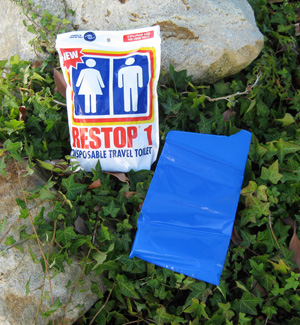
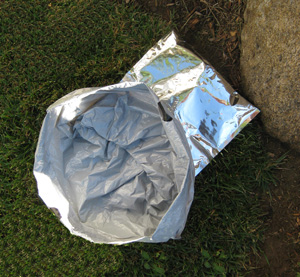
Restop 1 (Disposable Urine Bags)

  • What are they? – Bags with wide, semi-rigid openings that are easy to use by both men and women
  • How do they work? – Fluid collected in each bag is absorbed by polymers and enzymes that will convert up to 20 ounces of liquid into a gel. Equipped with a one-way valve, spillage is not an issue.
  • Can I carry it with me? – Yes! This bag will fit in your field bag, backpack, jacket pocket, and fanny bag. (Oops. No pun intended.)
  • What do I do with a bag after I use it? – The self-contained, deodorized and environmental features of Restop bags make it possible for you to throw them away in the trash after they have been used.
  • Why can’t I just go behind a tree? – Excessive human waste in public areas creates unsanitary conditions.


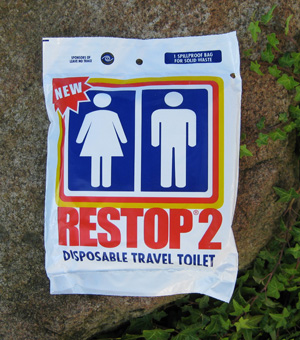
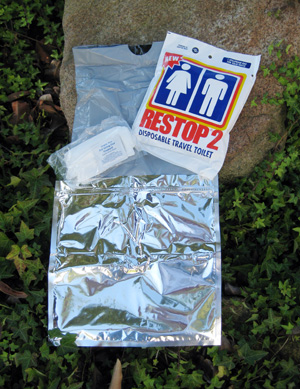
Restop 2 (Disposable Solid Waste Bags)

  • What are they? – Clean deodorized bags that fit inside a commode and are designed to collect solid waste.
  • How do they work? – Fluid and waste collected in each double-lined bag is absorbed by polymers and special enzymes required for solid waste. The construction of these double-lined bags ensures that odor and spillage is not an issue. Each bag comes with toilet paper and an antiseptic wipe.
  • Can I carry it with me? – Yes! This bag will fit in your field bag, backpack, jacket pocket, and waist bag.
  • Do I have to have a commode to use Restop 2 bags? – No. However, it makes things a bit easier.
  • What do I do with a bag after it has been used? – The self-contained, deodorized and environmental features of Restop bags make it possible to throw them away in the trash after they have been used.
  • Why can’t I just go behind a tree? – Excessive human waste in public areas creates unsanitary conditions.


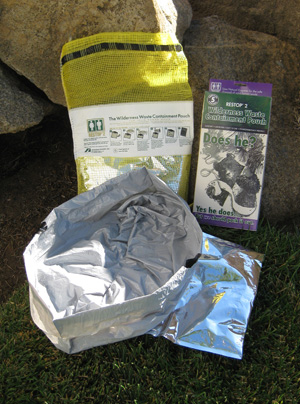
Restop 2W – Wilderness Waste Containment Pouch

  • What is in this pouch? – A set of five Restop 2 bags packed within a mesh bag that makes it easier to carry your used Restop bags out of remote areas.
  • How do they work? – Fluid and waste collected in each double-lined bag is absorbed by polymers and special enzymes required for solid waste. The construction of these double-lined bags ensures that odor and spillage is not an issue. Each bag comes with toilet paper and an antiseptic wipe.
  • Can I carry it with me? – Yes!
  • What do I do with my bags after they have been used? – The self-contained, deodorized and environmental features of Restop bags make it possible to throw them away in the trash after they have been used.
  • Why can’t I just go behind a tree? – Excessive human waste in public areas creates unsanitary conditions.


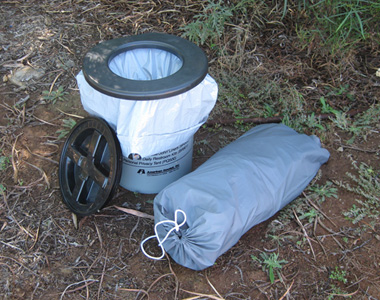
Restop Commode

  • What are they? – Sturdy grey bucket-like bases equipped with a full-sized folding toilet seat that can withstand 300 lbs of pressure for ten hours.
  • How do they work? – Place a Restop 2 bag into a commode and fold the edges of this bag over the edge of the commode before lowering the seat.
  • Can I carry it with me? – You could easily take this with you, but it might be better to set up an outdoor restroom facility (see privacy tent below).
  • Why can’t I just go behind a tree? – Excessive human waste in public areas creates unsanitary conditions.


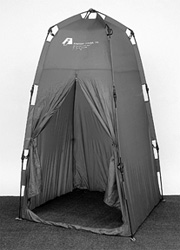
Restop Privacy Tent

  • What is it? – An easy-to-assemble tent with anchor stakes that houses a commode. The zippered panel opens from the inside to protect your privacy.
  • How do they work? – This tent is assembled quickly through the use of quick-connect joints (those bendable support rods used typically with tents).
  • Can I carry it with me? – Yes! This tent folds into a carrying case.
  • Why can’t I just go behind a tree? – Excessive human waste in public areas creates unsanitary conditions.

Intrigued? Learn much more about these products at the RESTOP store.

We would like to thank RESTOP for allowing us to use their product images for this article.
Read Full Post »

Press Release by The Society of Botanical Artists

© 2009 by Brigitte E. M. Daniel

© 2009 by Brigitte E. M. Daniel

Be prepared to lose yourself in a world of colour and spectacle as botanical art bursts into bloom from late April when the Society of Botanical Artists holds its Annual London Open Exhibition between Friday 24 April and Sunday 3 May 2009. The season may be short but a wonderful display is always guaranteed!

Botanical art is a centuries-old traditional art form, enjoying a magnificent renaissance with contemporary artists eager to explore new styles of presentation whilst maintaining the traditional values of the genre. The Society of Botanical Artists’ exhibition provides a fabulous showcase featuring at least 700 selected works by contemporary artists, embracing a wide variety of styles and techniques. Enjoy the perennial favourites: watercolour, oil and pastels but also the increasingly popular variations in coloured pencil and graphite pencil. Appreciate both the traditional skills as well as more contemporary interpretations.

The light and airy Lecture Hall at Westminster Central Hall offers a spacious backdrop where visitors can peruse the diversity of flower and plant images, including fruits and vegetables, from the familiar to the rare. Admire the work of members and non-members, all eager to delight with their passion and their skills. Although members are predominantly from the UK, The Society has also attracted members from Europe, the United States, New Zealand and Japan. All work exhibited has been through a selection process and the Society’s members, several of whom have international reputations, include many recipients of awards – not least of which are the prestigious Royal Horticultural Society’s Gold medals for their botanical illustration. Many also have work in national and international institutions and private collections. However, the exhibition also provides an important opportunity for new and aspiring botanical artists to show their work.

The title of the exhibition is Flowers and Gardens. All work is for sale and includes a section with prints and cards. Be sure to catch the pick of the bunch and don’t be surprised if you think you can even detect the scent!


Westminster Central Hall, Storey’s Gate, London

Friday 24 April to Sunday 3 May 2009
Daily from 10am to 5pm, including Sundays
Free admission
All work for sale
Daily demonstrations by artists

Read Full Post »

The Colored Pencil Society of America has a new online exhibit. Their very popular Explore This! exhibit has become an annual online event so that the colored pencil medium, and the work of colored pencil artists, can be introduced to a broader audience.

Unlike other colored pencil exhibits hosted by the CPSA and its chapters, the Explore This! exhibition is a mixed media affair. Artists are not required to work primarily in colored pencil. They can incorporate other media as long as colored pencil is the primary medium used. Also distinguishing this unique exhibit is the acceptance of three-dimensional art upon which colored pencil work has been applied.

Challenge your assumptions about colored pencils. Visit Explore This! 5.


Additional Resources:

parkerorchidsexhibit
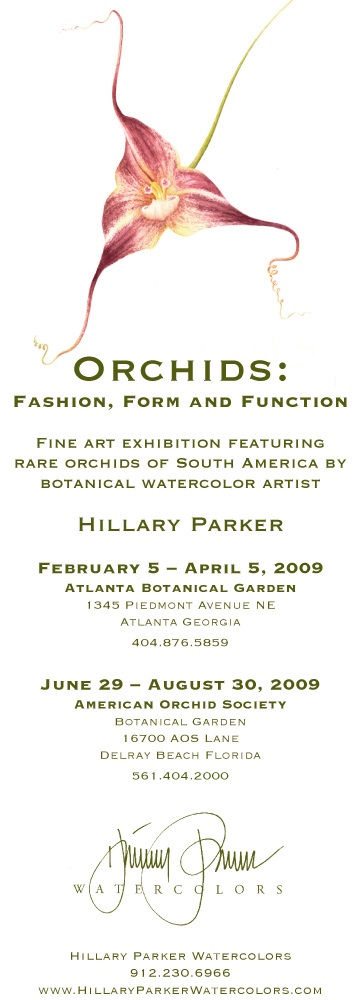
ArtPlantae Today had the good fortune to interview botanical artist, Hillary Parker, about her upcoming exhibit featuring rare orchids from South America. We would like to thank Hillary for taking the time to stop and talk with us.

ARTPLANTAE TODAY: How did you become interested in South American orchids?
HILLARY PARKER: I was asked to do another solo show at the Atlanta Botanical Garden and they requested orchids.  Not particularly drawn to them on my own, I then spent time working [with] and interviewing the orchid curator there as different orchids bloomed in their conservatory throughout 2008. I became fascinated by the stories of each plant’s pollinator and was even more drawn to the idea that their flower’s fashion and form were directly connected to the lure and act of pollination.

APT: Did you travel to South America? If so, did you spend time in the field?
HP: I wish I could have gone on location to the Andes of South America, as with all of my research, however, I go where I can to find the living plants and see them in their environment. In this case, it was the Orchid Conservatory at the Atlanta Botanical Garden.

APT: How did you create this collection of paintings? What was your overall process? Did you use mixed media or just watercolor?
HP: As a botanical watercolor artist and art educator, I love to share with the viewer what I have learned about each subject I paint.  In this case, it was the fashion and form of each flower enabling the function of pollination. I chose 4 orchids to paint.  I did 3 original pieces for each orchid.  I did a watercolor/graphite of the entire plant, I did a watercolor portrait of the bloom, and for the third piece, I did a mixed media collage of all the “process” work, sketches, color samples, photos, and written info about the fashion, form and function of the flower, as an educational tool for Garden visitors.

APT: What role does fashion play in this exhibit?
HP: Fashion clearly plays an imperative role in the plant world…and human one as well.  Looking to pollinate relies on attracting a pollinator. Fashion, as well as form are vital to these plants’s future as well as the form of each flower who controls the movement and placement of the pollinator in order to deposit the pollen on it before it leaves the bloom.

APT: How many paintings will be on view?
HP: There are a total of 12 original works of art.  The solo exhibit is titled, Orchids: Fashion, Form and Function. There are 8 original watercolors and 4 mixed media collages on view from February 5 – April 5, 2009 at the Atlanta Botanical Garden in the Fuqua Conservatory.

APT: Will your exhibit travel to other venues this year? Next year?
HP: The exhibit will then be highlighted in Orchids Magazine and travel to the American Orchid Society’s headquarters in Delray Beach this summer and be on exhibit there June 20 – August 30, 2009. 


Additional Resources
:

Read Full Post »

ArtPlantae Books will host authors and artists at the 2009 Los Angeles Garden Show to be held at the Los Angeles County Arboretum & Botanic Garden. The planned program will complement the garden show’s theme (“A Festival of Flavors”), as well as ArtPlantae’s theme for 2009. You are invited to join us at the Los Angeles Garden Show on May 1-3, 2009.

Program details will be published as they become available.

Read Full Post »

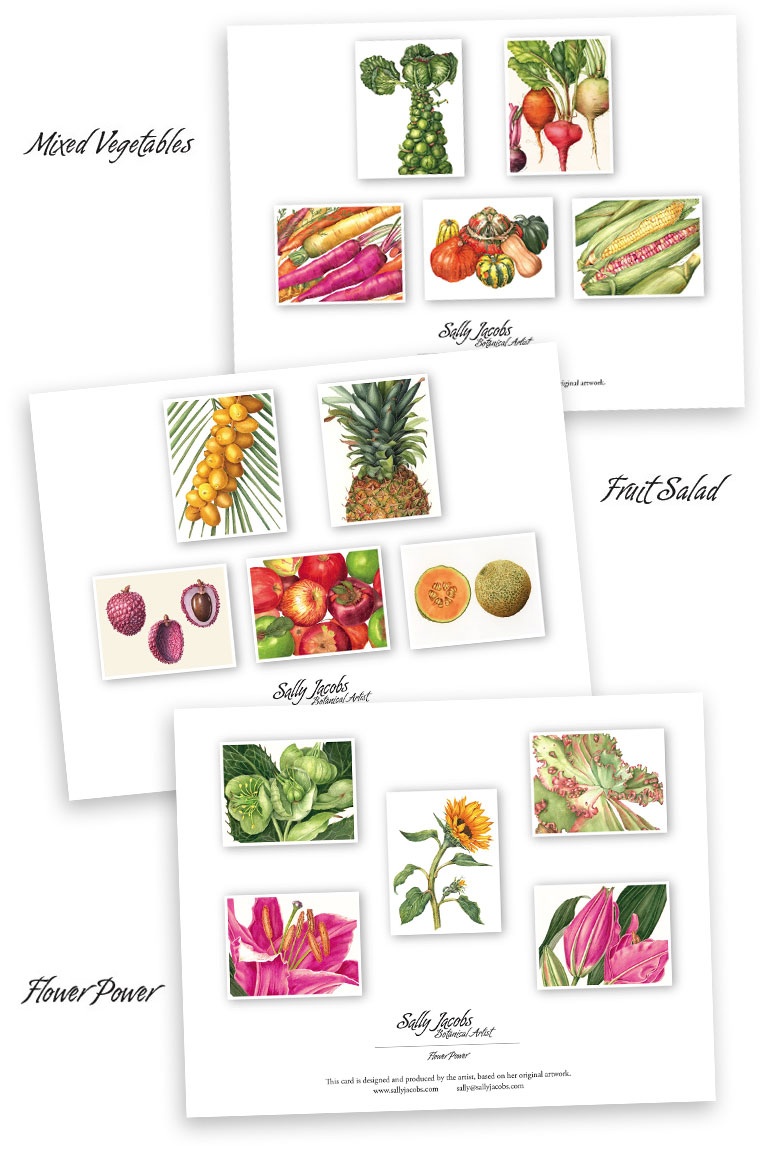
California artist, Sally Jacobs, has created a new collection of notecards featuring the fruit and vegetables from her local farmers market. Each package contains five notecard-size reproductions of Sally’s original artwork. Each collection is dedicated to either fruit, vegetables, or flowers. Click on the image at left to view the paintings in each collection.

Visit Sally Jacobs’ gallery at www.sallyjacobs.com.

Now available at ArtPlantae Books.

Read Full Post »

Exhibit: Book As Sculpture
Location: Brandstater Gallery, La Sierra University, Riverside, CA
Directions: View map
Summary: Fifteen artists transform books into contemporary art. Forty works of art will be on view through February 9, 2009. This exhibit brings attention to the book arts and is being held in conjunction with a semester class about creating handmade books. See exhibit photos and read about contributing artists on the exhibit’s website.

Read Full Post »

« Newer Posts - Older Posts »