Feeds:
Posts
Comments

Archive for the ‘botanical art’ Category

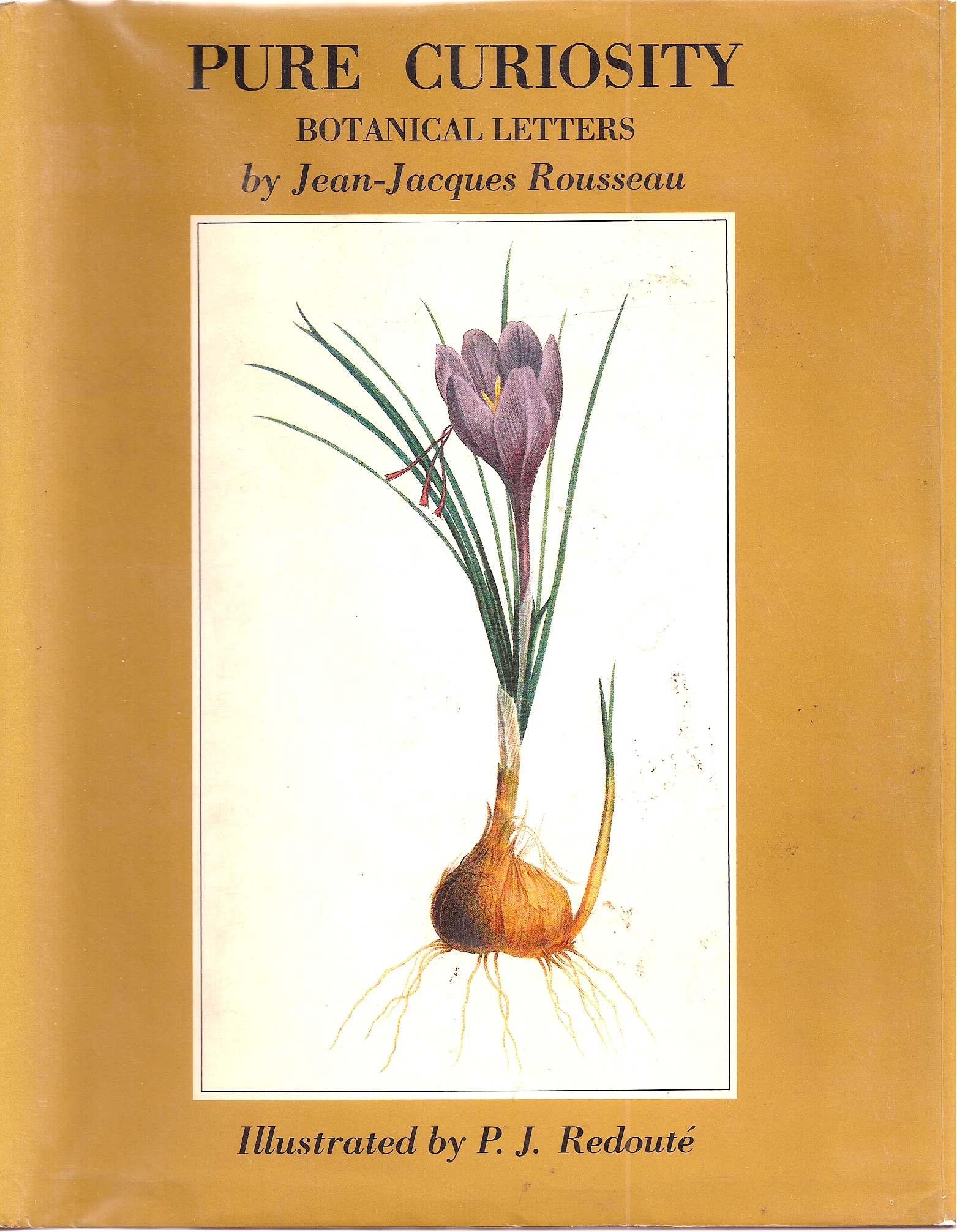
Philosopher Jean-Jacques Rousseau always had an interest in botany. His knowledge and passion for plants were captured in a series of letters he wrote to a friend between 1771 and 1773.

Rousseau wrote a series of eight letters to a friend who was teaching her four-year old daughter botany. In Letter One, he describes the parts of a flower. Letter Two is filled with descriptions about the characteristics of the Cruciferae (Brassicaceae; Mustard family). In Letter Three, Rousseau urges his friend to learn only from “the book of nature” and then continues to describe the plants in the pea family (Fabaceae). Letter Four is dedicated to the Laminaceae (Mint family) and the Scrophulariaceae (Figwort family). The Umbelliferae (Apiaceae; Carrot family) are the focus of Rousseau’s writing in Letter Five. The Asteraceae (Sunflower family) are described in Letter Six. Rousseau’s commentary about fruit trees (Letter Seven) and pressed plant collections (Letter Eight) close this series of educational and enlightening letters.

Rousseau’s letters were so educational, in fact, they were circulated in the intellectual salons that were popular at this time. Botany was very fashionable back then and bound collections of Rousseau’s letters were in high demand. His letters were first published in a collection of his work in 1782, five years after his death. The letters were then published separately in 1800 and 1802. In 1805, sixty-five color plates by Pierre Joseph Redouté were added to Rousseau’s collection of letters, which had by then become known as La Botanique. The book above, Pure Curiosity: Botanical Letters and Notes towards a Dictionary of Botanical Terms is a facsimile based on the third edition of La Botanique (1821).

When Rousseau died, he left behind drafts of what appears to be a dictionary of botanical terms. He was writing a dictionary so the layman could make sense of the terminology used by botanists. A portion of this dictionary is included in Pure Curiosity. Botanical terms are arranged alphabetically in English, with the French words used by Rousseau in parentheses. Redouté’s work is also featured in this section of the book.

Pure Curiosity is still available on the used book market and comes with a strong recommendation for anyone with an interest in botanical art history or an interest in informal science education.


Literature Cited

Rousseau, Jean-Jacques. 1712-1778. Pure Curiosity. Translation of La botanique de J.J. Rousseau. Copyright © 1979 by The Felix Gluck Press Limited.
ISBN: 0-448-22920-X


Related

Read Full Post »

The L.A. Garden Show will be held next week at the Los Angeles County Arboretum & Botanic Garden. There will be eco-gardening ideas, garden tours, garden chats, activities for children, a bustling marketplace, and the unveiling of the new Permasphere. There will also be botanical art. Lots of it.

Members of the Botanical Artists Guild of Southern California are currently showing their work in the Arboretum library, located near the main entrance. Their exhibition, Seeing the Details will be on view through June 30, 2010. The Guild will also be in the Marketplace conducting demonstrations, selling prints and cards, and discussing their work with garden show visitors.

ArtPlantae Books will be in the Marketplace as well. We hope to see you in the garden!

The L.A. Garden Show will be held April 30 – May 2, 2010. Admission is $3 (Ages 5-12), $6 (Students & Seniors), $8 Adults. Parking is free with shuttle. Preferred parking is $10. View all details here.
Directions to Arboretum

Read Full Post »

© Corinne Lapen-Cohen. All rights reserved

Botanical artist, Corinne Lapin-Cohen, will have a one-woman exhibition featuring over 60 botanical watercolor paintings and metalpoint pieces in the historic 18th-century Benedict family homestead situated on over 4,000 acres of fields and woodlands.

The Discoveries…Botanical Explorations exhibition will be held May 23 – September 6, 2010 at The Gallery in the Park, Ward Pound Ridge Reservation in Cross River, NY. The opening reception will be on May 23 from 2 PM – 4 PM.

Read Full Post »

Today is the last day of National Environmental Education Week. Celebrate EE Week through the weekend with ArtPlantae Books at the Green Scene Garden Show. We’re there today and tomorrow from 10 AM – 4 PM.

Pick up a brochure about TheMulch.com to learn more about this resource for gardeners. View and purchase complete sets of Marianne Wallace’s America’s series. Get a copy of Water: The Epic Struggle for Wealth, Power, and Civilization.

Save 20% off on books and journaling supplies this weekend. This offer is only good during Green Scene. Hope to see you on the Orchard Lawn!

The Green Scene Garden Show is located at the Fullerton Arboretum on the campus of California State University, Fullerton.

Read Full Post »


This article was published originally in the November 2004 issue The Southern California Botanical Artist
which was the newsletter of the Botanical Artists Guild of Southern California. It has been updated and is reprinted below with permission.

East Coast Artist Taken with California’s Desert Wildflowers
Henry R. Mockel paints the desert landscape

By Tania Marien

Impressed with what she saw during a visit to California to attend a nursing conference, Beverly Mockel returned to Cooperstown, New York to talk her husband, artist Henry R. Mockel, into moving to the Golden State. When she succeeded at this task, they moved to the town of Calico in the Mojave Desert in 1958. While residents of Calico, the Mockel’s often took trips to Joshua Tree National Park to see the wildflowers. They made frequent stops so Henry could paint flowers along the way. Eventually they decided they should move closer to the flowers, so they moved themselves and their 47-foot house trailer to Twentynine Palms in 1961. After settling into their new home, Henry and Beverly opened the Pioneer Art Gallery in what is now the Historic Plaza. One can only imagine that this new exciting desert lifestyle was quite a change for Henry, a former bookbinder, farmer and cattle rancher.

Henry Mockel was not an artist when he immigrated to the United States from Germany in 1923. His interest in art did not begin until after he moved to New York where he first studied engineering at City College. He then studied art at Grand Central School of Art and continued his art studies for 15 years. His specialty was etching and woodblock printing. Unfortunately, a studio fire destroyed his work and his equipment. Only a few of his etchings survived. After the fire, Henry began creating serigraphs. His original serigraphs are available for purchase at Henry R. Mockel’s – the business that distributes Mockel’s note cards and prints.

What are serigraphs? Serigraphs are screen prints. The fine art version of screen prints, that is, not the T-shirt type of prints. A drawing is made into a stencil and ink is forced through the stencil onto paper. Each color in a serigraph is its own print. Some of Mockel’s plant portraits are the result of 45 separate printings!

Taken with the desert and its flora and fauna, Mockel spent many days studying plants and drawing them in the field. He studied botany and took copious notes on his desert adventures with Beverly. The culmination of 14 years’ worth of observations resulted in a book they co-wrote in 1971 titled, Mockel’s Desert Wildflower Notebook. This book contains illustrations, photographs and descriptions of 133 desert plants. Mockel’s renderings of these plants were done as watercolors, scratchboard, or serigraphs. The Mockels wanted to create a reference that could be understood by anyone with an interest in plants, so they deliberately avoided the use of technical language in their plant descriptions. While no longer in print, this book can be viewed at the following locations: Theodore Payne Foundation, Blaksley Library at the Santa Barbara Botanic Garden, UC Davis’ Shields Library, the California Academy of Sciences, UCLA’s Biomed Library, UC Riverside’s Science Library, and the Riverside County Library System. Check your local library to see if this book is available near you.

Very little is printed about Henry Mockel as a person or an artist. According to Rosemary Brockway, owner of Henry R. Mockel’s and friend of the late Beverly Mockel, Beverly kept Henry protected so that he could focus on his artwork. As a result, the residents of Twentynine Palms knew very little about him. Fortunately, Henry did share some of himself and his interests in the books he wrote with his wife and in the articles he wrote for Desert Magazine. Henry wrote five articles for the magazine from 1961–1965. In these articles, he shares with readers that the first desert flower he ever painted grew in Mule Canyon in the Calico Mountains. He also gives readers a glimpse of how hazardous botanizing can be at times:

The Hole-in-the-Sand (Nicolletia occidentalis) we discovered while proceeding on tip-toe on a short-cut from Pioneer Town to Big Bear. The road was recommended to us as being scenic. We had to build only one bridge, while the rest of the time, as occasion demanded, a short hasty prayer sufficed (Mockel, 1963).

In the Desert articles, Mockel does not describe in detail how he sketched desert flowers. He did, however, mention that he drew his plant portraits only from living plant specimens and he never broke the stems of any plant he drew (Mockel, 1965). He also mentioned he spent many hours in the field sketching next to his subjects. Mockel printed limited editions of 100 of each piece he created. He then destroyed the stencils upon the completion of each printed series.

The Borrego Desert Nature Center has an exhibit of Mockel’s work. Originally scheduled to end in June 2004, this exhibit is on-going (although not always available for viewing). Approximately 20 serigraphs are featured in the exhibit and they are for sale as prints at $100 each (members of the nature center receive a 15% discount). An additional 30 serigraphs are in storage, so if you are looking for something in particular, be sure to ask for help. The Borrego Desert Nature Center is located in Borrego Springs in the Imperial Valley west of the Salton Sea. It is run by the Anza-Borrego Desert Natural History Association.

Mockel’s work is included in the Botanical Art Collection at the Hunt Institute for Botanical Documentation at Carnegie Mellon University in Pittsburgh, PA. The Hunt has 47 pieces of Henry’s artwork in the following media: serigraph (paper), serigraph (illustration board), scratchboard, pencil on tracing paper, watercolor (paper), watercolor (illustration board). Henry had three pieces of artwork accepted into the 2nd Annual International Exhibition of Botanical Art & Illustration at the Hunt in 1968.

Mockel’s artwork has also been seen in local publications. Two of Henry’s plant portraits were featured on the cover of Lasca Leaves in Autumn 1963 and Summer 1964. Lasca Leaves is a periodical that used to be published by the, then, California Arboretum Foundation of the Los Angeles County Arboretum and Botanic Garden. The Arboretum gift shop also sold a special collection of note cards featuring twelve plants and shrubs that Mockel painted at the Arboretum.

Henry R. Mockel died on May 3, 1981 in Joshua Tree, CA. His wife Beverly continued to sell Henry’s work at their gallery. Two years before she died, Beverly sold the business and it is now operated under the name Henry R. Mockel’s. Beverly passed away in March 1990.

To learn more about Henry R. Mockel first-hand through his own words, see the following resources:

  • Mockel, Henry R. 1961. An Eastern artist discovers the Mojave. Desert Magazine. 25: 22-23 (June)
  • Mockel, Henry R. 1961. Our Eastern artist settles on the Mojave. Desert Magazine. 25: 14 (September)
  • Mockel, Henry R. 1963. An Eastern artist finds the desert’s real treasure. Desert Magazine. 27: 19-21 (February)
  • Mockel, Henry R. 1964. The story of the date. Desert Magazine. 28: 47 (March)
  • Mockel, Henry R. 1965. Artist reveals desert’s real treasure. Desert Magazine. 29: 27-29, 36 (March)
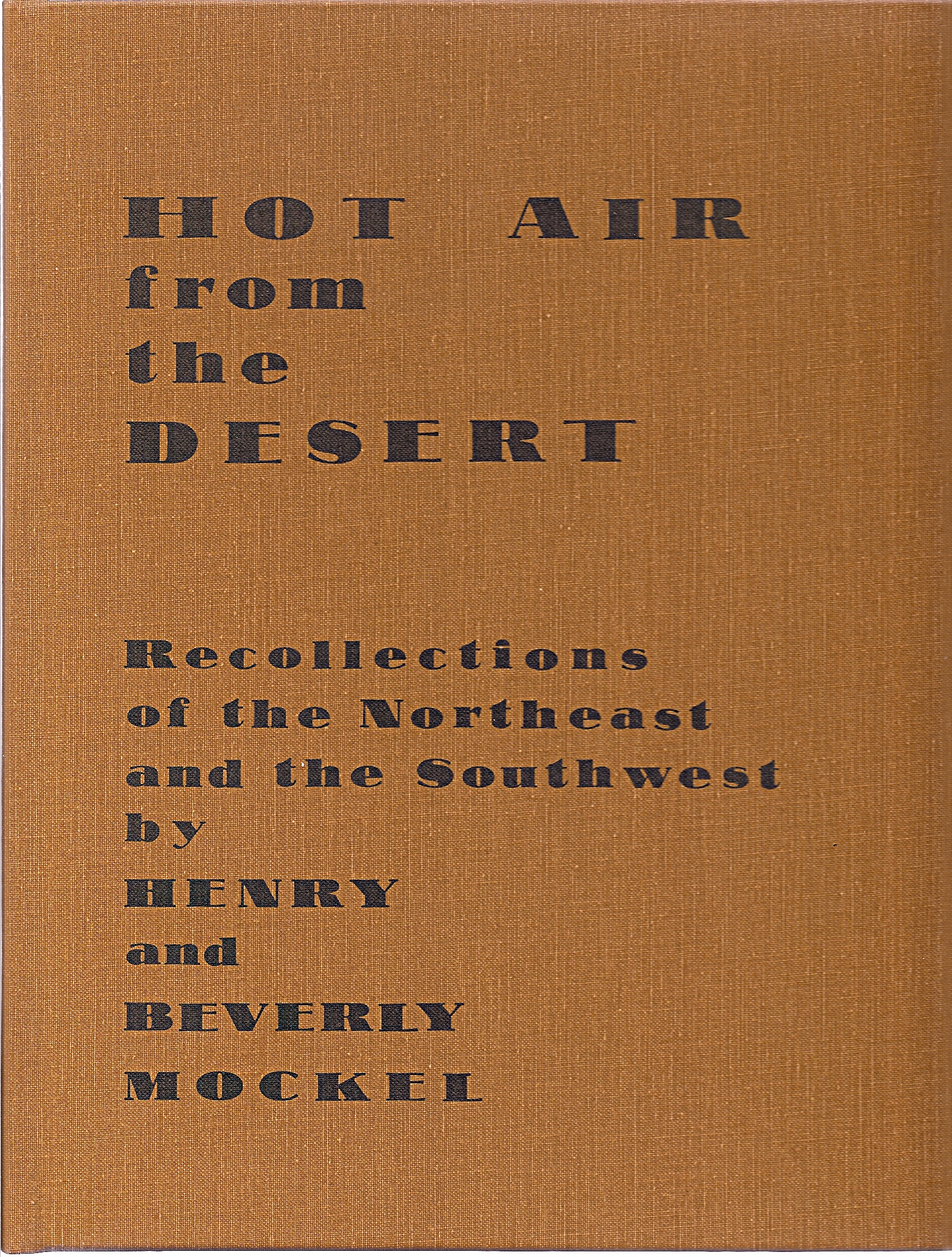
  • Mockel, Henry R. and Beverly Mockel. 1968. Hot Air from the Desert – Recollections of the Northeast and the Southwest. Self-published. Twentynine Palms, CA.
  • Mockel, Henry R. and Beverly Mockel. 1971. Mockel’s Desert Flower Notebook. Self-published. Twentynine Palms, CA.

*Note cards can be ordered from Henry R. Mockel’s in Twentynine Palms, CA. Request an order form by writing to: Henry R. Mockel’s, P.O. Box 726, Twentynine Palms, CA 92277 or call (760) 361-4832.


Related


UPDATE (March 2014)
:
Journalist Ann Japenga learns more about Henry Mockel. She writes about her discoveries in Henry Mockel: The Philosopher of Flowers at California Desert Art.

Read Full Post »
Green Scene Garden Show Tomorrow

The Green Scene Garden Show begins tomorrow at the Fullerton Arboretum on the campus of California State University, Fullerton. There will be over 80 vendors selling plants, vegetables, garden art, accessories, and books. Admission to Green Scene is $6. The show will be open from 10 am – 4 pm on both Saturday and Sunday.

ArtPlantae Books will end EE Week on the Orchard Lawn and will be having a storewide sale. Save 20% off your entire purchase all weekend. This offer applies only to sales at the Green Scene Garden Show during the show’s business hours. This offer is not valid online and is limited to stock on hand. This offer does not apply to notecards, notepads, and prints in the Sally Jacobs Collection. Pre-orders and special orders must be paid for during Green Scene business hours.

What will you find at ArtPlantae this weekend?

  • A display copy of Botany for the Artist by Sarah Simblet. This title is not released until April 19, 2010. Preview the book and pre-order this really, really nice reference.
  • Complete Sets of Marianne Wallace’s America’s series.
  • Nature Journaling Supplies
  • Children’s Books
  • Children Sketchbook Supplies
  • Botanical Art “How-To” Books
  • Botanical Art History Books
  • Hand-held Magnifiers and More!

Tomorrow is also e-Free Day, a new annual event launched by the American Booksellers Association to invite the public to participate in the community events created by independent bookstores. Leave your gadgets behind and spend at day at your local independent bookstore, the beautiful Fullerton Arboretum, or at a garden event near you.

Read Full Post »

The current renaissance of botanical art began in the 1980s. Dr. Shirley Sherwood is credited with reviving the public’s awareness of botanical art. Since the first certificate program in botanical art was established at the New York Botanical Garden, programs have been established in Arizona, California, Colorado, Florida, Illinois, Maryland, Massachusetts, Minnesota, North Carolina, Pittsburgh, and Washington DC. Public workshops in botanical art are offered in almost every state across the country at botanical gardens, community centers, and even online. Regular readers of this website are treated to news of new workshops almost weekly and are not surprised by the rich offering of learning opportunities across the country.

Newcomers to botanical art and illustration, on the other hand, are surprised to learn there are certificate programs for this centuries old discipline considered by some to be merely a hobby of weekend art enthusiasts. Because ArtPlantae has the attention of such a large audience this week, I thought it would be a good time to address a question I’ve heard more than once which is:

So what is a certificate program in botanical art, anyway?

Answering this question for us today are Lee McCaffree and Catherine Watters, founders of the certificate program at the Filoli Estate in Woodside, CA. Lee and Catherine serve as the primary instructors and curriculum designers for this program. Here is what they have to say about Filoli’s certificate program and the value of botanical art education:

Botanical art emphasizes the connection between nature and art. Botanical artists develop the skill of observing nature in detail so they can create an accurate image of plants. This art form is a way to document the plants in our environment. Artists have an awareness and understanding of plants because they spend many hours observing and painting them. When these paintings are displayed in an exhibition, audience awareness of plants increases.

The Filoli Botanical Art Certificate Program gives students a way to learn this art form by offering a unique, in-depth study of botanical art through challenging, integrated and comprehensive courses. The curriculum includes the systematic study of artistic skills and concepts, basic botany and botanical art history. A certificate is presented upon successful completion of coursework (180 classroom hours plus homework) and presentation of a portfolio and final project. This program is for the serious student who wishes to develop knowledge and skills in botanical art. The minimum time for completion of the program is generally 2 years; there is no limit on how long a student may take to finish.

What makes the Botanical Art Program at Filoli unique is that it is taught in the beautiful Georgian country house surrounded by a spectacular 16-acre English Renaissance garden and 600 acres of open space. The certificate program has long been an essential part of Filoli’s mission to interpret and preserve the history of this country estate and its surroundings in the San Francisco area. Plants from the garden are used regularly as subjects in the classroom.

The program at Filoli teaches individuals how to “interpret and observe” in the same way explorers, botanists, and artists recorded their discoveries so many years ago. In addition to the integrated coursework designed by Lee and Catherine, the Filoli program invites highly acclaimed national and international interpreters/observers to teach at Filoli. Programs with visiting instructors are usually intensive multiple day courses and provide students with truly unique learning opportunities.

Filoli is participating in National Environmental Education Week through its nature education program which, like the botanical art program, encourages environmental awareness. View Filoli’s EE Week activities on their website. Be sure to also read about their Teachers and School Programs and the workshops for families and children, including a botanical art workshop for kids scheduled for April 24, 2010.


Related Information
:


Question for EE Week Readers
:

Read Full Post »

« Newer Posts - Older Posts »