
"Mommy & Me" students meet a tunicate for the first time while exploring the bay. (© Mote Marine Laboratory)
-
Aquaculture – Sustainably growing fresh and saltwater fish for food production and for supporting fish populations in the wild.
Coastal Ecology – Research on Florida’s coastal ecosystems, including rivers, bays and estuaries, to inform the conservation and management of these environments.
Coral Reef Research – Research, conservation and restoration of coral reef ecosystems.
Ecotoxicology – The study of natural and man-made environmental toxins, their movement through marine environments and their impact on humans and marine animals.
Fisheries Enhancement – The preservation and enhancement of economically-important coastal fish and invertebrate populations.
Marine Mammal and Sea Turtle Research – Research on the biology and environmental needs of marine mammals and sea turtles to inform conservation and management of these species in the wild.
Shark Research – This center studies sharks, skates and rays from many different angles ranging from molecular biology to ecology and conservation.
Our guest today is Natalie Fisher. Natalie is a volunteer marine science educator at Mote who is on sabbatical from Brecons Beacons National Park in Great Britain where she helps to run its busiest attraction – the National Park Visitor Centre.
Natalie has stopped by today to discuss how she creates intellectual and emotional connections between her students and the ocean.
ARTPLANTAE: Thank you, Natalie, for speaking with us. Tell us what you do at Mote Marine Laboratory in Florida.
NATALIE FISHER: Thanks for inviting me. My job is to get involved in almost every aspect of the work of Mote’s Education Division. I develop new curriculae, teach visiting school, scout, and home-school groups, do outreach work, help out with public programs and events, set up and breakdown classes, the works! I also align our school programs to state standards and, am excited to take the lead in writing a new interpretive plan for the Aquarium.
AP: Mote’s specialty is “nearshore marine research.” What does the phrase “nearshore” mean? Are there set boundaries that come with this area of study?
NF: A great deal of Mote’s research takes place in the shallow coastal waters of southwest Florida’s continental shelf, often near or within sight of the shoreline. For instance, Mote scientists have long-running research projects on the sharks, manatees, fishes, sea turtles and overall ecology of the waters along Florida’s Gulf coast. However, we don’t restrict our studies to that – several of our projects around the world have focused on species that travel far from shore. For example, Mote scientists have tracked whale sharks that migrate thousands of miles and spend much of their time in deep offshore waters.

Mote summer campers learn about the importance of Turtle Exclusion Devices in fishing nets. (Courtesty Mote Marine Laboratory)
AP: Mote offers a range of learning opportunities. They offer classes for children as young as two-years old, conduct summer day camps, lead field trips satisfying Florida’s state standards, create overnight adventures for young children and teens, create custom programs for organizations, visit classrooms to deliver interactive marine science programs, and even offer live multimedia programs utilizing current technology. When working with preschool-age children, what do you want them to know about the ocean after exploring Sarasota Bay?
NF: First and foremost that being in the water is a positive experience. Secondly, that it’s fun to learn with other children. At this age, our classes are as much about learning and practicing social, motor and language skills as they are about learning about the ocean.
Thirdly, all our programs each teach one broad concept (or theme, to borrow from interpretation) which we’d like our students to remember – for example that an estuary is the ocean’s nursery. In the preschool classes we’ll reinforce that message through songs, stories, crafts and role-plays, but the experiential part of the lesson is often the most important in terms of making a connection.
Whatever the theme of the individual class or series of classes, the goal of the education division is to foster stewardship of the ocean, so all our programs have this at their heart.
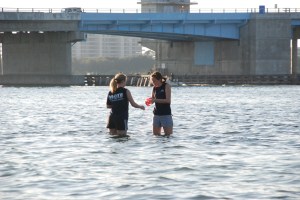
Mote High School interns work on their research projects. (© Mote Marine Laboratory)
AP: How does Mote make the ocean a “cool” topic for teenagers?
NF: By making it relevant. We use technology where it’s appropriate and we emphasize that the work they’re doing in class involves many of the tools and techniques that Mote scientists use for their research.
We’re currently developing an iPod Touch app for students to use during their visits. Students will be able to use the app during their program to add data they collect to an existing database, then use that information at school to compare their results to real data collected by students from earlier Mote programs, other schools or other sites.
We draw from current scientific studies in our classes — a cutting-edge approach that goes far beyond textbooks. The science we’re talking about is happening right now, right here at Mote. We simulate real research techniques as closely as we can, making our classes interactive and realistic for our students.
We also run an internship for high-schoolers, through which they get to experience working in different areas of the Laboratory and Aquarium (and earn community service hours towards college scholarships). Our interns learn how their school science lessons have real-world applications by conducting their own research projects.
AP: Mote’s area of focus is nearshore marine science. Explain how you connect children and adults to the ocean existing beyond the bay and the exhibits in the Aquarium.
NF: Many of the animals we study and interpret (describe and discuss with students) help us to make that connection. For example, loggerhead sea turtles may nest on our beaches here in Sarasota, but they migrate throughout the Gulf of Mexico and beyond. We can tell their story by introducing students to Mote’s resident loggerheads. Students can learn about the human hazards faced by ocean animals through learning about our sea turtle, dolphin and whale hospital patients. All visitors to Mote Aquarium can meet our resident sea turtles, dolphins and manatees (our resident animals were deemed non-releasable by government officials). Summer-campers can also experience Mote’s science through our Center for Tropical Research in the Florida Keys, and the public can discover Mote’s coral reef research in the Florida Keys Eco-Discovery Center.
We emphasize the connectivity of the ocean, its currents and the migratory patterns of many of its animals to figuratively carry our visitors beyond the shallow waters of Sarasota Bay, into the Gulf of Mexico and beyond.
AP: The amount of time you spend with children and adults is very brief. What is the primary message Mote aims to deliver to students, regardless of their age?
NF: That marine life has inherent value which makes it worth studying and conserving.
AP: Many classrooms are miles away from the nearest ocean. If a teacher cannot take students to Mote on a field trip, how might a teacher engage students in a conversation about an environment they will never see, hear, smell, or feel?
NF: We run a series of interactive programs which aim to do just that. It’s important that our young people learn that their science studies have a practical application, and that they develop a sense of global citizenship, and there’s no better way to do both than by studying the ocean that connects us all. We use video-conferencing technology to engage with schools all over the USA and beyond through our award-winning SeaTrek programs.
SeaTrek, which was created by Mote’s Center for Digital Learning, offers students of all grade levels the opportunity to connect to the ocean through us here at Mote. The students learn scientific principles and processes through exciting and engaging programming delivered “live from inside the shark tank” (thanks to a little digital “magic”) directly into their classroom.
In addition to these structured means of outreach, we make education-focused materials and resources available through our YouTube channel (www.youtube.com/seatrek), where educators can watch samples of our programming and our new “Science Minutes” slots – short video clips (also available for purchase on DVD) teaching a range of science topics that can be integrated into their own lessons.
We also have traveling exhibits that tour schools and community centers across the country. Sanctuary Reef, Discovery Reef and Sea Monsters allow students to interact with and learn about marine ecosystems in a hands-on way without leaving school.
AP: All fantastic learning opportunities! Thank you, Natalie, for sharing Mote’s programs and online resources with us.
Did you know?
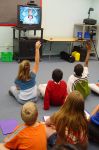
A class enjoys an award-winning SeaTrek program. (© Mote Marine Laboratory)
- You can download Mote’s education schedule for 2011? Visit their Marine Science Education page.
- Information about SeaTrek programs and Mote’s traveling exhibits can be viewed at www.mote.org/seatrek?
- SeaTrek received the 2009-2010 Pinnacle Award from the nonprofit Center for Interactive Learning and Collaboration. The award honors videoconferencing programs rated highest by teachers. This is the third consecutive year SeaTrek has won the prestigious award for outstanding performance by a content provider.


 ArtPlantae Today
Well said, Miss Natalie.
Great job Natalie!!