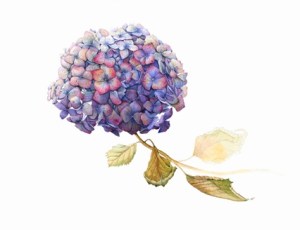
Blue Hydrangea © Mally Francis. All rights reserved
Meet Mally Francis!
Mally, when viewing your new website, I am first taken by examples of your artwork, your working studio, and then the B&B. It is a dreamy arrangement. Let’s talk about your art first. What attracted you to botanical art?
This seemed the perfect answer to combining my love of flowers and of drawing. I remember that when I saw my first botanical drawing I marveled at the detail and, as soon as I started, I knew that this is what I wanted to do.
Do you have a background in the arts or do you come to botanical art from another discipline?
I would have dearly loved to have studied the arts but, at that time, art college was rather frowned upon. I qualified as a Speech & Language Therapist and used my drawing skills when working with children to encourage and stimulate their language as part of their therapy. I feel that my training as a therapist has helped to give me the ability to impart knowledge when I am teaching artists. I was lucky enough to attend classes with Anne-Marie Evans every week for several years.
In which media do you work? Which medium do you like to teach?
I work in pencil and watercolour and that is also my preferred medium for teaching although I can also teach the use of coloured pencil drawing.
What is your teaching philosophy?
My teaching philosophy is to encourage all students to develop their own skills to the highest level possible. There is never any competition in my classes and everyone can work at their own pace. The courses are always enjoyable and old friends meet each other year after year as they return to continue their studies. Everyone has their own aspirations and it gives me great pleasure to help them to achieve their own goals.
Describe a typical day in one of your multi-day workshops.
Classes begin at 9.45 with coffee and work begins in earnest at 10 o’clock. I usually begin the day discussing and demonstrating as my approach is very structured. We have no coffee or tea-breaks as I believe that it disrupts the morning, however, students can help themselves to a drink whenever they wish. There is a delicious lunch at about 12.30 and students can take a walk if they wish before the afternoon session. Formal class finishes at 4.00 but students are welcome to stay as long as they like.
I admire your spacious teaching studio. I like that it serves as both a fine art studio and a photography studio. Do you have any tips for artists who are creating a teaching studio of their own?
Light is most important and enough space to work comfortably. I also feel a good library is essential but we are increasingly dependent upon the Internet to access information about plants and artists. Broadband access is therefore extremely useful.
About the bed & breakfast…..how do you find time to operate a B&B, paint, and prepare for classes?
I am lucky enough to have an incredibly supportive husband, so we work as a team. When a course is in progress, I only take artists who are on the course for B&B.
What information would you like readers to know about your multi-day courses?
I would encourage interested people to look at my website www.thewagonhouse.com as this gives an overall picture. I have been teaching here in my studio at Heligan for ten years and I am always happy to answer questions by e-mail. I have had the pleasure of meeting a wonderful selection of artists over the years and they have produced some excellent work.
Thank you, Mally, for visiting with us today.
Take Mally’s advice and visit The Wagon House online! You will learn more about her classes and become immersed in slide shows featuring Mally paintings, The Sawpit Studio, the B&B, and Mally’s selection of greeting cards.
The current schedule of botanical art classes at The Wagon House is listed below. This information has also been updated at Classes Near You > England.
The Wagon House
Lost Gardens of Heligan, Cornwall
www.thewagonhouse.com
A bed-and-breakfast in the English countryside where you can eat breakfast at a time that is convenient for you, visit the gardens in Cornwall, and take botanical art classes too!
- Four-Day Botanical Painting Course – March 18 – 21, 2011. Classes are taught in a renovated, well-lit studio. The studio building itself is a 250-years old. Cost: £280.00, includes lunch each day.
- Four-Day Botanical Painting Course – April 8 – 11, 2011. Classes are taught in a renovated, well-lit studio. The studio building itself is a 250-years old. Cost: £280.00, includes lunch each day.
- Four-Day Botanical Painting Course – May 6 – 9, 2011. Classes are taught in a renovated, well-lit studio. The studio building itself is a 250-years old. Cost: £280.00, includes lunch each day.
- Four-Day Botanical Painting Course – June 17 – 20, 2011. Classes are taught in a renovated, well-lit studio. The studio building itself is a 250-years old. Cost: £280.00, includes lunch each day.
- Five-Day Botanical Painting Course – July 13 – 17, 2011. Cost: £350.00 including lunch each day during the course. One day per week Termly Fees: £250.00 bring your own packed lunch.
- Four-Day Botanical Painting Course – September 8 – 11, 2011. Classes are taught in a renovated, well-lit studio. The studio building itself is a 250-years old. Cost: £280.00, includes lunch each day.
- Five-Day Botanical Painting Course – September 27 – October 1, 2011. Cost: £350.00 including lunch each day during the course. One day per week Termly Fees: £250.00 bring your own packed lunch.


 ArtPlantae Today